Construction closures rise from 2,293 in 2023 to 2,843 so far this year
Soaring raw material and construction costs compounded by rate hike
Government vows housing supply push, but ground-breaking delays loom
Authorities expand PF guarantees, set up financial distress relief center
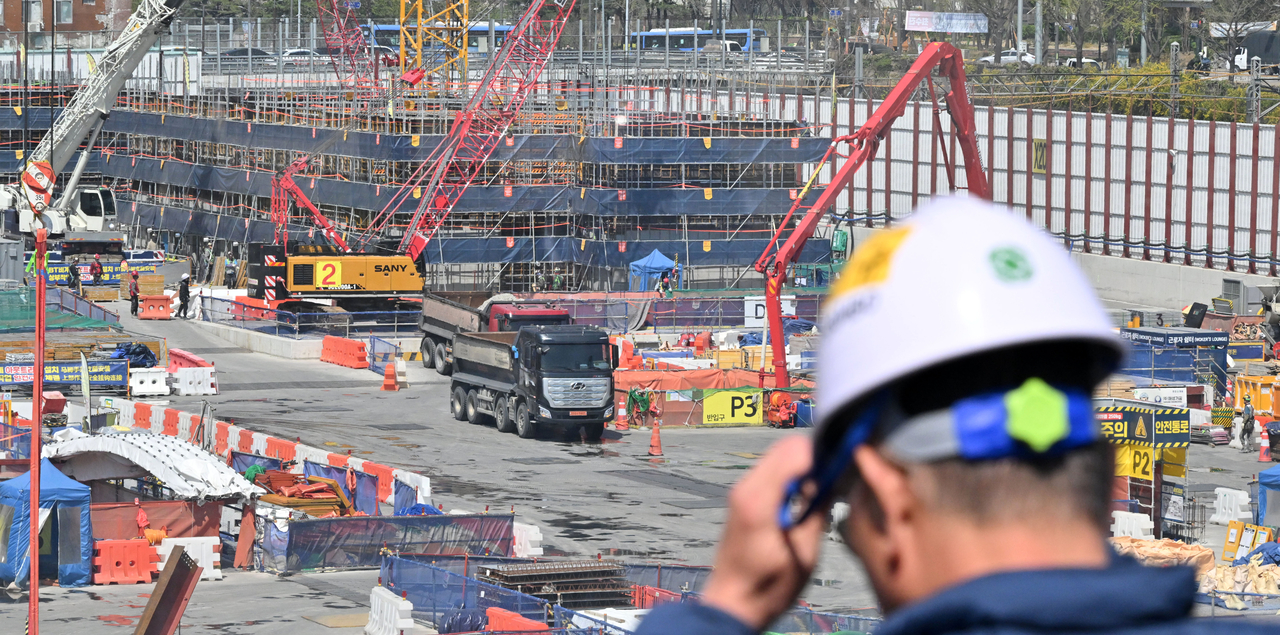
Fears of a wave of construction company failures are spreading again after the Bank of Korea pushed its benchmark interest rate back above 3 percent for the first time in one year and nine months — a sector that relies on financing far more heavily than most industries. Closure notices filed by construction firms have risen 24 percent over the past three years, and Taewang E&C, the third-largest construction company in Daegu, recently applied for court receivership. With the industry already struggling, the rate hike has added a fresh blow, fueling concern that the real estate project financing (PF) distress and liquidity crisis that gripped mid-sized builders during the sharp rate increases of 2022 and 2023 could be repeating itself.
According to the Ministry of Land, Infrastructure and Transport's Construction Industry Knowledge Information System (KISCON), 2,843 construction business closure notices were registered between January and Thursday of this year.
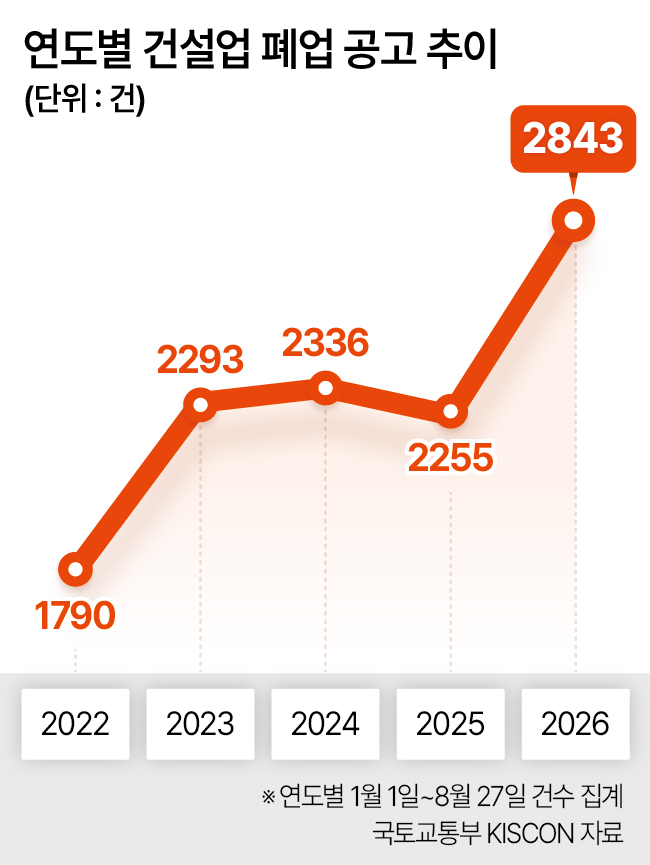
Construction closure notices have trended upward over the past five years. From 1,790 in 2022, the figure climbed to 2,293 in 2023, then held in the low 2,000s — 2,336 in 2024 and 2,255 in 2025 — before accelerating this year. While some notices reflect business-type conversions rather than outright shutdowns, even accounting for that, this year's total is about 24 percent higher than the 2023 figure, when the liquidity crisis triggered by rate hikes first took hold in earnest.
Industry observers attribute the trend to the cumulative toll of years of high inflation and high interest rates. Raw material prices surged in the wake of the Russia-Ukraine war that broke out in 2022 and ongoing Middle East conflicts, sending construction costs sharply higher. The prolonged fallout from PF loan defaults tied to rate hikes deepened the cash crunch at construction firms. As unsold units piled up amid a real estate downturn, developers found themselves unable to recoup funds, and the added burden of financing costs pushed a growing number of smaller regional builders into bankruptcy.
"Back in 2023, the impact of the rate hikes was just beginning to be felt, and conditions have worsened since then — more and more small and mid-sized regional builders are failing because they simply cannot hold on," said Lee Ji-hye, a research fellow at the Korea Construction Industry Research Institute. "Redevelopment and reconstruction project contracts are also being concentrated among large conglomerates, so the smaller the firm, the harder the hit."
The concern now is that the benchmark rate has crossed back above 3 percent before any of those headwinds have eased. The Bank of Korea's Monetary Policy Board raised the benchmark interest rate to 3.0 percent per annum on Thursday — a second consecutive increase and only the third back-to-back hike since the current rate system was introduced in March 2008.
The central bank framed the move as a preemptive step to address strong growth and inflation concerns, but for construction firms already at the edge, it means additional strain. Analysts warn that with the government pushing to expand housing supply in response to rising home prices in Seoul and the greater metropolitan area, a pullback in new ground-breakings could deepen an already acute supply shortage.
"A rate hike raises borrowing costs for developers through PF and other channels — that is a negative factor," said Lee Eun-hyung, a research fellow at the Korea Construction Policy Research Institute. "It is not a positive development for expanding housing supply." Ham Young-jin, head of the real estate research lab at Woori Bank, also cautioned that "the housing supply market faces upward pressure on financial costs including PF amid already high construction expenses, which will translate into higher pre-sale prices and broader market stress."
The government is working to ease financial pressure on the construction sector through PF stabilization and financial support measures. Under the Aug. 13 rapid housing supply plan, the annual average volume of PF guarantees will be expanded to 28.7 trillion won ($20.8 billion) over the next three years, and the construction-cost-plus PF guarantee program will be enlarged from 4 trillion won to 5 trillion won. A 30 percent guarantee fee discount set to expire next April will be extended through the end of next year, and projects that break ground within three months of receiving a guarantee will receive an additional 10 percent fee reduction.
The Ministry of Land, Infrastructure and Transport and the Financial Services Commission also held a meeting Thursday with construction and financial industry representatives to review progress on the Aug. 13 measures, discuss support for restoring the private housing supply ecosystem, and examine plans for a PF and construction firm financial distress relief center. Of 20 tasks under the enhanced financial support package, 11 are to be advanced this month, and a PF and construction firm financial distress relief center — to be operated jointly by the Financial Supervisory Service and Korea Development Bank — is set to be established.
hwshin@heraldcorp.com