Tax-evasion tips up 40% in three years, hitting 24,646 cases last year
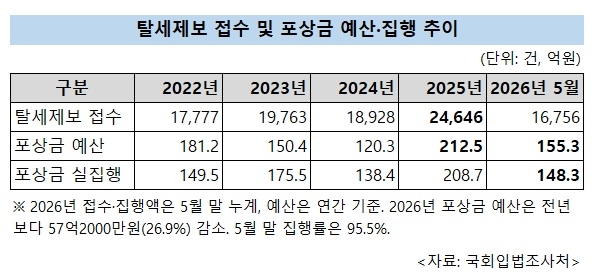
Reward budget cut from 21.25 billion to 15.53 billion won this year
Only 704 million won left, but 2.7 billion won in payouts due by end of June
Analysts warn of delayed or missed payments without additional funding

Tax-evasion tips filed with authorities have risen roughly 40 percent over the past three years, yet the budget for rewarding informants was cut by 27 percent this year — and more than 95 percent of that reduced budget had already been spent by the end of May.
The amount needed to pay out rewards by the end of June was nearly four times the remaining budget, raising the prospect that informants promised rewards for reporting tax cheats may not be paid on time.
According to National Tax Service data included in the National Assembly Research Service's "2026 National Audit Issue Analysis," released Sunday, the number of tax-evasion tips received rose from 17,777 in 2022 to 24,646 last year — an increase of 6,869 cases, or 38.6 percent. A further 16,756 tips were filed in the first five months of this year alone.
The reward program pays informants who provide material evidence helping to recover evaded taxes or who report hidden assets belonging to tax delinquents. Reward rates range from 5 to 20 percent of the recovered tax amount, with a maximum payout of 4 billion won ($2.92 million).
The number of rewards paid out last year reached 516 cases, up 66.5 percent from 310 cases in 2024, while the total amount disbursed rose 50.8 percent, from 13.84 billion won to 20.87 billion won. The tax recovered on the basis of tips last year reached 1.04 trillion won. Reward payments amounted to about 2.0 percent of that recovered sum.
Despite the surge in tips and reward demand, the budget allocated for the program this year actually shrank. Last year's reward budget stood at 21.25 billion won; this year it was cut to 15.53 billion won — a reduction of 5.72 billion won, or 26.9 percent.
The shortfall materialized well before the year was half over. By the end of May, 14.83 billion won had been paid out, consuming 95.5 percent of the annual budget. Only 704 million won remained.
Yet as of the end of June, 85 cases requiring reward payments had been identified, totaling about 2.7 billion won — roughly 2 billion won more than what was left in the budget. Without additional funding, second-half reward payments could be delayed or pushed into next year.
The practice of drawing on other program budgets to cover the shortfall has become a recurring pattern. In 2023, the original budget of 15.04 billion won was supplemented by 2.51 billion won transferred from other programs, bringing total disbursements to 17.55 billion won. In 2024, an original budget of 12.03 billion won was topped up by 1.8 billion won in reallocated funds, resulting in payments of 13.84 billion won.
The scope of the reward program has consistently expanded over the years. In 2018, the government raised the maximum payout from 3 billion won to 4 billion won and increased the reward rate ceiling from 15 to 20 percent. A mid-year payment option was introduced in 2021, and in 2024 penalty surcharges were added to the base used to calculate rewards. A dedicated reporting center for real estate tax evasion has been in operation since October last year.
The result is a structural mismatch: the government keeps broadening the program and encouraging tips, but consistently sets the reward budget below actual demand. Any further expansion — such as raising or eliminating the payout cap — would only increase demand further. Without a corresponding budget increase, the pattern of recovering evaded taxes through tips while deferring the promised rewards to the following year is likely to continue.
Rewards are legally required to be paid within a set deadline. Under the enforcement decree of the Framework Act on National Taxes, payments must be made within two months of the last day of the month in which the reward notification period ends. Budget shortfalls that cause payment delays could put the tax authority in breach of its statutory obligations.
The National Assembly Research Service noted that reward payments over the past five years have consistently amounted to between 1.4 and 2.6 percent of recovered taxes, calling the program a cost-effective tool for recouping evaded revenue. It warned that without timely additional funding, "there is a risk not only of delayed payments in the second half of the year but also of payments not being made at all within the year," and said a stable funding mechanism and close monitoring of payment timelines were needed.
fact0514@heraldcorp.com