
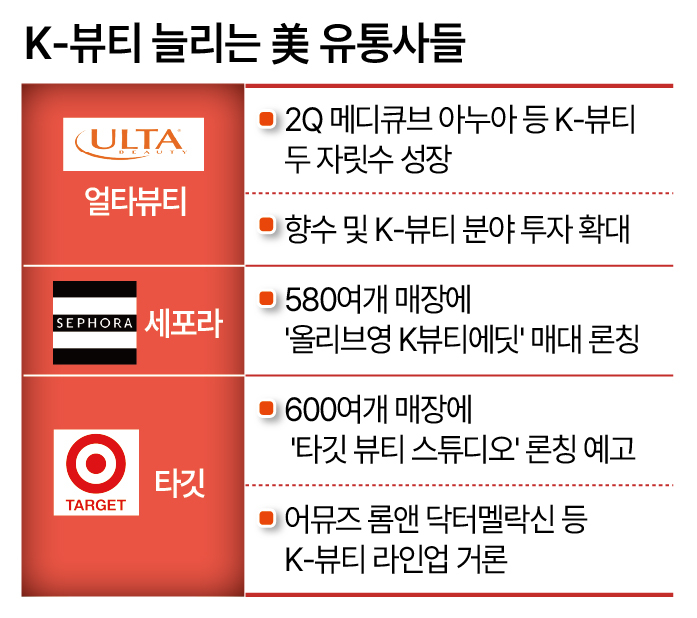
Target launching 'Beauty Studio' in 600+ stores this month, with K-beauty brands at its core
Ulta Beauty expands exclusive lineup as K-beauty sales post double-digit growth
Sephora rolls out CJ Olive Young-curated K-beauty section across 580 US stores
"One of the things that matters to us is correcting the widely held perception that K-beauty is fast fashion." — Kecia Steelman, CEO of Ulta Beauty
Major US retail and beauty platforms are racing to expand their K-beauty shelf space, driven by a shared conviction that the category's growth represents a lasting structural shift rather than a fleeting trend. Eager to attract younger, trend-conscious consumers, these retailers are also moving aggressively to secure exclusive K-beauty brand partnerships.
Target, one of the largest retailers in the United States, is launching its "Target Beauty Studio" in more than 600 stores nationwide this month, according to industry sources. The initiative extends a beauty-focused strategy the company has pursued in earnest since ending its partnership with Ulta Beauty earlier this year. K-beauty sits at the heart of the offering: among a lineup of roughly 90 brands, the rollout includes a number of Korean labels — Amuse, Rom&nd, Aromatica, Dr. Melaxin, Eqlbe, Kaja and Ingredient Editor among them.
Cara Sylvester, Target's chief merchandising officer, said at the company's second-quarter earnings call that "we have set a new ambition" and that the Beauty Studio "is not just about bringing in new products — it will deliver a completely new, immersive experience." Target also hired and trained specialist staff, including beauty advisers, ahead of the launch.
Ulta Beauty, one of the largest dedicated beauty retailers in the US, is similarly deepening its K-beauty category. CEO Kecia Steelman said at the company's second-quarter earnings presentation that K-beauty sales had posted double-digit year-on-year growth, which "further reinforces our conviction in our K-beauty assortment," and pledged to expand the chain's roster of exclusive brands. She also said correcting the widespread perception of K-beauty as fast fashion was among the company's priorities.
Ulta Beauty added Tirmélaxin, Numbuzin, Dr. Lizeul, Cleardy and Centellian24 to its K-beauty lineup in the second quarter of this year. Medicube, Anua and Peach & Lily were cited as Korean brands that have grown in both the premium and mass skincare segments. Ulta Beauty operates more than 1,500 stores across the United States.
![A dedicated "Olive Young K-Beauty Edit" section at the Sephora Times Square flagship store in New York, photographed on Aug. 20 (local time). The section, now installed across more than 580 Sephora stores in the United States, showcases K-beauty brands handpicked by CJ Olive Young. [CJ Newsroom]](https://wimg.heraldcorp.com/news/cms/2026/09/04/news-p.v1.20260904.2179405a4c4741d7890d038ddba0427e_P1.jpg)
Sephora officially launched the "Olive Young K-Beauty Edit" on Aug. 20, installing dedicated sections in more than 580 of its US stores and opening a dedicated online shop. The space will carry K-beauty products curated by CJ Olive Young twice a year. The inaugural selection features more than 150 products from 19 brands, including Rejuran, Manyo Factory and Menokin.
Sephora plans to bring the Olive Young K-Beauty Edit to stores in Singapore, Malaysia, Thailand and Hong Kong before the end of the year, with Canada, Australia, the United Kingdom and the Middle East to follow next year.
The push by US retail and beauty companies to expand their K-beauty sections is driven by a desire to draw in younger, trend-sensitive shoppers. As competition in the local beauty market intensifies, retailers are also pursuing exclusive brand arrangements as a way to differentiate themselves. "Of late, more and more US buyers have been asking what makes a brand unique and how its products differ from competitors," one industry official said.
Shinhan Investment, in a recent report on Target's beauty expansion, said the moves by major US retailers signal that "K-indie beauty is being recognized as an independent growth category" in the industry. The brokerage added that the market is entering a phase in which offline penetration through large retailers such as Target and Ulta Beauty will accelerate from 2026 onward, following a period of growth centered on Amazon's online channel.
Marketing costs at K-beauty companies are also rising, driven in part by expenses associated with entering overseas brick-and-mortar stores. APR, whose Medicube brand is stocked at Walmart, Target, Ulta Beauty and other major US chains, spent 287.1 billion won ($211 million) on advertising and promotion in the first half of this year — nearly triple the 99.3 billion won it spent in the same period a year earlier. As a share of revenue, the ratio climbed from 17 percent to 21 percent.
soho0902@heraldcorp.com





