
Geumcheon-gu District Mayor Choi Ki-chan held a community meeting Thursday on a data center project in Doksan-dong — his first official policy directive since taking office was to establish a resident-participatory review system for data centers and push for regulatory reform with the Ministry of Land, Infrastructure and Transport and the Seoul Metropolitan Government.
Geumcheon-gu has reaffirmed its commitment to incorporating the views of nearby residents when approving building permits for data centers.
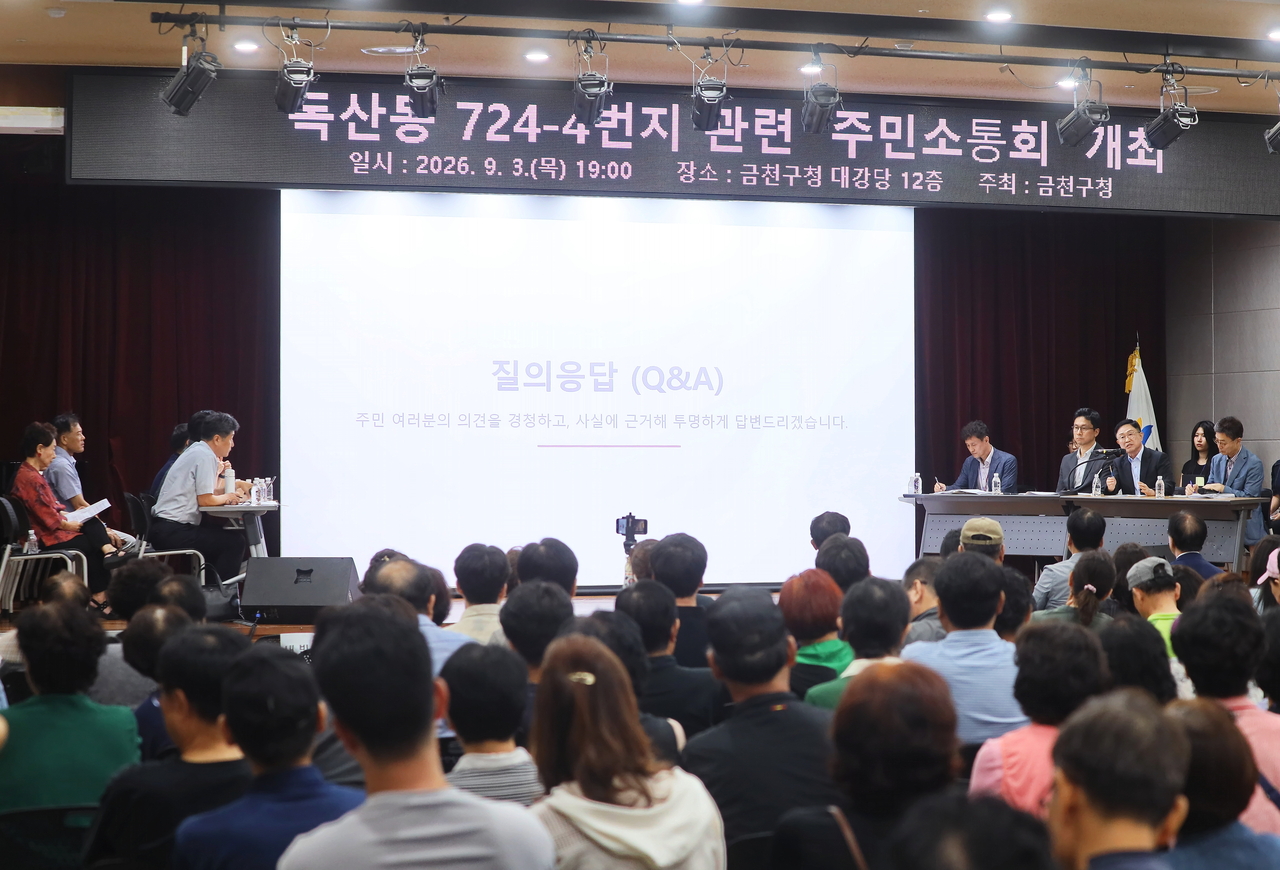
District Mayor Choi Ki-chan held a community meeting Thursday on a planned data center in Doksan-dong at the main auditorium on the 12th floor of the district office. The meeting was convened to hear residents' concerns about data center construction near residential areas, explore ways to address them, and discuss regulatory improvements.
At the meeting, Choi said the district plans to take residents' opinions into account in reviewing building permit applications for data centers in the areas around Doksan-dong lots 151-5 and 151-16 and 151-17. The remarks were a clear restatement of his intention to reflect community input in the permitting process.
Choi had already acted on that commitment on his first day in office on July 1, when he signed as his inaugural directive a policy to establish a resident-participatory review system for data centers and pursue regulatory reform. Under the policy, submission of residents' opinions would be made mandatory for data center permit applications in nearby areas.
More recently, Choi submitted a supporting opinion on a data center regulatory reform agenda item raised at the Seoul District Mayors' Council, continuing to press for swift improvements to the relevant rules.
He also directed the formation of a dedicated data center task force under the deputy district mayor to manage data center issues comprehensively. The district has separately called on the Ministry of Land, Infrastructure and Transport to amend the Building Act and on the Seoul Metropolitan Government to revise the Seoul Urban Planning Ordinance, both aimed at institutionally restricting data center siting in residential zones.
Until those regulatory changes take effect, the district is conducting preliminary reviews under the current framework to more closely examine the impact on residents' safety and living environment.
The plan is to objectively verify environmental concerns arising from data center construction — including electromagnetic radiation, noise and urban heat island effects — and to share all developments transparently with residents to prevent conflict stemming from a lack of communication.
Working with relevant agencies and specialists across disciplines, the district has developed a data center building checklist covering 47 items across five categories: architectural planning, environmental impact, environmental pollution, fire prevention and facility safety.
A pool of 12 experts in disaster prevention, mechanical systems, noise and vibration, electromagnetic radiation, and environmental science has been assembled to review residents' concerns. The district also plans to allow resident-recommended experts to participate when needed, to strengthen the objectivity and credibility of the review process.
Choi had championed data center regulatory reform even before becoming district mayor, when he served as a Seoul Metropolitan Council lawmaker, working to fundamentally resolve conflicts arising from data centers being built in residential neighborhoods.
In April, he introduced a bill to partially amend the Seoul Urban Planning Ordinance to restrict data center siting in residential zones. The bill would exclude data centers from the category of broadcasting and telecommunications facilities permitted in second- and third-class general residential zones.
He also pushed for a swift amendment to the Building Act that would require data center permit decisions to go through an architectural committee review, and submitted a resolution urging the prompt establishment of institutional safeguards that comprehensively consider siting criteria, environmental impact and community acceptance — formally titled a resolution calling for amendments to the Building Act related to data center siting for safe residential environments.
"Resolving residents' concerns and conflicts over data center construction requires an institutional foundation, not just responses to individual projects," Choi said. "Geumcheon-gu will lead the way in proactively driving regulatory reform while making every administrative effort possible to protect residents' safety and their right to a comfortable living environment."
seouldream01@heraldcorp.com





