Basic 90-day term extendable twice by 30 days each under special prosecutor act
Ballot shortage, turnout manipulation and junket allegations among key targets
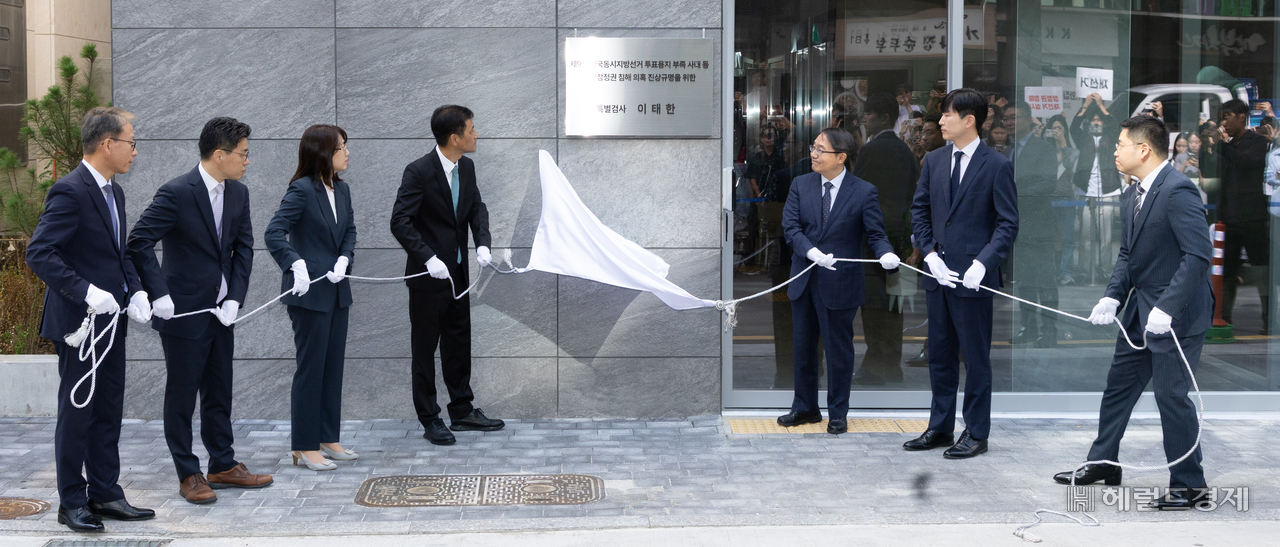
The special prosecutor team tasked with investigating allegations surrounding the National Election Commission — including the ballot shortage that emerged during the June 3 local elections — held a nameplate unveiling ceremony Monday and formally launched its investigation. The team said it would not treat materials from the earlier joint prosecutors-police investigation task force as a given starting point.
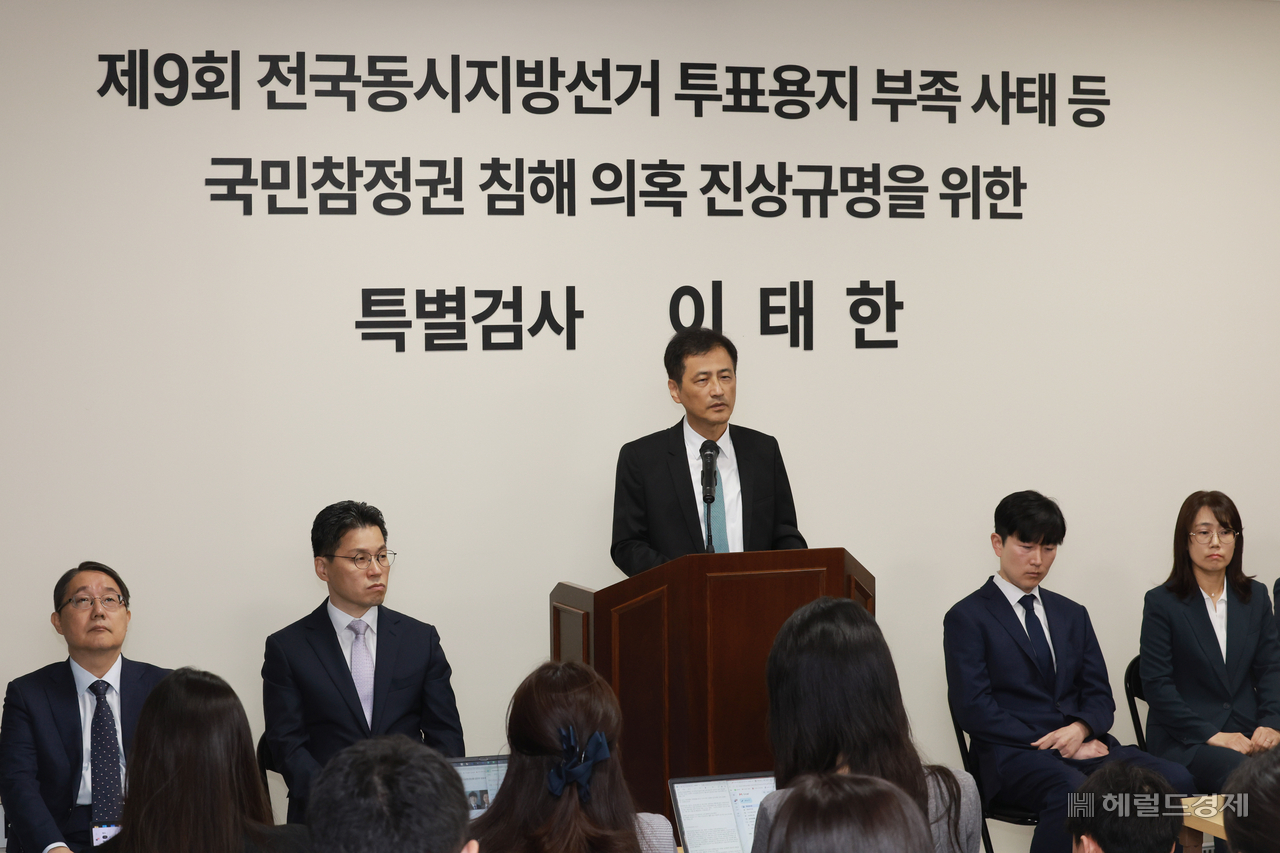
The team held the ceremony at its office in Seocho-gu, Seoul, at 10 a.m. Monday, announcing the formal start of its probe into alleged violations of citizens' constitutional right to vote. Special Prosecutor Lee Tae-han attended along with five deputy special prosecutors — Park Hyeok, Kim Eun-jeong, Kim Sang-cheon, Kwon Geun-hwan and Kim Jin-woo — as well as investigation support chief Ha Jong-chan.
In his opening remarks, Lee said the team would "conduct a swift and thorough investigation with a deep sense of responsibility, in order to protect citizens' constitutionally guaranteed right to vote and restore the fairness and credibility of elections." He added that the team would "faithfully uphold due process and human rights throughout the investigation and will not be swayed by unverified allegations or political controversy."
The ballot shortage occurred during the ninth round of local elections in June. As public calls grew for an investigation into the alleged infringement of voting rights, a joint prosecutors-police task force was formed Aug. 9 under Seoul Central District Prosecutors' Office third deputy chief Kim Tae-hun to look into the matter. Political circles subsequently passed a special prosecutor act, responding to demands that the NEC — long considered untouchable — be thoroughly investigated.
The backgrounds of Lee and his deputy special prosecutors point to an emphasis on expertise. Lee was commissioned as a prosecutor at the Daegu District Prosecutors' Office in 1994 and went on to serve as deputy chief prosecutor at the Incheon District Prosecutors' Office, chief of the trial division at the Busan District Prosecutors' Office, and chief of the special investigations division at the Ulsan District Prosecutors' Office, earning a reputation as a specialist in complex cases. He left the prosecution service in 2011 and joined law firm Dongin as an attorney.
Deputy Special Prosecutor Park Hyeok, a legal professional with prosecutorial experience, will serve as the central figure of the team, according to Lee. Deputy Special Prosecutor Kim Eun-jeong previously worked at the Supreme Prosecutors' Office as a research official and at the Ministry of Personnel Management, and is expected to play a role in investigating alleged personnel irregularities at the NEC.
Deputy Special Prosecutor Kim Sang-cheon, who has a background as a researcher at the Korea Institute for National Security Strategy and previously served as a prosecutor at the Corruption Investigation Office for High-ranking Officials, is expected to handle forensic investigations and information systems analysis. Deputy Special Prosecutor Kwon Geun-hwan brings a diverse career spanning police officer, prosecutor and judge. Deputy Special Prosecutor Kim Jin-woo, drawing on his experience at a law firm, is set to serve in a "red team" role.
The team has received 15 of its 20 allotted seconded prosecutors, with the remaining five expected to join shortly. This contrasts with the second omnibus special prosecutor team — which investigated remaining allegations after the three preceding special prosecutor probes into insurrection, Kim Keon Hee and the Marine corporal case — which failed to fill its quota of 15 seconded prosecutors throughout its 180-day mandate. Legal circles interpret the strong staffing as partly reflecting the opportunity to investigate major cases before prosecutors lose their investigative authority after Oct. 2.
However, securing seconded investigation officers from the prosecution has proven somewhat difficult, as the schedule overlaps with the planned opening of the Serious Crimes Investigation Agency next month. The team plans to visit the agency once it opens and request additional secondments. It also said it would seek personnel from the National Forensic Service if needed.
The team will conduct its investigation over a base period of 90 days, extendable twice by 30 days each if necessary. Under the special prosecutor act, the team's mandate covers 12 matters: the ballot shortage during the ninth local elections, allegations of forcing ahead with vote counting, voter turnout underreporting, voter turnout manipulation, destruction and loss of election materials, allegations of overseas junkets, preferential promotion and improper hiring of officials' children, and other complaints, referrals and self-initiated cases.
The joint task force had laid investigative groundwork by questioning lower-level officials on various allegations. The special prosecutor team is expected to take over the relevant materials, build on them and move into full-scale investigation. The team stressed, however, that those materials represent only a portion of its baseline information, and that while it will analyze them, it intends to start fresh with a new approach.
"I cannot go into specifics about what has been handed over, but it is only part of the baseline materials," Lee said Monday. "We will not conduct our investigation on the premise of the task force's factual findings — we plan to officially start anew based on the special prosecutor team's own internal judgment."
Determining the cause of the ballot shortage during the local elections stands as one of the team's biggest tasks. The joint task force had focused on the reduction of the minimum print quantity threshold to 50 percent, tracing the issue back to the research contract that underpinned that change.
Attention is also focused on uncovering the truth behind the alleged voter turnout manipulation. The special prosecutor team is expected to move quickly to establish the facts and causes, with proving intent seen as a key hurdle. The outlines of the overseas junket allegations have also begun to emerge from the task force's work, and the special prosecutor team is expected to review those findings before launching its own full investigation.
bell@heraldcorp.com