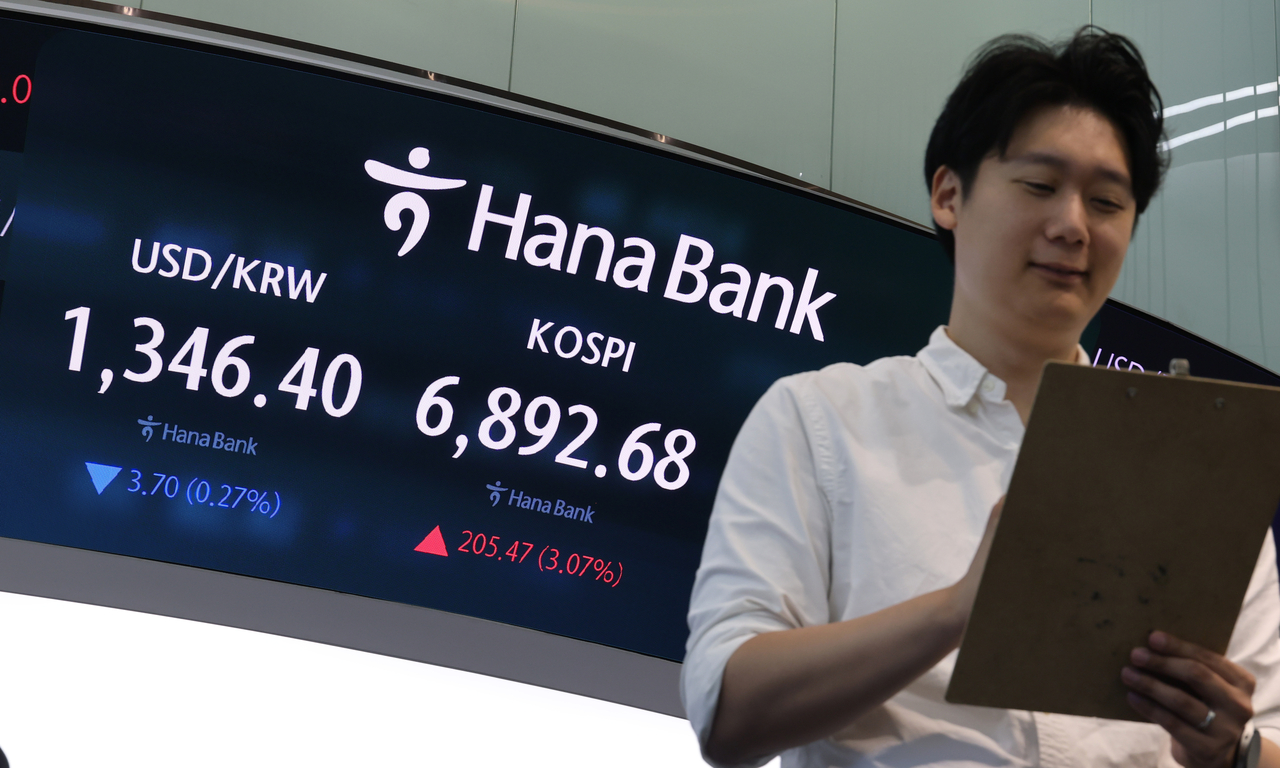
The government has put forward the Konex market as an exit option for companies on the verge of delisting, but industry observers say Konex itself must first be revitalized before the policy can have any real effect.
Konex's market capitalization stands at just 3 trillion won ($2.21 billion), and daily average trading volume hovers in the low 1 billion won range. Industry participants say reviving the near-dormant market must come before any meaningful effort to soften the blow of delisting.
According to financial investment industry sources, the government announced Friday that Kosdaq-listed companies placed under administrative watch for falling below the minimum market capitalization threshold since July 1 would be allowed to transfer their listing to Konex — without going through a liquidation trading period and at their existing share price — provided they meet certain financial requirements.
To qualify, a company must have posted an operating profit in at least two of the past three fiscal years, or in one year while maintaining equity capital of at least 20 billion won; companies with capital impairment are excluded. The mandatory appointment of a designated adviser — a standard Konex listing requirement — will be waived for a set period to facilitate swift transfers. Of the 97 Kosdaq companies with a market capitalization below 20 billion won as of Aug. 26, an estimated 43, or 44.3 percent, are expected to be eligible.
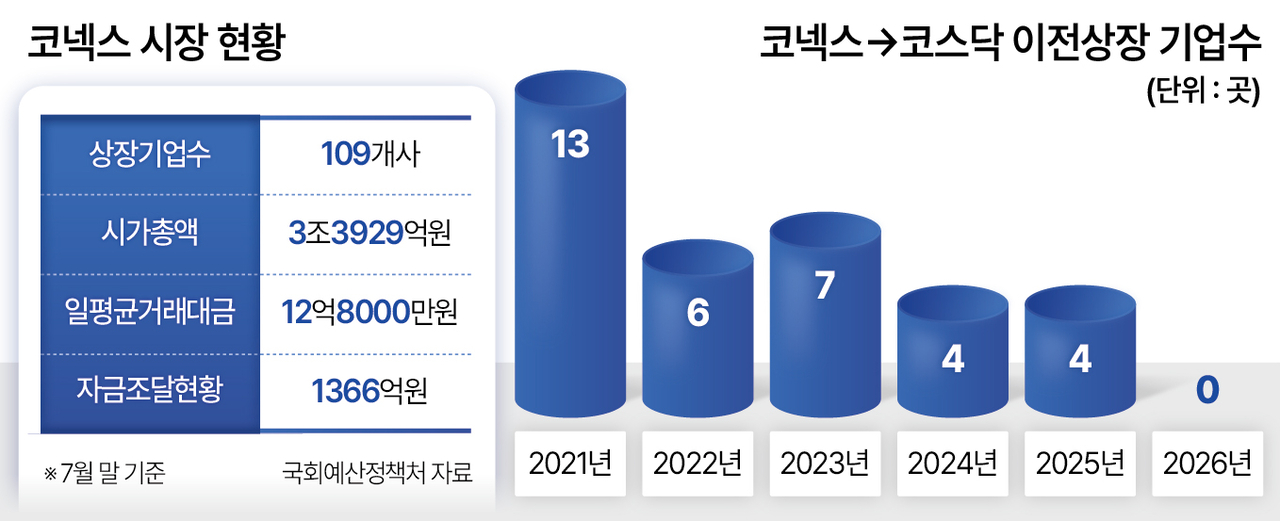
The core problem is that Konex remains far too small and illiquid. According to Korea Exchange, 109 companies were listed on Konex as of the end of July, with a combined market capitalization of 3.39 trillion won. Daily average trading volume stood at 287,000 shares, with a daily average trading value of 1.28 billion won.
SK Signet led all Konex stocks in July trading value, recording a monthly cumulative total of 15.51 billion won. The top five stocks — SK Signet, followed by Ensol Biosciences (3.04 billion won), Jincostech (2.11 billion won), Pharmaresearch Bio (1.04 billion won) and Rapichi (780 million won) — together accounted for 22.48 billion won in cumulative trading value.
Given that the market's total monthly trading value was approximately 28.2 billion won, the single top stock accounted for roughly half of all market activity, while the top five made up about 80 percent.
The number of companies graduating from Konex to Kosdaq has also been declining. The figure dropped from 13 in 2021 to six in 2022, seven in 2023, and four each in 2024 and 2025. So far this year, the count stands at zero.
Supply-and-demand dynamics also need improvement. Konex, where attracting early-stage investment is central to its purpose, was designed to be driven by institutional and other professional investors rather than retail participants. Yet retail investors accounted for roughly 90 percent of Konex trading value this year, while institutions made up 4.97 percent and foreign investors just 0.003 percent — leaving individual traders to prop up a market built for professionals.
Kim Yong-jin, a business administration professor at Sogang University, said the market cannot function properly without information flow and capital circulation. "Even on Kosdaq, a significant number of stocks receive no research coverage from brokerages — Konex is bound to be even more overlooked," he said.
Kim added that liquidity on the Kospi is not generated by individual stock trading alone, but through a range of products such as ETFs and the participation of liquidity providers. "Konex also needs to explore ways to create various derivative products and increase liquidity supply so that asking prices can form more densely," he said.
Lee Jun-seo, a business administration professor at Dongguk University, said the Konex market must be normalized before delisting candidates are transferred there. "Moving companies to Konex under the current liquidity conditions is, in effect, not much different from delisting," he said.
Lee added that a broader market restructuring should also be considered — including transferring competitive Konex companies to Kosdaq while routing the rest into the over-the-counter K-OTC market.
jiyun@heraldcorp.com
moon@heraldcorp.com