Our Neighborhood Police Station (11): Gwanak Police Station, Seoul
In its 81st year, the Korea Herald introduces each of Seoul's 31 police stations.

On the afternoon of July 16, near Sillim Station in Gwanak-gu, Seoul, two middle school students on their way home from a career-exploration field trip spotted something alarming. A woman in her 30s was having a seizure and lurching toward the road. Sensing she was about to be hit, Kwon Do-gyeom, 14, and Kwak Ji-seong, 15, of Miseong Middle School grabbed her by both arms and pulled her back from the traffic lane. They then called 112 and stayed by her side until she calmed down.
The two students recently received a commendation and a cash reward from Gwanak Police Station — the first time minors have received a 112 reporting reward from the station since the program launched last year. Among Seoul's 31 police stations, Gwanak has the highest record of disbursing 112 reporting rewards, actively channeling citizens' tips and actions into public safety efforts and recognizing outstanding reports with formal thanks.
About 41 percent of Gwanak-gu's roughly 477,500 residents are in their 20s and 30s, and 62.7 percent live alone — the highest single-person household rate among Seoul's autonomous districts. The share of female residents in their 20s and 30s, at 29.4 percent, is among the highest in the country. Last year, the district logged the fourth-highest number of 112 calls among Seoul's 31 police stations, and reports of stalking and dating violence ranked either first or second in the city. Building on that reality, Gwanak Police Station has made community reporting and participation a cornerstone of its public safety strategy.
Following a series of murders near Sillim Station and Mokgolsan in 2023, the station expanded its crime-prevention infrastructure and provided personal safety devices to vulnerable residents. Gwanak-gu is now covered by 7,373 closed-circuit television cameras, of which 4,023 are intelligent CCTV units capable of detecting and analyzing abnormal behavior.
The investment in crime-prevention infrastructure and field-focused policing has paid off. Gwanak Police Station was named the top station nationwide at the Korean National Police Agency's crime-prevention competition two years running, in 2024 and 2025. Over the past four years, annual 112 calls have fallen 13 percent and the five major crime categories have dropped 19 percent.
Gwanak Police Station, which opened in 1976 and marks its 50th anniversary this year, employs more than 920 staff. As Gwanak-gu has grown and demand for policing has risen with it, the station was elevated late last year to one commanded by a superintendent — a senior police rank.
![An exterior view of Gwanak Police Station in Seoul. [Gwanak Police Station]](https://wimg.heraldcorp.com/news/cms/2026/09/07/news-p.v1.20260825.42db992d4a40403696344cde734cf6c7_P1.png)
The faces protecting the community: Im Ju-wan, Intensive Investigation Team, Investigation Division 1

Gwanak-gu is so densely packed with single-room studios that it has earned the nickname "one-room village." Young workers new to Seoul flock there for relatively affordable deposits, but the district has long been shadowed by jeonse fraud. In 2025 alone, about 800 jeonse fraud cases were filed in Gwanak-gu — the most in Seoul. Gwanak Police Station responded last year by establishing a dedicated Intensive Investigation Team within its investigation division. The team's mission, led by Im Ju-wan, is to consolidate scattered jeonse fraud cases and pursue them as a single coordinated inquiry.
The team recently investigated a large-scale deposit theft. Suspects holding Chinese citizenship or naturalized as Korean used relatives' names to construct 12 buildings with no capital of their own, then signed leases with more than 100 tenants before making off with 19 billion won ($14 million) in deposits. The cases had initially been spread across other investigation teams as roughly 40 separate complaints. "The Intensive Investigation Team consolidated those cases and began by tracing the co-conspirator relationships among the multiple nominal owners," Im said. "We then expanded the investigation to the actual landlords above them, identified the ringleaders and secured their detention."
Since its launch, the team has closed about 300 jeonse fraud cases, of which roughly 200 have been referred to prosecutors.
Yet progress in the investigation does not mean the victims' ordeal is over. More than 90 percent of jeonse fraud victims in Gwanak-gu are young workers in their 20s and 30s. Many scraped together deposits from loans and their parents' retirement savings, only to lose everything — and even after foreclosure proceedings, they often receive little or no dividend payout, leaving them unable to move elsewhere. "Victims still have not recovered their deposits," Im said. "That is why it is hard to feel proud of the investigative results alone."
Im urged prospective tenants to exercise caution. "In Gwanak, people sometimes sign leases simply because a place is newly built or conveniently located," he said. "You need to check the registry, examine encumbrances such as collateral mortgages, choose a property with no loans or a low loan-to-value ratio if possible, and confirm whether deposit insurance is in place."
Choi Nam-uk, Phishing Crime Investigation Team, Criminal Investigation Division 2

A report recently came in from an apartment in Gwanak-gu: a caller suspected his mother was being victimized by a voice phishing scam. The victim, a woman close to 80, had been deceived by a criminal organization posing as Financial Supervisory Service employees and prosecutors. She had handed over 88 million won in cash across seven separate transactions, each time leaving the money hanging from her door handle.
Even after her son reported the crime to police, the organization demanded an additional 10 million won from the victim. Officers persuaded the victim and her son to prepare counterfeit cash, then staked out positions inside and outside the apartment. When a male courier arrived to collect the money, police arrested him on the spot. Investigators then tracked down a second courier — a woman — and apprehended her as well. Inside her bag, officers found a cash envelope worth 6 million won that she had just collected from a separate victim.
Voice phishing schemes impersonating prosecutors and Financial Supervisory Service officials have persisted for years, yet the elderly and young workers continue to fall prey. The scammers manipulate victims psychologically by stoking anxiety and guilt, and sometimes push victims to hide in motels or guesthouses — a tactic known as "self-confinement."
"They approach the victim from one side with intense scolding and from the other side as someone coming to help," said Choi Nam-uk, head of the Phishing Crime Investigation Team in Criminal Investigation Division 2. "When that cycle repeats, the victim comes to trust and follow whoever appears to be helping them."
Gwanak Police Station is regarded as one of the busiest stations in the Seoul Metropolitan Police Agency for voice phishing cases. In 2024, 312 cases were filed with losses of 8.6 billion won; last year the figures rose to 364 cases and 11.9 billion won in damages. Since early this year, the station has split its phishing crime investigation team into two units — one handling in-person crimes and the other covering non-contact offenses.
This year, however, the damage has fallen sharply. Through July, 104 cases were reported with losses of 2.7 billion won, a roughly 70 percent drop from 8.3 billion won over the same period last year. The number of cases also fell about 60 percent year on year. "The strengthened pan-government response centered on the integrated telecommunications and financial fraud task force, along with crackdowns on overseas scam compounds, appear to have had an effect," Choi said. "Even as the scale of losses has declined, the number of arrests has actually risen significantly."
Police are also taking a proactive approach to prevention through partnerships with telecommunications and financial institutions. The Korean National Police Agency's integrated telecommunications and financial fraud task force shares intelligence on malicious apps and phishing sites with carriers and financial institutions, which in turn pass relevant user information back to police. Officers then visit suspects' registered addresses directly. When a potential victim avoids contact or refuses to meet, police use location checks to track down those hiding in motels or other lodgings.
"A fairly large number of such lists come down to Gwanak Police Station, and we actually prevent real harm in about three or four cases a month," Choi said. "For victims who are already under the control of a criminal organization, having police come directly to them is the most effective approach."
His prevention advice for the public is straightforward. "If someone is demanding you take responsibility for something you did not do, just say 'All right, I'll take responsibility' and hang up," Choi said. "If you feel even the slightest doubt, don't agonize over it alone — go to the nearest police station or district police post and check." He added: "Real investigations are not like the movies, where prosecutors or officers shout and intimidate. They follow the law and procedure — examining evidence and taking statements."
Bae Jun-beom, sergeant, Sillim District Police Post
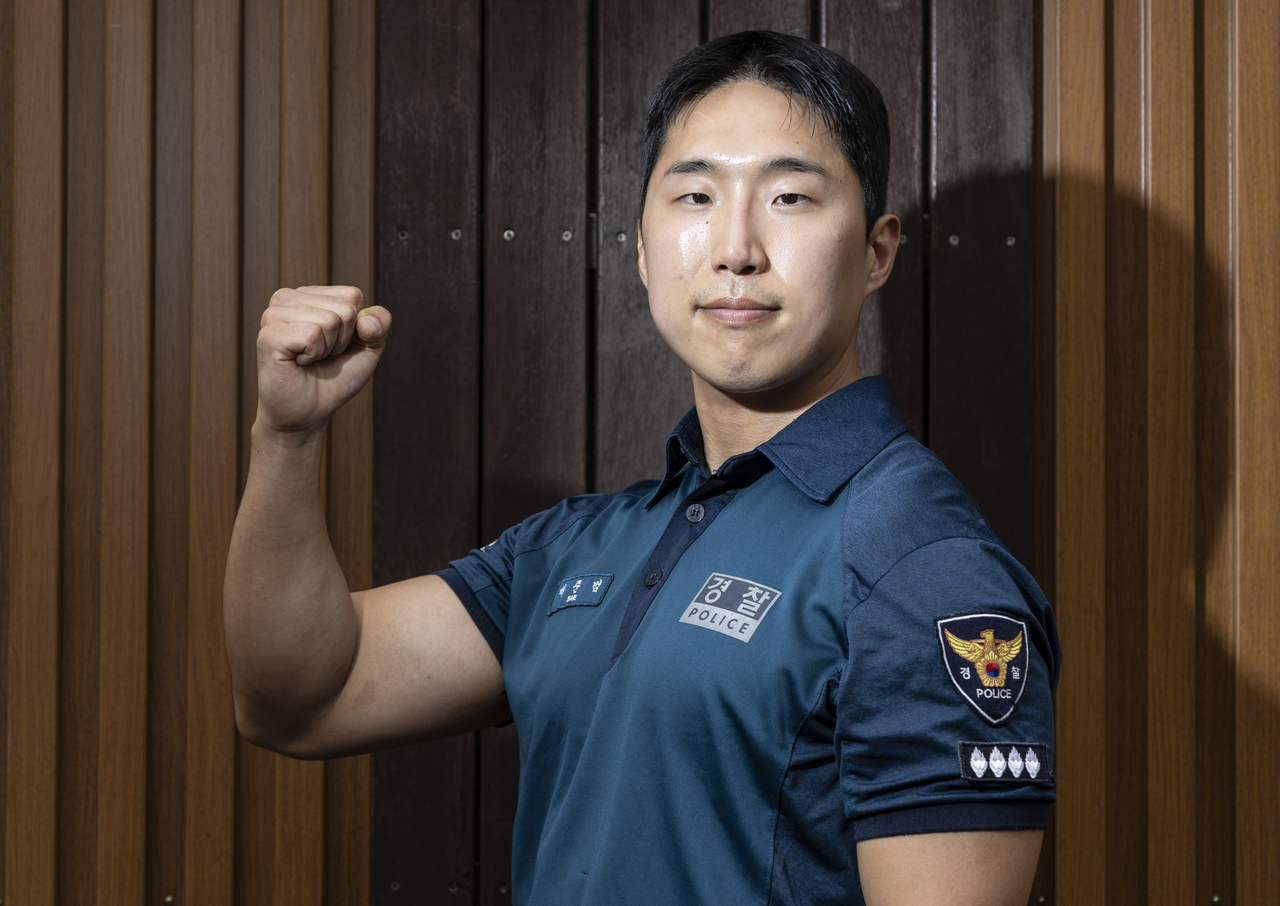
The people Gwanak Police Station protects are not limited to crime victims. Officers also keep watch for signs of crisis among ordinary residents they encounter on the job. In March, a report came in from a residential neighborhood in Seowon-dong, Gwanak-gu: a woman said her husband had not come home. Officers responded, found the man and escorted him back to the house — and the call seemed to be wrapping up.
But the moment an officer stepped inside, the situation changed entirely. Insects were falling from the ceiling near the front door, and the floor bore the marks of a mite infestation. The rice cooker held rice that had long since turned sour, and fruit flies swarmed around the food. With no wardrobe in sight, clothes were strewn across the floor, and a heavy stench filled the air.
The couple living there were in their 70s and 80s. The husband had poor eyesight from cataracts, and the wife was undergoing dialysis but had been unable to get to the hospital regularly. Sergeant Bae Jun-beom of the Sillim District Police Post, grasping the situation, reached out to the Gwanak-gu district office and the local community service center for help. Emergency pest control, a thorough cleaning and repainting of the home followed, and visiting nursing services were arranged for the wife, who had difficulty moving around. For about a month afterward, Bae continued to check in with the district office and community center on the couple's progress and paid return visits to their home.
Bae said spotting households in crisis requires not grand gestures but the small, everyday attention of neighbors. "Police cannot personally check every home," he said. "If you notice something different about someone nearby, I hope you'll take a moment to pay attention."
newday@heraldcorp.com