'Weapons performance alone cannot guarantee security'
Diversifying supply chains for critical minerals, semiconductors takes center stage
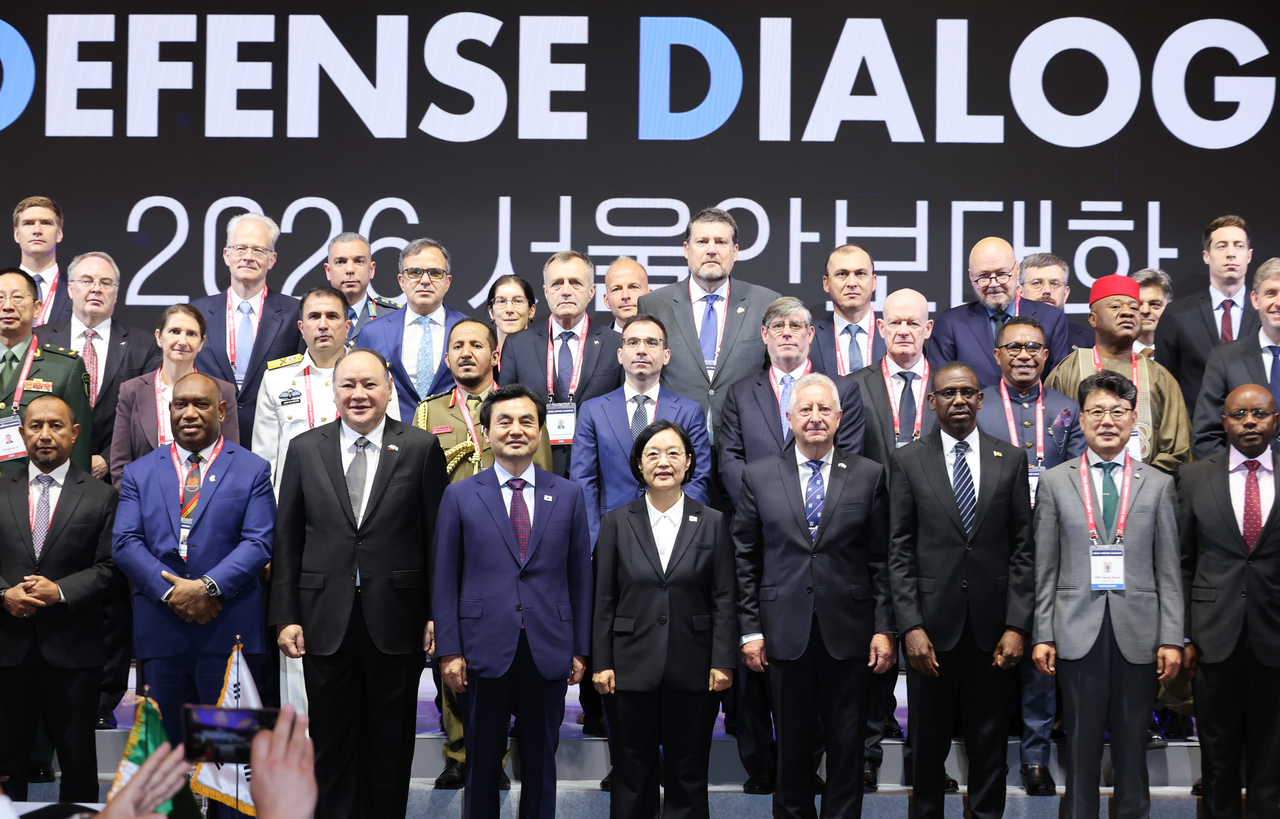
The global defense industry ecosystem is facing a fundamental test as expanding geopolitical uncertainty, prolonged conflicts and intensifying competition in advanced technology converge. Against this backdrop, the 2026 Seoul Defense Dialogue held a session on the resilience of defense supply chains.
South Korea's Ministry of National Defense said Tuesday afternoon that it held a plenary session titled "The Defense Industry Ecosystem and Global Supply Chain Resilience" at The Grand Lotte Seoul in Jung-gu, Seoul.
This year's Seoul Defense Dialogue, the 15th edition, is running for three days from Sept. 7 to Sept. 9 under the theme "In an Age of Chaos, Toward a New Coexistence." About 1,000 key security figures from 67 countries and international organizations are attending, including defense ministers from four countries — the Czech Republic, Papua New Guinea, the Philippines and Uganda — and deputy defense ministers from six countries.
Choi Byung-il, a professor at the Graduate School of International Studies at Ewha Womans University, moderated the session. Panelists included Desmond Chu, Singapore's Minister of State for Defense; Dashtseden Basandamba, deputy defense minister of Mongolia; and Janne Kuusela, deputy defense minister of Finland.
Experts attending the session said modern security is no longer determined by the sheer size of a country's military power alone.
As crises and conflicts drag on, defense production capacity, logistical support capabilities, stable access to key raw materials and components, and the industrial base needed to sustain them become critical. They said these factors are core conditions for deterrence and defense readiness.
Participants said recent major conflicts have shown that national and collective security depend not just on weapons performance. Production speed, inventory resilience, maintenance and supply capabilities, and international supply chain connectivity also matter.
They warned that excessive dependence on specific regions or limited sources for critical minerals, semiconductors, batteries, precision components, propulsion systems, ammunition, and space, cyber and AI-related technologies poses a risk. A single geopolitical shock could trigger production delays and weaken operational sustainability across the defense industry.
At the same time, emerging technologies such as AI, unmanned systems, quantum technology and space technology are rapidly being applied to defense, they said. Balancing technology acquisition and protection, joint development and export controls, and interoperability and technological sovereignty has emerged as a new policy challenge.
They stressed that building a stable defense supply chain is not merely a means to strengthen the military power of individual countries or specific blocs.
The more unstable the international order becomes, the more defense cooperation among responsible countries must serve as a foundation for upholding a rules-based order, they said. Such cooperation should also deter aggression and coercion while maintaining the international community's collective response capacity during crises. Compliance with international law and export control norms, prevention of indiscriminate proliferation, and transparent, accountable management of defense cooperation are key requirements, they said. These factors determine the stability and legitimacy of the defense industry ecosystem.
rimsclub@heraldcorp.com