Seoul Metropolitan Council's Transportation Committee Inspects Dongbuk Line Construction Site and Jinjeop Vehicle Depot
The Dongbuk Line subway is a 13.4-kilometer line running from Wangsimni Station to Korea University Station to Sangye Station, set to open in November 2027. As of September 2026, the line was 76.4 percent complete.
Preparations for comprehensive test operations are also gathering pace, with the first train set among the vehicles to be deployed on the Dongbuk Line already brought into the vehicle depot.
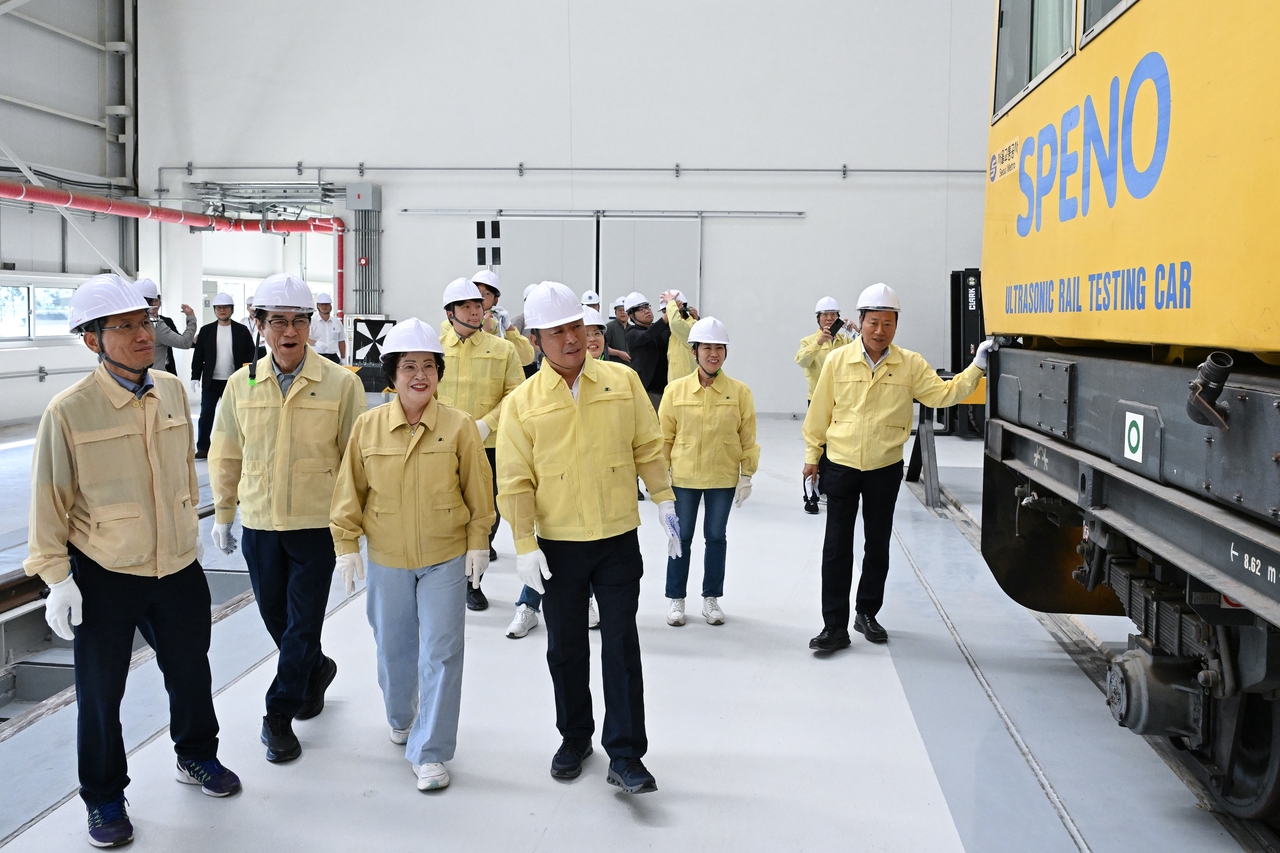
The findings came after the Seoul Metropolitan Council's Transportation Committee visited the Dongbuk Line construction site and the recently opened Jinjeop Vehicle Depot. The visit took place Friday during the 339th extraordinary session to check on construction and operational status. The committee is chaired by Han Shin of the Democratic Party of Korea, representing Seongbuk 1st District.
That day's site visit began at Dongbuk Line Station 103 (Jegi-dong Station). It then continued to the Dongbuk Line vehicle depot in Junggye-dong, Nowon-gu, and the Jinjeop Vehicle Depot in Jinjeop-eup, Namyangju.
The Dongbuk Line subway, connecting Wangsimni Station to Korea University Station to Sangye Station, spans a total of 13.4 kilometers with 16 stations and one vehicle depot. Construction is underway with a target opening date of November 2027.
During the site inspection, committee members reiterated that safety must be secured as the top priority above all else.
They noted that civil engineering and building work, along with track, electrical, signal and communication work, are all proceeding simultaneously. They called for clearly defined safety-management responsibilities by process, along with advance checks for potential hazards.
They also requested that, during the upcoming vehicle bring-in and comprehensive test-operation stages, connections between the vehicle, signal and power systems at each facility be thoroughly verified. They called for rigorous inspections to ensure citizen safety ahead of the opening schedule.
While inspecting the Jinjeop Vehicle Depot, committee members stressed that it took over operations from the long-running Changdong Vehicle Depot. They said it needs a safety-management system capable of quickly identifying and fixing any problems that arise in the early days of operation.
The Jinjeop Vehicle Depot was built on about 197,000 square meters in Jinjeop-eup, Namyangju, to take over the functions of the former Changdong Vehicle Depot. It comprises 14 buildings, including a general management building and inspection sheds, an 850-meter test-run track, 36 storage tracks and 11 inspection tracks. As a key rail facility, it is responsible for light maintenance and repairs of trains on Metropolitan Subway Line 4 and the Jinjeop Line. It currently manages 52 train sets across three types, totaling 520 cars.
Given the depot's location at an elevation of 288 meters above sea level, committee members called for regular checks on the 24-hour emergency cooperation system built with relevant agencies. The system is meant to address heavy winter snowfall and icy roads, and members asked that it function smoothly in real situations.
Alongside this, they urged continued improvements to working conditions, such as prioritizing snow removal on roads leading into the depot and securing transportation for workers. They also called for stable staffing levels and a reliable safety-management system, noting that the safety of on-site workers is directly linked to train maintenance and, ultimately, to citizen safety.
Transportation Committee Chairman Han Shin said, "The Dongbuk Line is a project citizens have long awaited to resolve traffic inconvenience in northeastern Seoul, but what matters most is safety on site." He added, "While the construction schedule is important, please make sure basic safety rules and inspection procedures are never neglected."
He then said, "The Jinjeop Vehicle Depot is a key facility that has taken over the role of the Changdong Vehicle Depot, which operated for more than 40 years, and is responsible for the safe operation of Metropolitan Subway Line 4 and the Jinjeop Line," adding, "Since unforeseen facility or operational problems may arise in the early stages of operation, we must listen to the voices of on-site workers and fix any problems that are found."
He concluded, "The safety of urban railways must be secured at every stage — from the construction site to train inspection, facility maintenance and disaster response," and added, "Going forward, the Transportation Committee will continue to prioritize the safety of citizens and on-site workers as it keeps monitoring the construction and operation of the subway."
seouldream01@heraldcorp.com