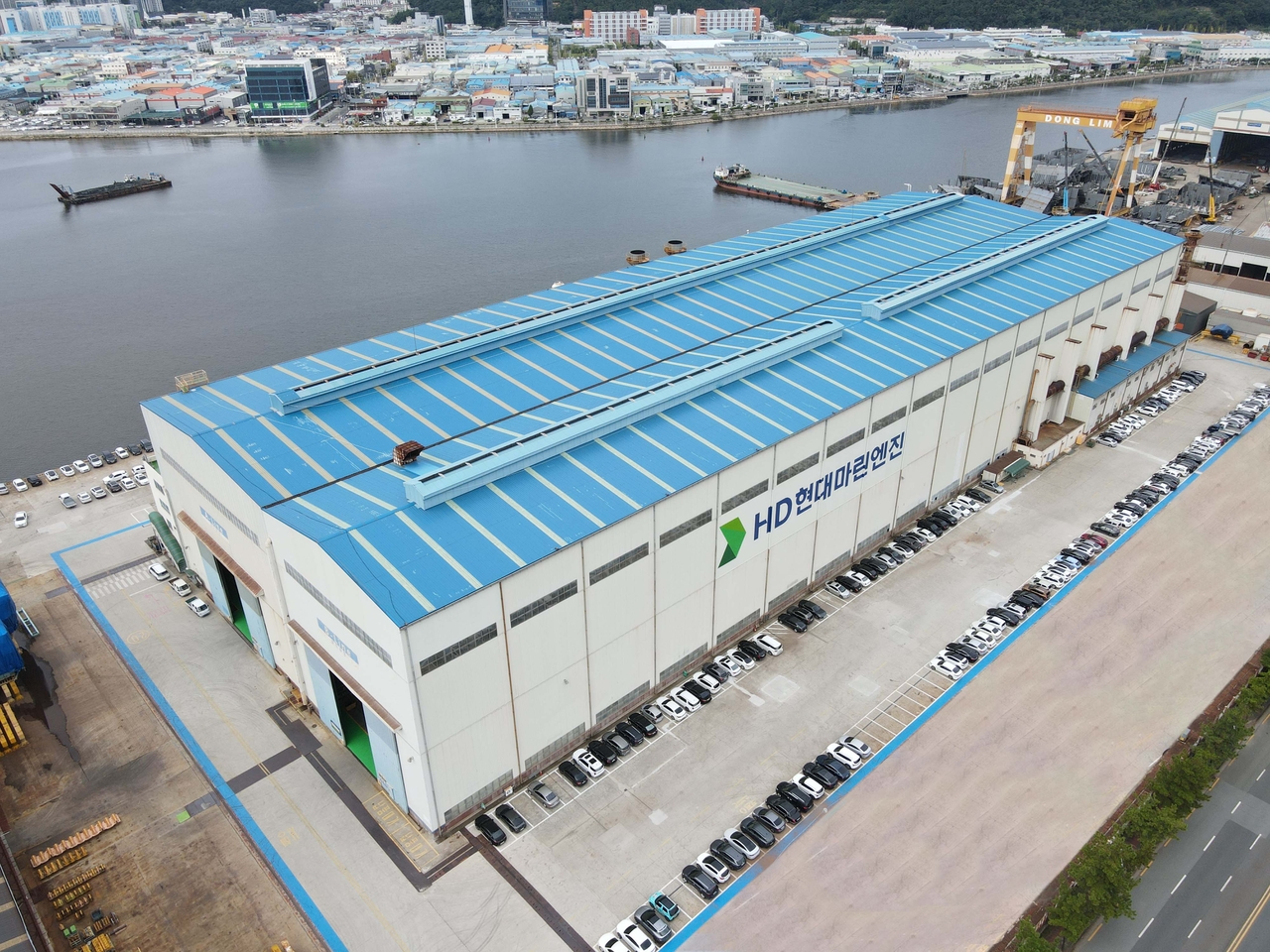
A visit to HD Hyundai Marine Engine's Changwon plant
Ship engines and components fill every corner of the factory floor
Downstream industry boom secures three years' worth of orders
Formerly STX Heavy Industries, the company joined HD Hyundai two years ago
Tapping HD Hyundai's network to find new customers
Order backlog and operating profit soar on string of good news
Operating profit up 130 percent year-on-year in first half
Accelerating eco-friendly engine development to fend off China
How's That Company? There are countless companies in the world — what exactly do they do? Companies keep splitting, merging and rebranding. Some launch new businesses; others shut down ventures they have run for years. This series brings you the dynamic stories of Korean industry through on-site reporting and data analysis, in an easy-to-follow format.
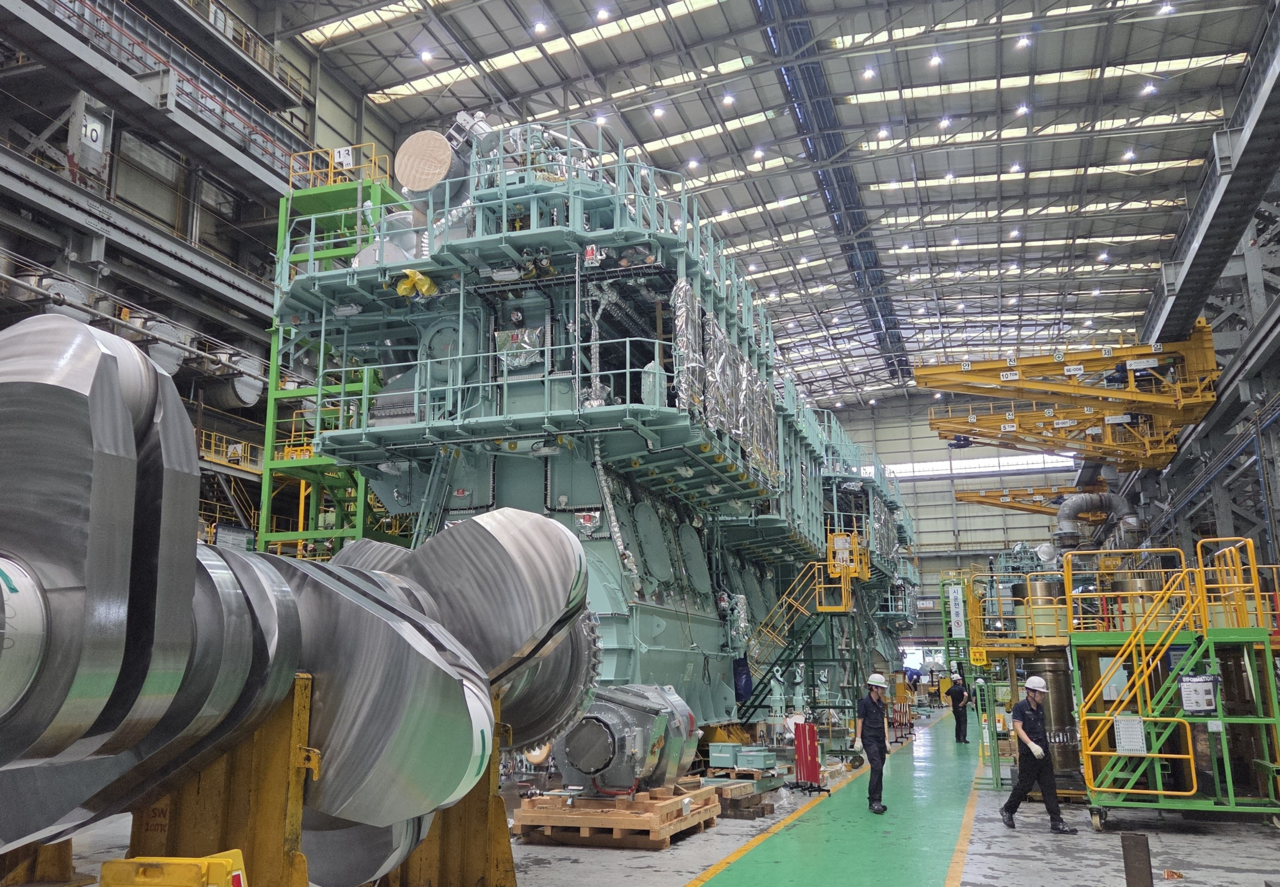
At HD Hyundai Marine Engine's Changwon plant, visited Aug. 31, eight ship engines standing four to five stories tall — about 13 meters — immediately caught the eye outside the factory. Each engine weighed up to 430 tons. Having completed final testing, they were awaiting delivery.
"Demand for ship engines has surged so much that we are seeing a supply shortage, and orders are piling up," Cho Min-sik, a senior manager at HD Hyundai Marine Engine, said that day. "Some shipbuilders, worried about the shortage, are moving to secure engines in advance, even before receiving orders from shipowners," he said.
Past the engines awaiting delivery, inside the 66,000-square-meter plant, more than a dozen engines under production and key components filled every available space. Orders have poured in amid a boom in downstream industries. A string of contract wins has already secured HD Hyundai Marine Engine three years' worth of work.
The plant was running at full capacity to meet delivery deadlines. Overhead cranes hoisted components weighing hundreds of tons across the factory floor. In a testing area in one corner of the plant, the roar of engines undergoing trial runs never let up. Workers moved constantly in and out of the engines, checking for malfunctions. "This is the first time we have maintained full-capacity operation since the shipbuilding boom of 2007 to 2008," said Kang Shin-won, a senior manager at HD Hyundai Marine Engine.
Nearby, the 22,110-square-meter plant of subsidiary HD Hyundai Crankshaft was just as busy. Forklifts ferried a constant stream of parts needed to manufacture crankshafts — the key component that converts the reciprocating motion of an engine's pistons into rotational motion to drive the propeller. HD Hyundai Marine Engine produces its own crankshafts through the subsidiary.
Building a single ship engine requires roughly tens of thousands of parts, all manufactured and assembled entirely by hand. Even a slight error can prevent an engine from working properly. "If the equipment or parts are even slightly off level during installation, we have to reassemble the entire product from scratch," Kang said.
Two years under HD Hyundai: maximizing synergy

HD Hyundai Marine Engine traces its roots to STX Heavy Industries, founded in 2001. Its main product is medium-sized ship engines, which accounted for 77.8 percent of the company's consolidated sales in the first half of this year. The remainder came from crankshafts and after-sales services.
HD Hyundai Marine Engine joined the HD Hyundai group in 2024, when HD Korea Shipbuilding — an HD Hyundai shipbuilding affiliate that mainly produces large engines — acquired STX Heavy Industries for more than 80 billion won ($59.7 million) to diversify its business portfolio. HD Hyundai's interest in the company runs deep: Chung Ki-sun, then HD Hyundai vice chairman and now chairman, visited the plant the year the acquisition was completed. Chung urged employees to "work together with one heart and one mind, with a sense of duty as a major pillar of the group."
The company's competitiveness has grown since joining HD Hyundai, as it can now share expertise with the engine and machinery division of HD Hyundai Heavy. "We are benchmarking each other's strengths in production processes and quality control," said Woo Young-je, a managing director at HD Hyundai Marine Engine. "On the sales side, we are using HD Hyundai's global network to find new customers," he said.
Having found its footing since the acquisition, HD Hyundai Marine Engine is posting record growth this year, driven by a surge in tanker orders — vessels that carry crude oil and petroleum products — following the fallout from the Middle East war, which has boosted demand for medium-sized ship engines.
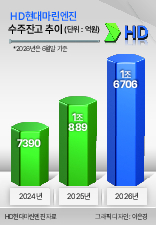
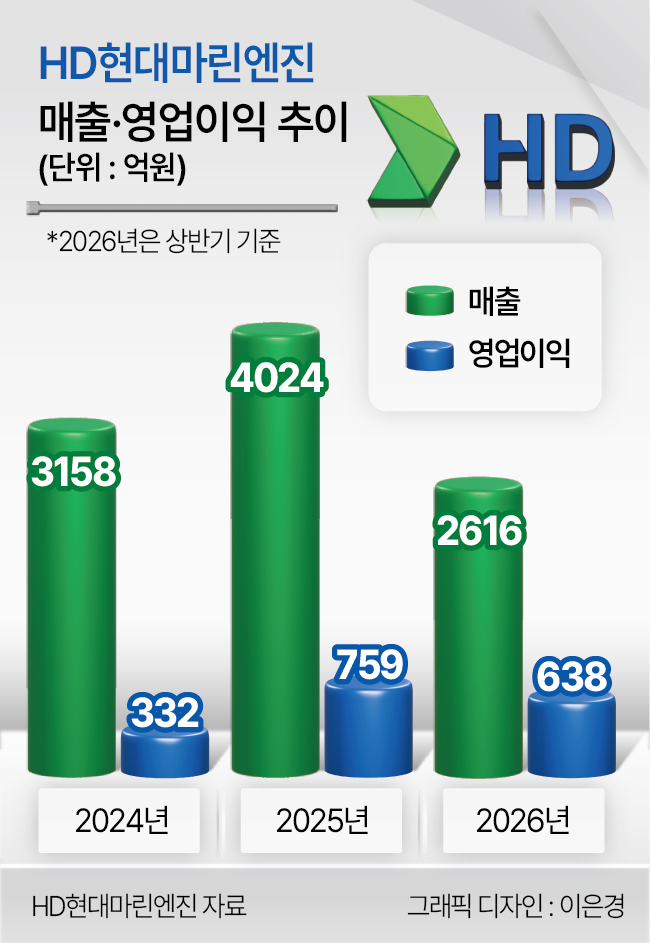
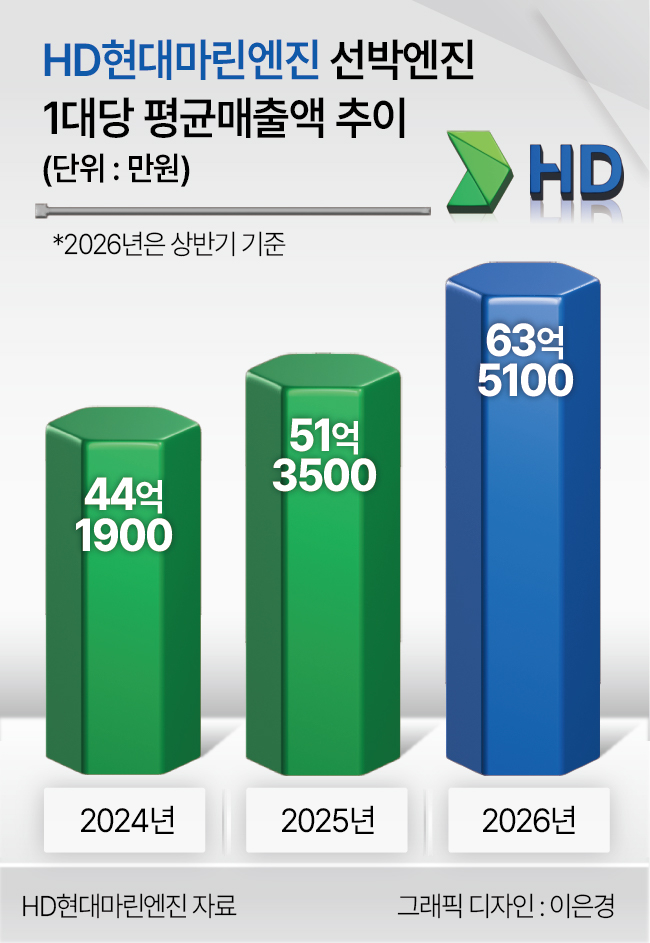
From the start of this year through last month, HD Hyundai Marine Engine signed 19 ship engine contracts worth a combined 870 billion won, more than double last year's total sales of 402.4 billion won. Its order backlog stood at 1.67 trillion won at the end of June, up 53.4 percent from 1.09 trillion won at the end of last year. As orders surged, average sales per engine rose from 5.13 billion won last year to 6.35 billion won in the first half of this year.
"We are expanding transactions with existing customers while actively pursuing new customers abroad, including in China, which is driving continued order growth," Woo said. Of the 19 contracts signed so far this year, 14 — well over half — were with Chinese customers, worth a combined 569.3 billion won, or 65.4 percent of the total contract value.
With orders pouring in from customers in China — the world's largest shipbuilding market by share — HD Hyundai Marine Engine plans to invest 65.3 billion won to optimize its production facilities. "The ship engine plant is focused first on raising production efficiency to work through the existing order backlog without a hitch," Woo said. "If additional capacity expansion becomes necessary down the road, we will weigh market conditions and order volumes before deciding whether to scale up," he added.
Earnings are climbing amid the unprecedented boom. HD Hyundai Marine Engine posted an operating profit of 63.8 billion won in the first half of this year, up 130 percent from 27.7 billion won in the same period last year. Sales over the same period rose 44 percent to 261.6 billion won. Its operating margin of 24.4 percent far exceeds the manufacturing industry average of 5 to 10 percent. With an order backlog exceeding 1 trillion won, the company's earnings growth is expected to continue for now.
China is catching up, but 'we're still up to 5 years ahead'

China's presence in the shipbuilding market has been growing, but Korean companies, including HD Hyundai Marine Engine, still hold the edge in ship engines, Woo said.
"Chinese companies' technology is three to five years behind Korean companies," he said. "It is true that Chinese firms are growing fast, but ship engines require high reliability and quality, years of accumulated production and assembly experience, precision machining, and delivery management. Korean engine makers still have the edge in this area," he said.
Even so, HD Hyundai Marine Engine plans to strengthen its competitiveness in eco-friendly engines to guard against China's rise, as strict decarbonization rules from the International Maritime Organization are expected to drive up demand for green engines. Under IMO regulations, shipowners will have to pay a carbon tax of up to $480 per ton starting in June 2028 if their greenhouse gas emissions exceed set thresholds.
The company is already mass-producing dual-fuel engines that run on LNG and liquefied petroleum gas. These engines are classified as eco-friendly because they can selectively use conventional diesel or lower-emission fuels such as LNG and LPG.
"Dual-fuel engines are more difficult to manufacture and require tougher quality control than conventional diesel engines," Woo said. "HD Hyundai Marine Engine will respond to the green market based on the experience we have built up producing dual-fuel engines." He added, "We will preemptively secure technology for next-generation eco-friendly fuel engines — including those running on LNG, methanol and ammonia — to firmly establish a sustainable business foundation."

yeongdai@heraldcorp.com