Ruling party pushes 'basic finance' package of loans, counseling, insurance and savings
Basic loans aim to guarantee financial access, curb illegal private lending
Financial, insurance sectors seen benefiting most, but risk management concerns loom
Funding remains a challenge, with securities, virtual asset industries floated as contributors
Concerns are deepening in the financial sector over a push to guarantee "basic financial rights" — a plan centered on long-term loans of up to 10 million won ($7,470) at annual interest rates of 2 to 3 percent for borrowers in the bottom 30 percent of credit scores. The government and ruling party argue that easing high-interest burdens on vulnerable groups would increase disposable income and reduce the social costs of loan delinquencies and defaults, but the financial industry warns that the expanded funding burden could undermine financial soundness.
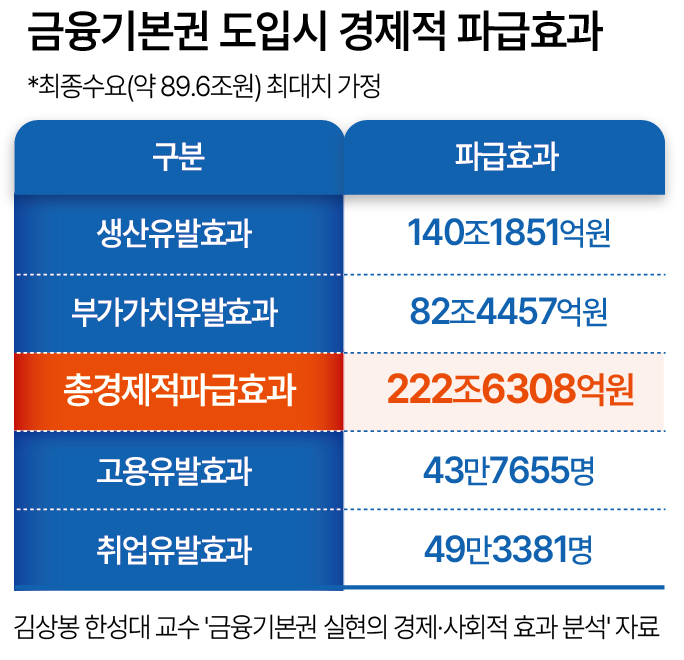
At the third policy forum on realizing the public's basic financial rights, held at the National Assembly on Thursday by Democratic Party of Korea Rep. Min Byung-duk, the Korea Inclusive Finance Agency and the Basic Society Committee, Kim Sang-bong, a professor at Hansung University, said an industrial linkage analysis reflecting policy demand related to basic financial rights as final demand estimated the total economic ripple effect at about 127 trillion to 223 trillion won. He forecast that in the long term, this could contribute an economic effect equivalent to about 4.7 to 8.4 percent of nominal GDP.
The government and ruling party are pushing to enact the National Basic Financial Guarantee Act, which would secure basic financial rights for low-credit and vulnerable groups. The bill divides basic financial rights into five categories — the right to access, survival, recovery, self-reliance and asset building — and centers on establishing a basic finance system to realize them. Specifically, it would introduce four "basic finance" programs: a "basic loan" offering long-term loans of up to 10 million won at annual interest rates of 2 to 3 percent to borrowers in the bottom 30 percent of credit scores, along with basic consultation and debt adjustment, basic insurance and basic savings.
The study ran under two scenarios, setting policy demand related to basic financial rights as final demand at 51.17 trillion won and 89.62 trillion won, respectively. Increases in production and value added, as well as employment effects generated as financial supply flows into consumption and investment, were calculated using an input-output table. Kim said, "For every 100 million won of final demand tied to basic financial rights, employment is expected to increase by 0.488 people and the number of people employed by 0.551." He added, "Under the maximum scenario, the employment inducement effect would reach about 440,000 people and the job inducement effect about 490,000 people, contributing to GDP growth and job creation."
By industry, the financial and insurance sector showed the largest ripple effect. Based on final demand of about 51 trillion won, the production inducement effect for financial and insurance services was estimated at about 62 trillion won, and the value-added inducement effect at about 39 trillion won. The sector also generated the most jobs of any industry, with both employment and job inducement figures at around 180,000 each. Ripple effects also extended to business support services, information and communication and broadcasting services, professional, scientific and technical services, and food and accommodation services. Yoo Kyung-won, a professor at Sangmyung University, suggested that authorities build a comprehensive database on policy-based inclusive finance to regularly assess the effectiveness of fund supply.
There is, however, no shortage of issues to resolve before basic financial rights can actually be introduced, since operating low-interest loans and insurance premium support as a permanent system requires a stable funding source. Kim Eun-kyung, who serves as both head of the Korea Inclusive Finance Agency and chair of the Credit Counseling and Recovery Service, earlier proposed expanding the pool of entities required to contribute to the agency's fund to include the financial investment and virtual asset industries. Future legislative discussions are expected to see repeated sharp disagreements over who should bear the funding burden, how much each should contribute and how the funds should be distributed.
Risk management pressure on banks is also cited as a challenge. There are significant concerns that supplying policy-based finance could destabilize existing credit assessment systems and encourage moral hazard among borrowers. Lee Min-hwan, a professor at Inha University who moderated the discussion, said, "Future legislation must also address who is covered and to what extent, how services are delivered, how to secure stable funding, and a data-based performance evaluation system."
An official at a financial holding company said, "Ultimately, where the money comes from and who takes on the bad debt if delinquencies occur will be the key issue," adding that simply stacking a new product on top of the many similar policy-based financial products already available, without consolidation, could make handling and management more complicated. Another bank official said a mechanism to ensure fairness in selecting who receives basic loans is also needed.
forest@heraldcorp.com