National Museum of Korea Director Yoo Hong-jun publicly apologized after a calligraphy work he recently presented as the writing of an independence activist turned out to be the work of a pro-Japanese collaborator.
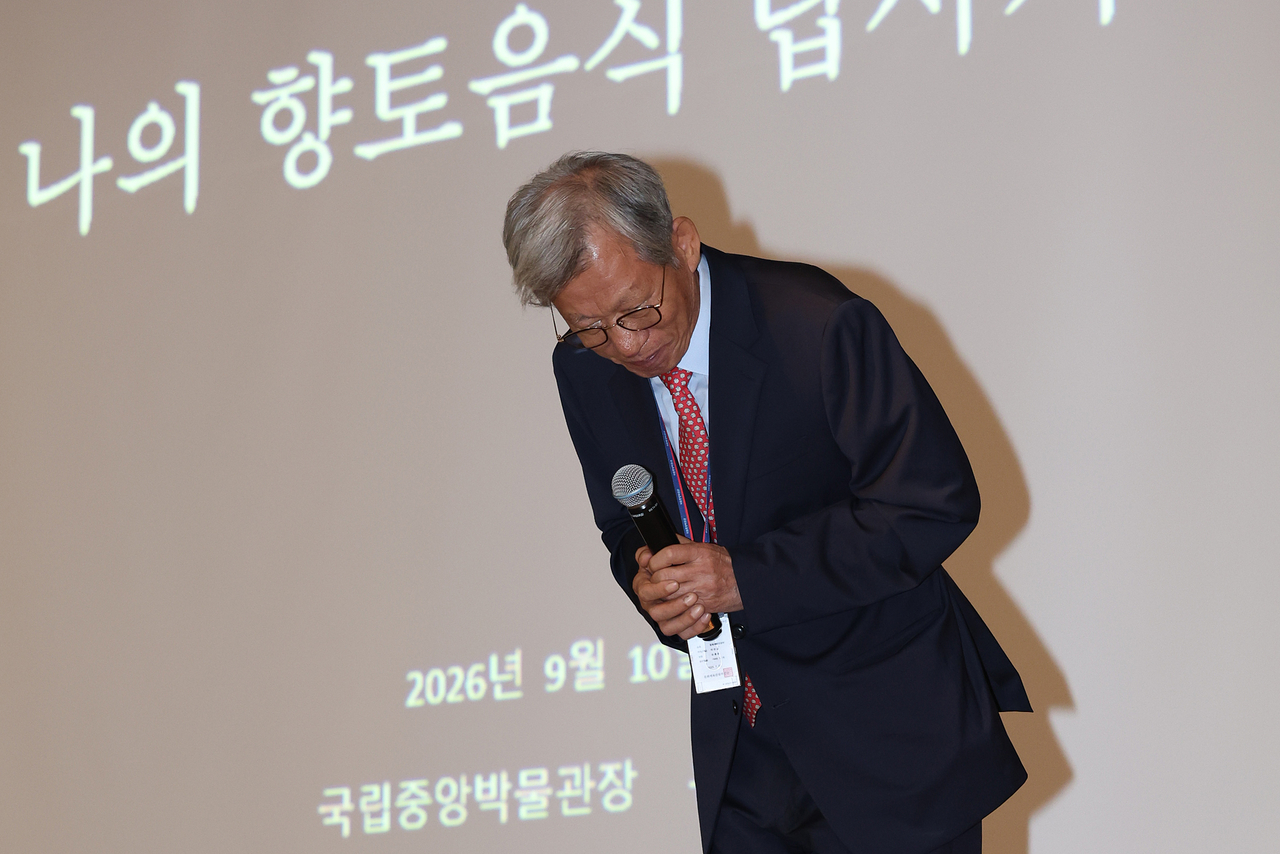
According to Yonhap, Yoo bowed his head Thursday during a special lecture titled "Matdaemat," a lecture series held in the main auditorium of the National Museum of Korea in Yongsan-gu, Seoul, saying, "I apologize for what happened recently at the museum."
Yoo said, "I feel deeply saddened that an error involving the calligraphy piece featured in the 'Urideurui Bapsang' ('Our Table') exhibition caused confusion for the public."
The museum came under criticism for inadequate verification of its exhibits after the calligraphy piece titled "Ilban Sigugeun" (roughly, "even a bowl of rice is the nation's grace"), introduced in the "Urideurui Bapsang" exhibition that opened in July this year, was confirmed to be the work of a pro-Japanese collaborator.
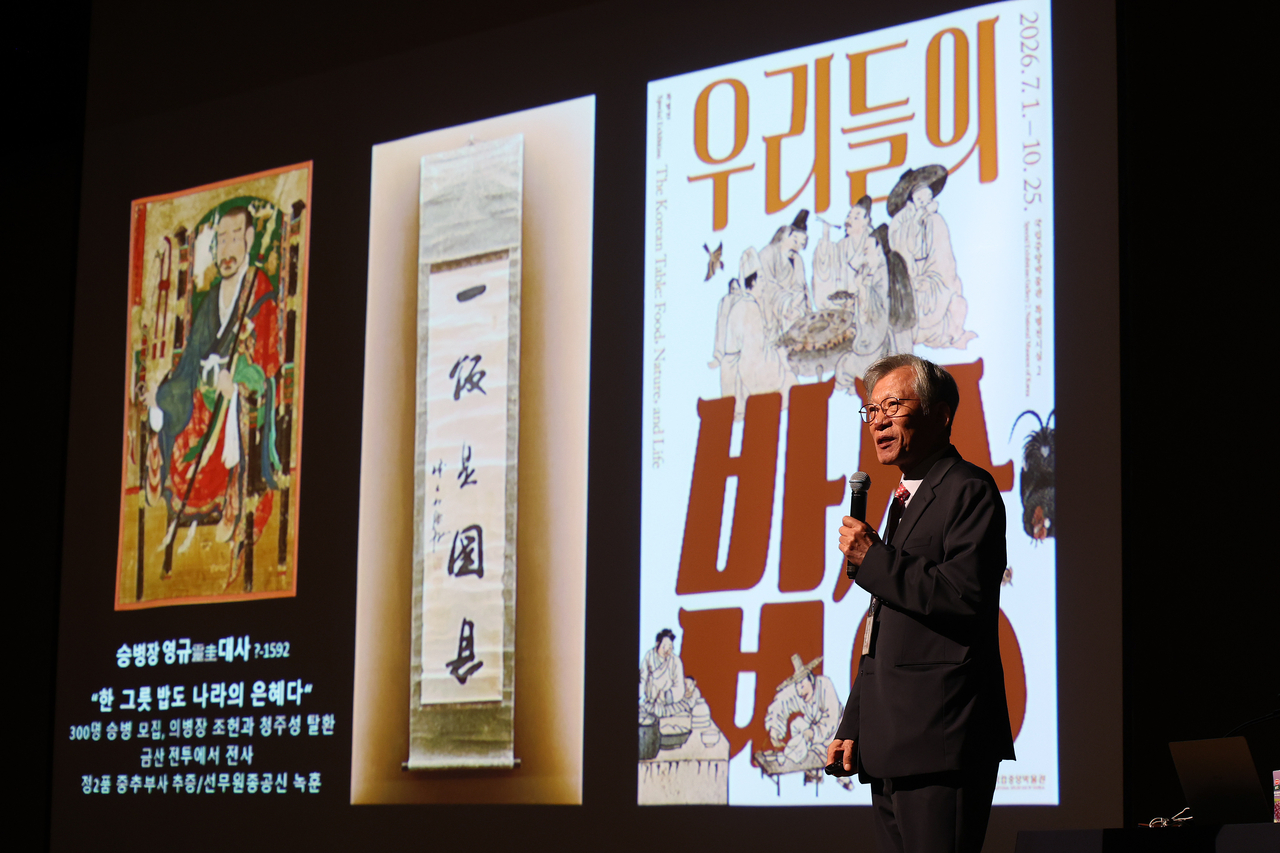
The scroll-form piece bears a saying attributed to the monk-general Yeonggyu (d. 1592), who is known as the first to raise a militia of monk soldiers during the Imjin War: "Even a bowl of rice is a debt owed to the nation."
Based on the signature "Han-in Park Won-geun" — literally "Korean Park Won-geun" — the museum had presented the work as the writing of independence activist Park Won-geun (1912-1950), a native of Boeun, North Chungcheong Province, and a photo of his descendants performing a memorial rite upon learning of the discovery was even released.
However, controversy erupted about a month into the exhibition when a tip revealed that "Park Won-geun" was in fact another name used by Park Jung-yang (1874-1959), a figure condemned as a pro-Japanese collaborator.
Park Jung-yang held posts during Japanese colonial rule including councilor of the Central Advisory Council, governor of Hwanghae Province and governor of North Chungcheong Province, and served as an imperially appointed member of the House of Peers in the Imperial Diet of Japan. He reportedly took part in suppressing the March First Independence Movement in 1919.
The Encyclopedia of Korean Culture, run by the Academy of Korean Studies, states that Park Jung-yang was regarded, according to the 1935 edition of "Joseon Gongnoja Myeonggam" (Directory of Meritorious Persons in Joseon), as one of the most meritorious figures over the 25 years of Japan's colonial rule of Korea.
Yoo said, "Exhibitions presented at the National Museum of Korea fundamentally deal with material culture," explaining that he had introduced the calligraphy piece to highlight the meaning of a single bowl of rice in times of national hardship.
He said, "Failing to correctly read the meaning of the artifact was a shortcoming and a mistake on the museum's part," adding, "We will make improvements so that this kind of mistake is not repeated."
Yoo bowed his head again, saying, "As director, I feel a deep sense of responsibility."
He added, "It is more important for a museum not to make a single mistake than to do a hundred things right," and said he hoped the meaning behind the phrase "Ilban Sigugeun" would be remembered.
husn7@heraldcorp.com