- Institute links 10 models into 'WaterKICT model chain'
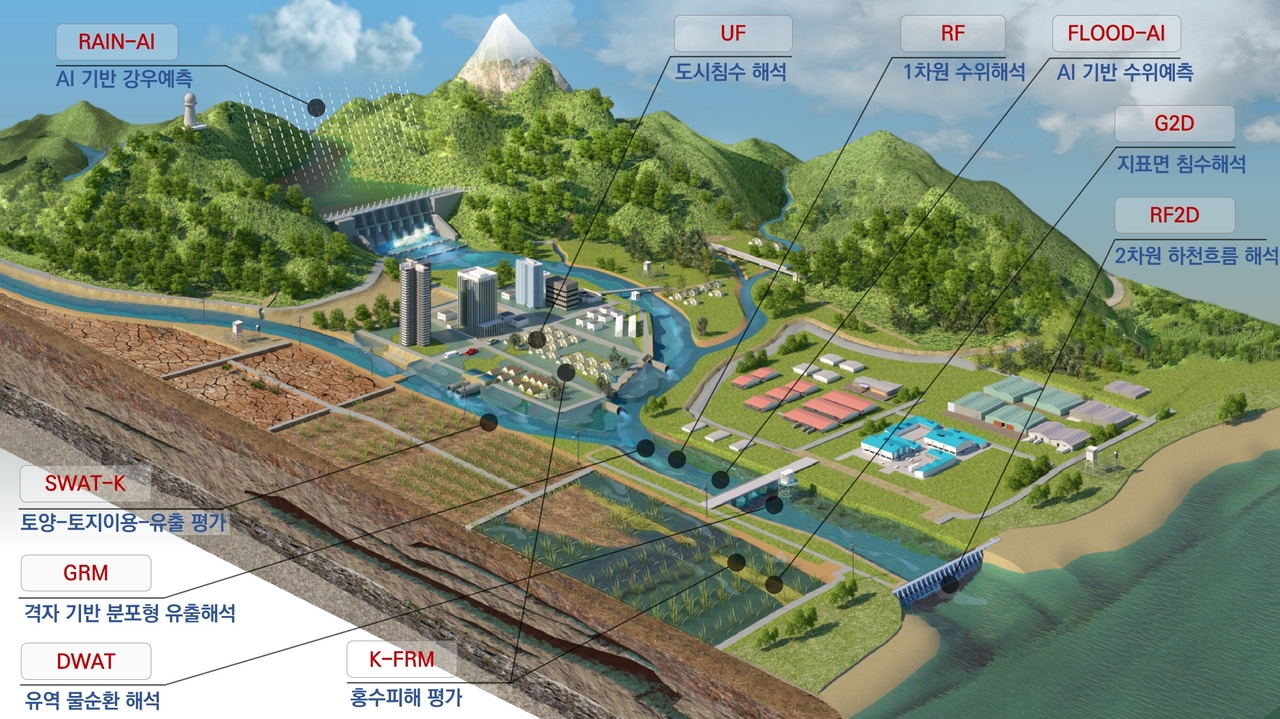
A new technology can predict, in a single integrated process, where water will flow during heavy rainfall, how much river levels will rise, which areas will flood and how severe the damage will be.
The Korea Institute of Civil Engineering and Building Technology said Thursday it has developed an integrated simulation model called the WaterKICT model chain, which predicts and assesses the entire process of water-related disasters, including floods, urban flooding and droughts.
The model links 10 individual models into a single system that analyzes the full chain of events in a water disaster -- from rainfall to runoff, river flow, flooding and damage assessment. Nine of the 10 models have already been developed to a level ready for immediate field application.
Until now, water disaster analysis in South Korea has relied mainly on models developed overseas. Such models have struggled to fully reflect the characteristics of Korean rivers, climate and terrain, and come with costs for adopting and maintaining the technology. Critics have also warned that using domestically accumulated analytical know-how to improve the performance of foreign models risks deepening the country's technological dependence.
A research team at the institute, led by Research Fellow Choi Yun-seok, upgraded its own individually developed simulation technologies to a practical, field-ready level and linked them into a single system. The effort established a foundation for analyzing the entire process of a water disaster -- from its onset to the resulting damage -- using homegrown technology.
The model has been listed as a recommended model by the World Meteorological Organization, a UN body, and has been incorporated into the government's preliminary feasibility study guidelines and river design standards. It has also been applied to the national flood forecasting system, where it is used for actual flood prediction.
The institute expects the new technology to reduce reliance on foreign models while establishing a foundation for South Korea's technological independence in water disaster analysis and forecasting. It said the model can also improve prediction accuracy for recurring disasters such as heavy rainfall and urban flooding, and provide a scientific basis for disaster response.
"The WaterKICT model chain is a meaningful case of localizing technology that has been recognized for its excellence both at home and abroad," said Park Sun-kyu, president of the Korea Institute of Civil Engineering and Building Technology. "It will contribute to protecting public safety from water disasters and to raising the level of the nation's water resource management technology."
nbgkoo@heraldcorp.com