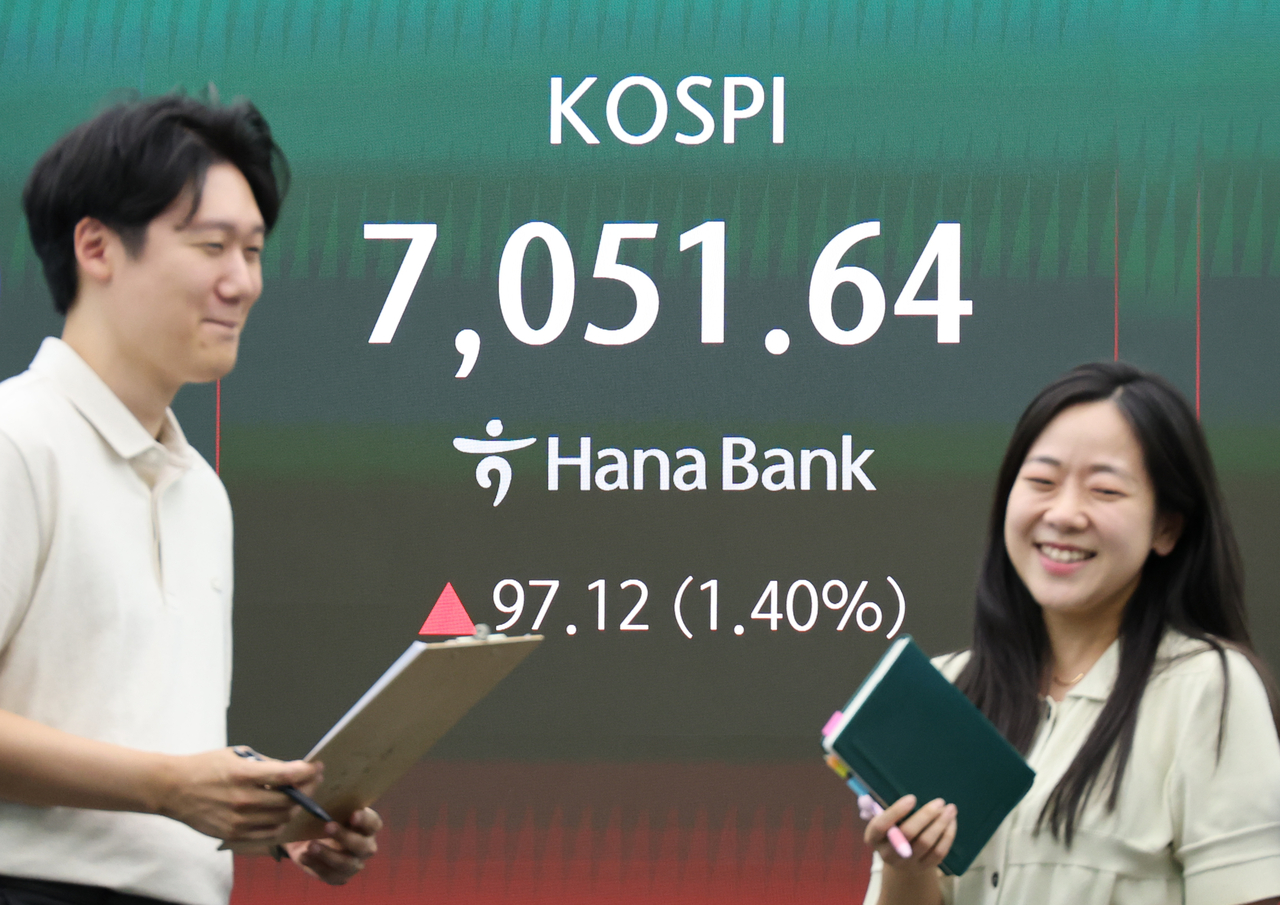
Retail investors dumped more than 16 trillion won ($12 billion) worth of shares over five trading days as the Kospi reclaimed the 7,000-point mark, cashing in on gains in a wave of profit-taking, data showed. They also snapped up inverse exchange-traded funds that bet on a market decline. Analysts say a thick overhang of retail buying above the 7,000 level, along with the growing likelihood of foreign investors' profit-taking above 7,500, could weigh on further gains.
The Korea Exchange said Thursday that retail investors net sold 16.84 trillion won worth of shares on the Kospi from Sept. 3 to Wednesday. On Monday alone, they sold a net 6.84 trillion won, marking the largest single-day net sale so far this year.
During the same period, the Kospi climbed 7.45 percent, from 6,562 points to 7,051 points, prompting the wave of profit-taking, analysts said.
Foreign and institutional investors bought a net 3.36 trillion won and 6.82 trillion won, respectively, supporting the index's rise. Other corporate entities also posted net purchases of 6.75 trillion won.
Retail selling was concentrated in the two semiconductor heavyweights. Individual investors net sold 6.37 trillion won worth of Samsung Electronics shares and 7.92 trillion won worth of SK hynix shares. The combined net selling of the two stocks totaled 14.29 trillion won, accounting for about 85 percent of all retail net selling on the Kospi.
While selling off shares en masse on the Kospi, retail investors are also betting on a market pullback. According to Koscom, they net purchased 196.9 billion won worth of KODEX 200 Futures Inverse 2X and 156.7 billion won worth of KODEX Inverse. They also bought 77.7 billion won worth of SOL SK hynix Futures Inverse 2X. The moves suggest investors are placing more weight on the possibility of a correction than on further gains for the Kospi.
Retail investors appear to have grown more wary as the Kospi repeatedly failed to close above the 7,000 mark even after breaching it during intraday trading. On Tuesday, the index approached 7,200 during the session before a wave of profit-taking pared its gains. Rising global oil prices and other external uncertainties also dampened investor sentiment.
Kang Jin-hyuk, a researcher at Shinhan Investment, said, "The Kospi has finally reclaimed the 7,000-point level, but it is running into resistance and the tug-of-war around the 60-day moving average continues, with the index also giving back some of its intraday gains."
Market watchers believe the index's future trajectory will hinge on how much of retail investors' massive profit-taking foreign and institutional investors can absorb. Since a large volume of retail buying is stacked above the 7,000 level, selling pressure could intensify the higher the index climbs.
According to iM Securities, retail buying was concentrated in the 7,000-8,500 point range between October last year and July this year. Cumulative net purchases by index range were tallied at 37.8 trillion won for the 7,000-7,500 range, 60.4 trillion won for the 7,500-8,000 range, and 56.6 trillion won for the 8,000-8,500 range.
Park Yu-an, a researcher at KB Securities, said, "Investors who traded in the 6,500-7,000 point range later experienced further declines. As the index climbs back to that same price range, there is a growing chance that sales aimed at reducing losses on those earlier purchases could emerge."
Kang said, "It will take time to win back the confidence of retail investors who exited amid the intense deleveraging process. Rather, the capacity for inflows from foreign investors, who respond more sensitively to fundamentals, is more meaningful for the Kospi's short-term resilience."
Market watchers also cite foreign investors' possible profit-taking as a variable. Park said, "Above 7,500 points, losses for retail investors who bought early in the correction will narrow, while foreign investors who bought at lower index levels will still have room to lock in gains."
moon@heraldcorp.com