Pipe damage suspected of leaking coagulant confirmed
Urgent need to identify pollution cause, prevent recurrence
Bucheon launches emergency cleanup, water quality tests
'Tap water safety unaffected'... residents remain anxious
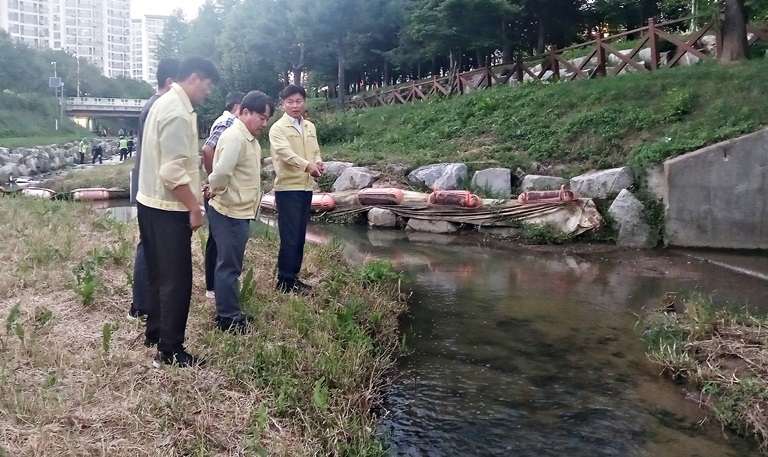
A mass die-off of fish accompanied by foam in Bereune Stream, in Yeowol-dong, Ojeong-gu, Bucheon, has raised calls for a comprehensive review of river ecosystem management and pollutant control systems.
Suspicion has grown that the incident stemmed from a facility management failure rather than a simple, temporary water quality problem. This came after Bucheon city officials, while tracing the pollutant's route into the stream, found damage to a buried chemical supply pipe near the Kkachiul Water Treatment Plant.
The city held a briefing at City Hall on Thursday regarding the fish die-off in Bereune Stream, outlining its response so far, the investigation into the cause, and future measures.
The incident began Sunday when authorities received a report of foam appearing in Bereune Stream along with dead fish.
Relevant city departments immediately went to the scene together, collecting the dead fish and pollutants and carrying out stream cleanup and containment work.
To prevent the pollution from spreading, the city installed containment nets and absorbent mats at six points along the stream. It also set up barriers and temporary water-blocking walls at locations suspected of contaminated water inflow.
Additional measures included using pumps to divert the contaminated water into sewage pipes, bypassing the stream.
Still, a clear determination of what caused the mass fish deaths is needed.
Water quality tests conducted so far have detected no heavy metals, but the stream's pH was found to be between 5 and 6. Specialized institutions are expected to confirm the exact cause of the fish deaths only after conducting a detailed investigation.
While investigating how the pollutant entered the stream, the city on Monday found the possibility of a coagulant leak from an inflow pipe leading to the Kkachiul Water Treatment Plant.
The city subsequently blocked the pathway through which the leaked water was escaping the plant and recovered the chemical-contaminated water. It also excavated around the buried chemical supply pipe for a detailed inspection.
The inspection confirmed damage to the pipe. The city has since shut off the pipeline and is carrying out follow-up measures.
With the pipe damage confirmed, the city must conduct a thorough inspection to determine whether other buried pipes carrying the same risk are also affected.
Because the damaged pipe is part of a chemical supply facility connected to the water treatment plant, the city also must review whether the facility's safety management and regular inspection system functioned properly.
The city maintains that residents' tap water remains safe.
The Kkachiul Water Treatment Plant's water treatment process is currently operating normally, and tap water production and supply have not been disrupted, the city said.
The city explained that the suspected coagulant leak occurred in a buried supply pipe section around a chemical storage tank located outside the treatment process. That section is separate from the treatment process line itself.
However, the effect on the stream and surrounding environment remains under investigation.
The city collected water samples from Bereune Stream and control samples from an upstream area from Sunday to Monday and requested detailed water quality testing from the Gyeonggi Province Health and Environment Research Institute. It is also conducting parallel water quality monitoring through a drinking water testing agency.
Measurements of pH at three groundwater wells near the treatment plant have shown no abnormalities so far. However, continued monitoring is needed of water quality in Bereune Stream and surrounding groundwater, as well as the condition of aquatic life.
The most important task now is to determine the exact composition and volume of the substance that entered the stream. Investigators must also trace its route, gauge the extent of its spread, and assess its impact on the aquatic ecosystem, as well as identify what caused the pipe to fail.
Based on the results of the detailed water quality tests, the city plans to assess the impact on the surrounding environment. It will also inspect and improve buried chemical pipelines overall and devise measures to prevent recurrence.
gilbert@heraldcorp.com