As the Kospi recovered the 7,000 mark following a sharp correction, exchange-traded funds tracking Samsung Group affiliates posted returns that far outpaced ETFs tied to other conglomerates during the downturn. Samsung Group ETFs had already outperformed their peers when the Kospi first broke through 7,000 in May, and the performance gap only widened through the subsequent correction.
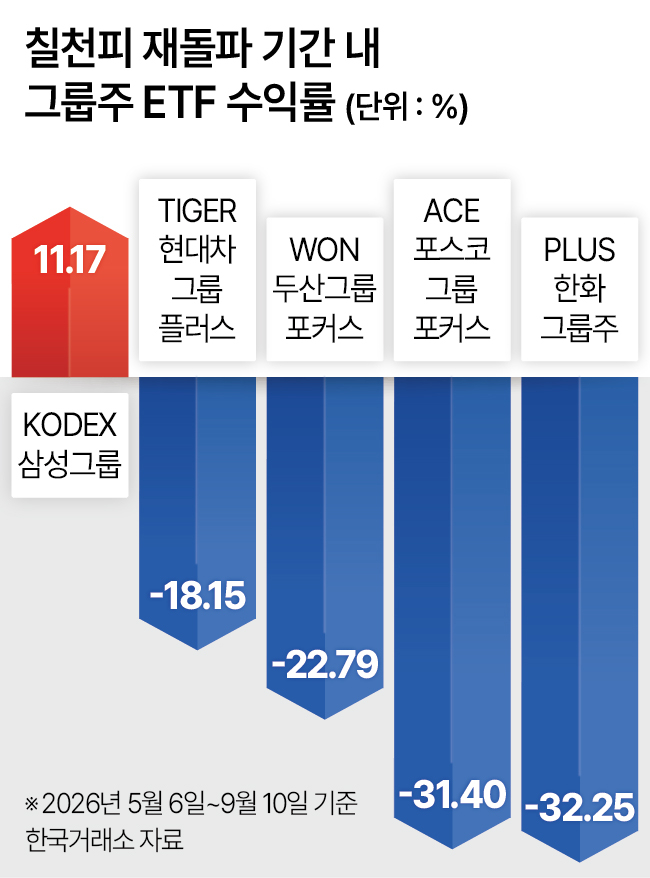
According to the Korea Exchange on Friday, the KODEX Samsung Group ETF rose 11.17 percent from May 6 -- when the Kospi first topped 7,000 -- through Thursday. Over the same stretch, the TIGER Hyundai Motor Group Plus ETF fell 18.15 percent, while the WON Doosan Group Focus ETF dropped 22.79 percent. The ACE POSCO Group Focus and PLUS Hanwha Group ETFs slid 31.40 percent and 32.25 percent, respectively. The performance gap between the KODEX Samsung Group ETF and the PLUS Hanwha Group ETF reached 43.42 percentage points. Group-affiliate ETFs bundle a conglomerate's major listed subsidiaries at set weightings, allowing investors to compare returns as if they had invested directly across each group's stock performance.
Other Samsung-linked ETFs also posted gains. Over the same period, the TIGER Samsung Group ETF climbed 13.47 percent and the KODEX Samsung Group Value ETF rose 8.54 percent. The ACE Samsung Group Sector Weighted and ACE Samsung Group Equal Weighted ETFs advanced 5.24 percent and 4.59 percent, respectively. That stands in stark contrast to the declines across major Hyundai Motor, Doosan, POSCO and Hanwha group ETFs.
Samsung Group ETFs have outperformed rival conglomerate ETFs since the start of the year. From the last trading day of last year through Thursday, the TIGER Samsung Group ETF gained 98.19 percent and the KODEX Samsung Group ETF rose 88.41 percent. Over the same period, the TIGER LG Group Plus ETF rose 46.06 percent, the TIGER Hyundai Motor Group Plus ETF gained 20.73 percent, and the PLUS Hanwha Group ETF advanced 15.31 percent. The ACE POSCO Group Focus ETF rose 3.11 percent, while the BNK Kakao Group Focus ETF fell 21.66 percent.
Strength in semiconductor and IT affiliates has helped drive Samsung Group ETFs' outperformance. As of that day, Samsung Electronics accounted for 26.18 percent of the KODEX Samsung Group ETF's holdings and Samsung Electro-Mechanics for 20.32 percent, together making up 46.50 percent of the fund -- nearly half of its total composition.
Profit forecasts for Samsung affiliates have also been revised upward in succession. Shin Hyun-yong, a researcher at Yuanta Securities Korea, said Samsung Life's 12-month forward net profit estimate rose 24.5 percent, from 4.31 trillion won ($3.22 billion) on Aug. 9 to 5.36 trillion won on Sept. 9. Samsung Electro-Mechanics' estimate rose 6.7 percent, from 2.46 trillion won to 2.63 trillion won, while Samsung SDI's climbed 4.6 percent, from 1.18 trillion won to 1.24 trillion won. Samsung Electronics' forecast also increased 3.6 percent over the same period, from 40.98 trillion won to 42.45 trillion won.
Market watchers expect the rally, which has so far been led by semiconductors, to broaden into other sectors. "Semiconductors drove the rebound since the July low," said Na Jung-hwan, a researcher at NH Investment. "While maintaining exposure to semiconductors, now is the time to think about which sector will lead the next leg up." He added, "Investors need to keep their semiconductor holdings while also adding domestic AI platforms, services and secondary batteries."
Over the past month, other conglomerate ETFs have also rebounded. From Aug. 10 through Thursday, the WON Doosan Group Focus ETF rose 12.47 percent, outpacing the TIGER Samsung Group ETF's 10.22 percent gain. The ACE POSCO Group Focus ETF also climbed 8.10 percent. The TIGER LG Group Plus and PLUS Hanwha Group ETFs rose 4.91 percent and 3.38 percent, respectively.
Shin Seung-jin, a researcher at Samsung Securities, pointed to consumer goods, energy storage systems and nuclear power as sectors likely to take on a bigger leadership role. "Since August, as semiconductors have risen, the rally has spread to sectors with strong individual momentum, such as consumer goods -- food, beverages and cosmetics -- energy storage systems, and nuclear power, including construction and utilities," Shin said. "For the rest of the second half, we expect the Korean market's leading sectors to broaden as AI semiconductors continue a gradual climb."
hajun825@heraldcorp.com