Samsung Electronics and SK hynix have bought back about half of their announced share buyback volumes just three weeks after starting the program, with the two companies together spending 25 trillion won ($18.7 billion). Amid heavy selling by individual and foreign investors, the two chipmakers have been in effect the only buyers propping up the Kospi, fueling concerns over a supply-demand vacuum once their buying ends.
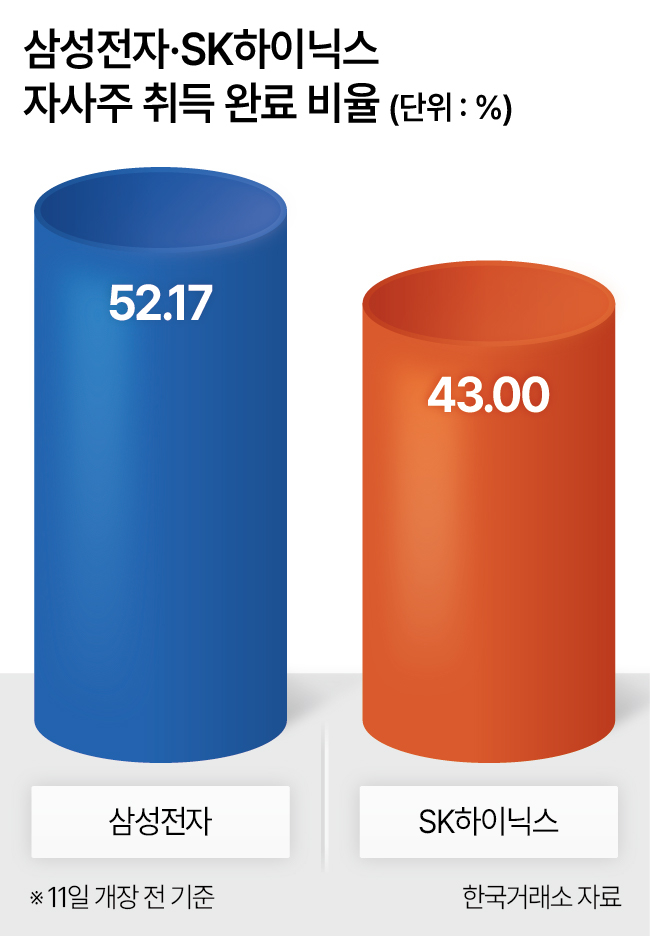
According to the Financial Supervisory Service's electronic disclosure system and the Korea Exchange, Samsung Electronics had completed 52.17 percent of its announced buyback volume and SK hynix 43.00 percent as of the market open Friday. Samsung Electronics purchased 27.8 million shares out of the 53,285,968 shares it disclosed on Aug. 21, while SK hynix bought 10.35 million shares out of the 24.07 million shares it disclosed Aug. 19.
The cumulative purchase amounts stood at 7.26 trillion won for Samsung Electronics and 17.73 trillion won for SK hynix. Together, the two companies' buybacks have absorbed roughly 25 trillion won worth of shares from the market. Dividing the purchase amount by the number of shares bought puts the average purchase price at about 261,000 won per share for Samsung Electronics and about 1.71 million won per share for SK hynix.
The two companies' massive buybacks stem from an effort to expand shareholder returns and employee compensation, backed by cash that has piled up amid the memory chip boom.
SK hynix's board approved a 40 trillion won share buyback on Aug. 19, covering about 3.3 percent of its total outstanding shares. All the repurchased shares will be retired once the buyback is complete, marking the largest share cancellation ever carried out by a listed Korean company.
Two days later, on Aug. 21, Samsung Electronics unveiled a shareholder return plan worth 90 trillion to 110 trillion won for this year and simultaneously approved a 15 trillion won buyback for employee compensation. Samsung Electronics had earlier agreed with its labor union to pay special performance bonuses in the chip division using treasury shares.
In trading data, such purchases are recorded as net buying by "other corporations" — the classification given to listed companies that buy their own shares on the open market.
From Aug. 20, when SK hynix began its buyback, through Thursday, "other corporations" posted net purchases of more than 1 trillion won on the Kospi on every trading day except Sept. 3. Cumulative net purchases over that period reached 23.38 trillion won — a figure remarkably close to the 24.98 trillion won the two chipmakers actually spent on their buybacks over the same stretch.
While the total buying by "other corporations" cannot be equated entirely with the two companies' buybacks, the similarity underscores how dominant an influence Samsung Electronics and SK hynix have had on that category of investors recently.
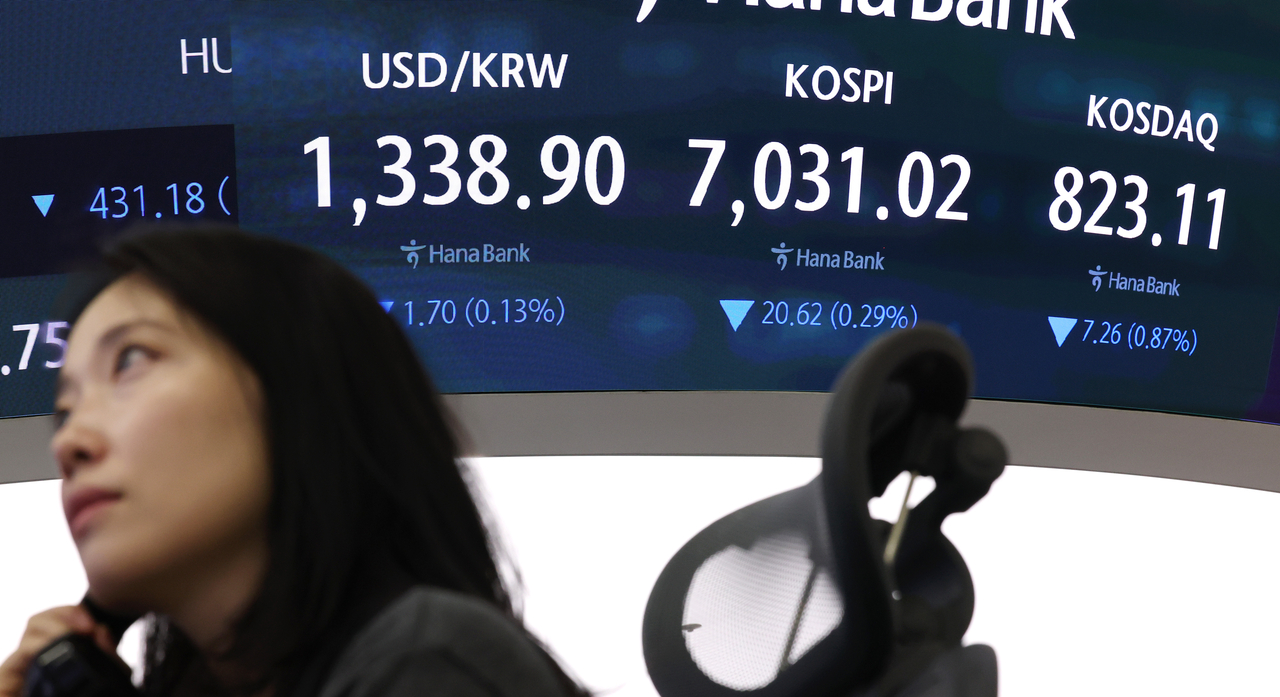
Over the same period, individual investors net sold 17.5 trillion won worth of shares and foreign investors net sold 7.95 trillion won. The two groups together dumped more than 25 trillion won in shares, but "other corporations" absorbed most of the selling and kept the index from falling further. The Kospi closed at 7,051.64 on Sept. 9, reclaiming the 7,000 mark on a closing basis for the first time in 33 trading days since July 23. The buyback-driven buying was the single biggest driver behind the Kospi's ability to hold its gains despite heavy selling by individuals.
The concern is what happens once the two companies finish their buybacks. The remaining volumes to be purchased stand at about 25.49 million shares for Samsung Electronics and 13.72 million shares for SK hynix. Simply converting those figures at the average purchase prices so far puts the remaining amount at around 30 trillion won. Given that the companies absorbed about half their target volumes in just three weeks, the buybacks are likely to wrap up earlier than the disclosed deadline of November. The moment the buying ends, the force that has effectively single-handedly supported the Kospi recently will vanish from the market.
The buying by "other corporations" is less a reflection of fresh investment capital flowing into the market than a temporary, time-limited purchase executed by companies within a fixed scope and schedule. Once the buybacks end without a new source of demand emerging, the Kospi is bound to face a gap in buying power. That is why there is concern the momentum needed to reclaim the index's previous peak could weaken — the Kospi first closed above the 9,000 mark in history in June and rose as high as the 9,300 range during trading.
"A notable shift in supply and demand is emerging in the recent Kospi rebound," said Kang Jin-hyuk, a researcher at Shinhan Investment. "Amid a lack of active buying under macro pressure, buybacks and other purchases by 'other corporations' have emerged as a fourth source of demand."
"For the rebound to continue, we need to watch for the possibility that foreign and individual investors — the market's key sources of demand — return, which requires checking conditions such as the macro environment and corporate earnings," Kang added. "It will take time to turn around the sentiment of individual investors who exited the market amid intense deleveraging."
th5@heraldcorp.com