Securities transaction tax exemptions for financial holding firm conversions, business restructuring lack follow-up management, clawback rules
No way to recover exempted taxes even if restructuring plans go unfulfilled or fraud occurs
Tax institute recommends anti-abuse measures alongside sunset extension of tax breaks
Government pushes extension, but post-verification safeguards remain unresolved

South Korea exempts securities transaction taxes to support corporate business restructuring and financial holding company conversions, but no separate follow-up management rule exists to claw back the exempted taxes even when a company violates requirements or commits fraud during the restructuring process, a review has found.
As the government pushes to extend the sunset clause on the tax break, experts say authorities need to verify whether the tax benefits actually lead to completed restructuring and establish a mechanism to recover already-exempted taxes in case of violations.
According to an in-depth evaluation report by the Korea Institute of Public Finance titled "Securities Transaction Tax Exemption for Restructuring Support and Financial Market Efficiency and Stability," released Saturday, Provision No. 16, which supports financial holding company conversions, and Provision No. 24, which supports business restructuring, under Article 117 of the Restriction of Special Taxation Act, have no separate follow-up management rules.
Provision No. 16 exempts securities transaction tax when a financial institution's shareholder or a financial holding company transfers or exchanges shares to establish or convert into a holding company. Provision No. 24 exempts the transaction tax when companies exchange shares with one another to implement a business restructuring plan approved under the Special Act on the Promotion of Corporate Vitality.
The problem is that once a company receives the tax exemption, there is no explicit mechanism to cancel the benefit or recover the exempted tax even if fraud or other misconduct occurs during the restructuring process. By contrast, some income and corporate tax breaks that support the same kind of restructuring include follow-up management rules that cancel the benefit if certain requirements are violated.
Regarding Provisions No. 16 and No. 24, the institute said, "There is a risk that a company could receive the tax benefit and then commit fraud in fact during the restructuring process." It added that follow-up management rules should be introduced over the medium to long term to allow the recovery of already-exempted securities transaction taxes.
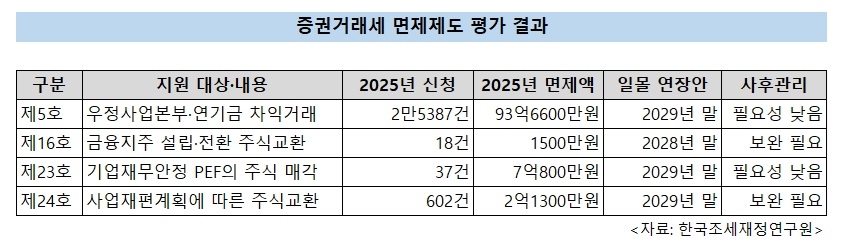
However, the researchers said the validity and effectiveness of the two systems stand on their own, separate from the gap in follow-up management. Last year, Provision No. 16 received 18 applications with a total exemption of 15 million won ($11,200). Provision No. 24 saw 602 cases totaling 213 million won.
Although usage volumes were not large, experts said the provisions help encourage small and midsize financial institutions to convert into holding companies and encourage companies to pursue preemptive business restructuring. Among eight experts surveyed, seven said Provision No. 16 was effective and seven said the same of Provision No. 24. On maintaining the systems, all eight experts supported keeping Provision No. 16, including conditional approval, while seven supported keeping Provision No. 24.
Provision No. 23, which supports exits by corporate restructuring private equity funds, exempted 708 million won in transaction tax across 37 cases last year. The researchers recommended extending the provision, saying that while usage has been minimal, it helps induce private equity funds to acquire companies undergoing financial structure improvement.
Provision No. 5, which supports arbitrage trading by the Korea Post and pension funds, saw 25,387 applications last year with a total exemption of 9.37 billion won. A quantitative analysis found that the average price gap between spot and derivative products narrowed by 5.58 basis points (1 basis point equals 0.01 percentage point) after the exemption was reintroduced. By maturity, the reduction in the price gap reached as much as 9.62 basis points.
In addition, the researchers concluded that separate follow-up management rules are not urgently needed for Provision No. 5, since its policy purpose ends once the transaction is completed, or for Provision No. 23, since the exemption applies only when equity is sold after a company completes its financial structure improvement.
In this year's tax code revision, the government decided to extend the application period for Provisions No. 5, No. 23 and No. 24 through the end of 2029, and Provision No. 16 through the end of 2028.
The researchers also concluded that the four provisions, whose sunset clauses are set to expire at the end of this year, should be extended. However, for Provisions No. 16 and No. 24, they called for establishing, over the medium to long term, a separate follow-up management mechanism to verify whether restructuring is actually carried out and to recover exempted taxes when it is not.
fact0514@heraldcorp.com