Based on government's revised tax reform plan
Tax on 1.5 billion won home rises from 690,000 to 806,000 won
Tax on 2 billion won home rises from 2.27 million to 2.77 million won
Burden grows despite 1.2 billion won basic deduction being maintained
![Lee Hyeong-il, nominee for deputy prime minister and Minister of Economy and Finance, answers reporters' questions as he arrives at his confirmation hearing preparation office at the Korea Deposit Insurance Corporation in Jung-gu, Seoul, on Saturday. [Yonhap]](https://wimg.heraldcorp.com/news/cms/2026/09/13/rcv.YNA.20260903.PYH2026090303910001300_P1.jpg)
If the government's tax reform bill passes the National Assembly unchanged, a non-resident single homeowner with a property assessed at 3 billion won ($2.24 million) will see their comprehensive real estate tax bill rise by about 4.29 million won from this year's level, according to estimates. Although the government has decided to keep the basic deduction at the current 1.2 billion won, higher tax rates and other changes are expected to increase the burden on owners of high-value properties significantly.
The figures come from documents the Ministry of Economy and Finance submitted to the National Assembly ahead of the confirmation hearing for Lee Hyeong-il, nominee for deputy prime minister and minister of economy and finance. Under the current system, a non-resident single homeowner with a property assessed at 3 billion won owes 7.75 million won in comprehensive real estate tax.
Should the government's reform bill be finalized and take effect next year, that figure would rise to 12.04 million won — an increase of 4.29 million won, or 55.4 percent, from this year. A property with a publicly assessed value of 3 billion won corresponds to a market price of roughly 4.3 billion won.
Under the government's original reform plan announced Aug. 3, the tax bill for such a property was projected to climb as high as 15.37 million won. At the time, the government proposed lowering the basic deduction for non-resident single homeowners from the current 1.2 billion won to 900 million won.
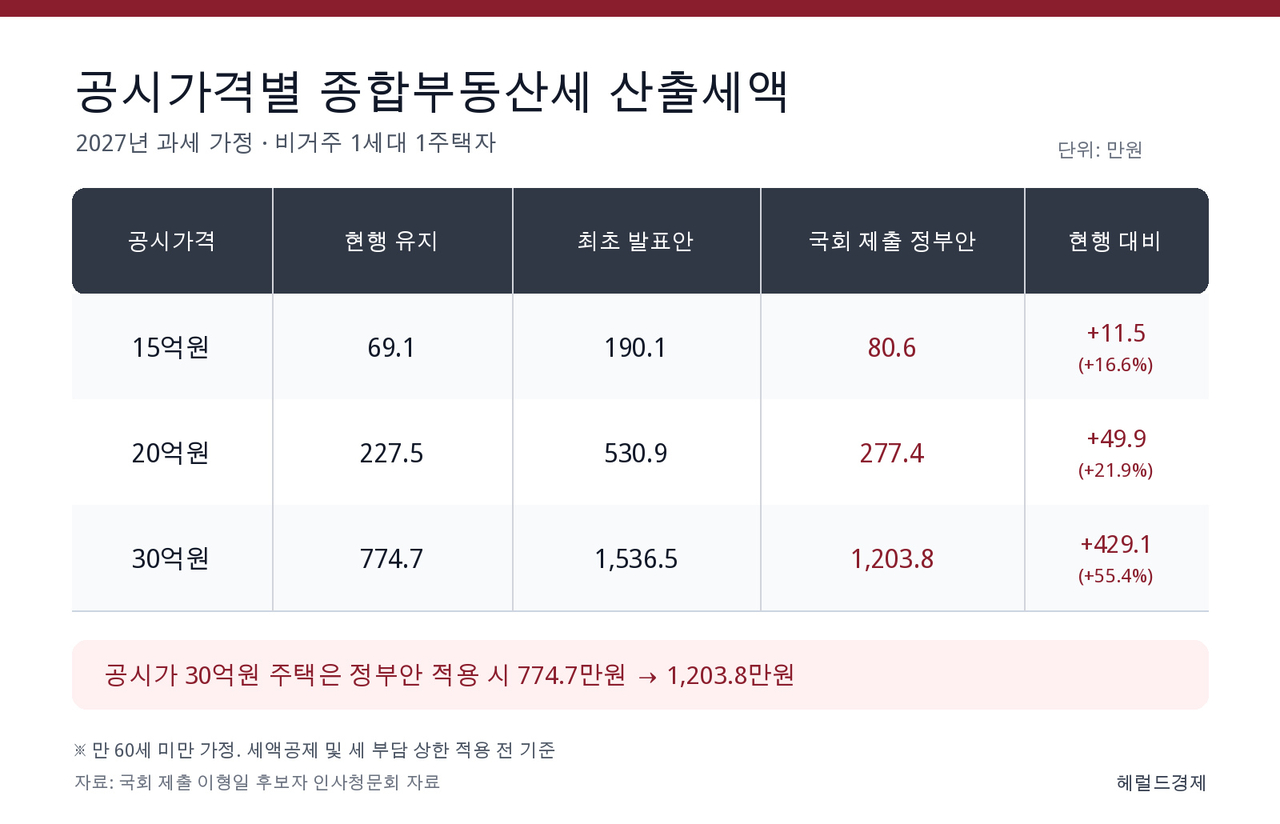
The government later revised the plan to keep the basic deduction at 1.2 billion won. As a result, the tax burden is 3.33 million won lower than under the original proposal, but still more than 4 million won higher than under the current system.
Owners of lower-assessed properties will also face higher bills. For a home assessed at 1.5 billion won, the comprehensive real estate tax would rise from 690,000 won this year to 806,000 won next year — an increase of 115,000 won. For a home assessed at 2 billion won, the bill would climb from 2.27 million won to 2.77 million won, an increase of 499,000 won.
The estimates assume the homeowner is a non-resident single homeowner under the age of 60. The figures represent calculated tax amounts before applying deductions for elderly owners or long-term holders, or the tax burden cap, meaning actual payments may vary depending on the property's price, the length of ownership and residency, and the owner's age.
Meanwhile, Lee purchased an apartment in Gwacheon, Gyeonggi Province, in February 2009 and held it for 17 years, but official residency records show he actually lived there for a total of just four months. The apartment has since been demolished for reconstruction.
The Ministry of Economy and Finance said Lee's family moved out starting in 2009 due to reasons including the ministry's relocation to Sejong. Asked whether the tax penalty applied to non-resident homeowners could also apply to Lee's reconstruction apartment, the ministry said it would be difficult to count the period of non-residency as a period of residency under the government bill submitted to the National Assembly.
However, asked whether holding a reconstruction property without actually living there for an extended period could be considered speculative demand, the ministry said the fact of non-residency alone was not sufficient to conclude that the ownership constituted speculation.
fact0514@heraldcorp.com