Hana Financial Research Institute releases report on finfluencer regulation
Finfluencers proliferate amid stock market boom
Financial Supervisory Service flags 5,511 suspected illegal videos
Report calls for legal definition of finfluencers as prerequisite for oversight

"Buy XX Power stock now. It's guaranteed to shoot up next week!"
"Check the link in the video comments if you want exclusive information."
As the Kospi more than doubled in just one year, the influence of "finfluencers" — individuals who produce financial and investment content through YouTube and other SNS platforms — has grown steadily.
Illegal finfluencers have multiplied rapidly, sharing investment tips through unlicensed advisory channels and impersonating celebrities, prompting the government to urge investors to exercise caution.
Experts say regulators must close the blind spots in the quasi-investment advisory framework that leave finfluencers largely unregulated, while also introducing indirect oversight through licensed financial institutions.
According to financial industry sources, the Hana Financial Research Institute, a research arm of Hana Bank, published a report titled "Finfluencers: Balancing Freedom and Responsibility" on Friday.
"In international usage, a finfluencer refers to an individual who shares investment content — including financial education and stock recommendations — through SNS, with the vast majority operating independently without any organizational affiliation," said researcher Noh Hye-ryeon. "As retail investing has gone mainstream, demand for information channels among young, small-scale investors has surged, giving rise to a culture of learning about finance through SNS, where freedom of expression and accessibility are guaranteed."
Finfluencer influence grows since COVID-19, and so do follower losses
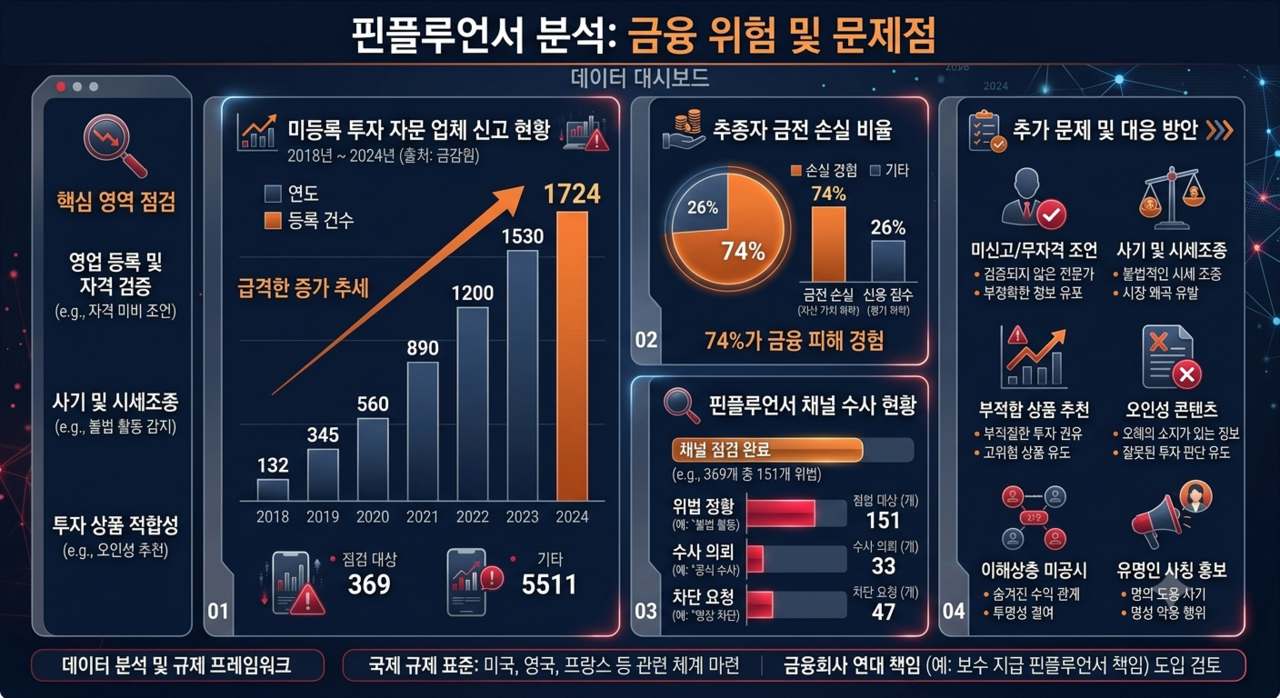
The rise of digital platforms such as YouTube has lowered the barriers to content creation, fueling a rapid increase in one-person media channels that publish financial content without professional qualifications. According to the Financial Supervisory Service, the number of registered quasi-investment advisory firms rose from 132 in 2018 to 1,724 in 2024.
The influx of investors in their 20s and 30s is widely cited as a key driver of finfluencers' growing reach. During the COVID-19 pandemic, a wave of new investors — many of them young people with little investment knowledge or experience — entered the market during the rebound that followed the sharp stock market decline.
"Drawing on the openness and accessibility of SNS, a new culture has taken hold, particularly among the MZ generation, of consuming financial information through finfluencers rather than traditional professional media," Noh said. "In an intensely competitive environment, market forces have pushed finfluencers to make financial content more entertaining in order to survive."
The problem is that as finfluencers' influence has grown, so have the financial losses and harm suffered by their followers. A 2024 survey by Capital One found that 74 percent of people who made investments based on SNS advice suffered losses, including financial damage and drops in credit scores. "While freedom of expression has no inherent limits, a lax accountability structure that allows information to spread indiscriminately without professional verification is expanding follower losses and harm — separate from outright fraud," Noh said.
International bodies have begun regulating unregistered or unqualified finfluencers. The International Organization of Securities Commissions identified six key risks posed by finfluencers last year: unregistered or unqualified advice, fraud and market manipulation, unsuitable product recommendations, misleading content, undisclosed conflicts of interest, and the misuse of celebrity endorsements. The United States, the United Kingdom, France and other countries are building regulatory frameworks to bring finfluencers under oversight.
FSS refers 33 channels for investigation; impersonation of prominent finfluencers also detected
In South Korea, however, a formal regulatory definition of finfluencers has yet to be established. The Financial Services Commission introduced a conceptual definition for the first time in March, but Noh said a normative definition remains absent.
Evidence of illegal activity by finfluencers has also been mounting. According to data submitted to the office of People Power Party lawmaker Park Sung-hoon of the National Assembly's Political Affairs Committee by the Financial Supervisory Service, the FSS reviewed 369 stock and economics finfluencer channels between April 13 and Aug. 21 this year and found signs of illegal activity in 151 of them, spanning 5,511 videos.
The FSS referred a total of 33 channels for criminal investigation and requested that authorities block 47 videos.
Among the most common violations was the creation of fake channels impersonating well-known finfluencers. Some operators presented schemes as investment projects involving financial institutions, built websites impersonating those institutions, collected investment funds and then disappeared. Authorities also uncovered cases in which operators purchased channels with large subscriber bases, converted them into stock-related channels and lured subscribers into unlicensed investment advisory groups.
Experts call for legal definition of finfluencers and indirect regulation through financial firms
Noh identified the legal codification of finfluencers as the top priority for financial regulators. Under current quasi-investment advisory rules, finfluencers who receive fixed compensation can be subject to legal oversight, but most finfluencer activities — including education, advertising, sponsorships and platform revenue — fall outside the regulatory scope. Because there is no concept of "registration" for finfluencers to begin with, oversight is entirely reactive, with no mechanism for preemptive action.
"There is still no normative definition of finfluencers, which makes it unclear who should be subject to strict monitoring, and limits the ability to comprehensively manage the wide range of risks they pose," Noh said.
The need for indirect regulation through financial institutions has also been raised. In the United States in 2024, a brokerage firm was fined $850,000 after regulators held it responsible for posts made by finfluencers it had paid. "Some countries hold financial institutions accountable for content produced in partnership with finfluencers, and domestic financial firms need to prepare for the introduction of similar regulations," Noh said.

hyuk@heraldcorp.com