![A scene from an OTT drama production [Photo: ChatGPT]](https://wimg.heraldcorp.com/news/cms/2026/09/13/news-p.v1.20260913.e1a22e00ea124869b3c49448703ba0bf_P1.jpg)
"I thought Chinese dramas were doomed to fail."
Chinese drama series, long dismissed for stiff performances and low production quality, are surging in South Korea's OTT market. The rise comes as domestic drama production has slowed under the weight of soaring costs — lead actors now command 300 million to 500 million won ($374,000) per episode — leaving a gap that Chinese titles are moving quickly to fill.
Once met with skepticism — "Who watches Chinese dramas these days?" and "They'll flop, guaranteed" — Chinese series have staged a remarkable turnaround in recent years, with a string of high-quality productions now posing a genuine challenge to K-content.
According to OTT industry sources, the Chinese series "Zhao Chun Qing Lang," released on Netflix on Aug. 26, ranked sixth on Netflix's top 10 series chart in South Korea on Sunday.
The show first broke into the domestic top 10 on Netflix's official tracking site Tudum during the first week of September (Aug. 31–Sept. 6) and has since climbed steadily in daily rankings. During the same period, it also reached second place in the global non-English shows category, drawing attention worldwide.
!["Zhao Chun Qing Lang" [Photo: Netflix]](https://wimg.heraldcorp.com/news/cms/2026/09/13/news-p.v1.20260913.1e322b5b79bb4120b7670b98d259525d_P1.jpg)
Based on a web novel of the same name, "Zhao Chun Qing Lang" is an office romance set in Beijing that follows the relationship between a prickly boss and a warm-hearted new employee, drawing praise for its grounded, realistic portrayal.
"Seeking the Jade," a romance Sageuk drama released on Netflix in March, also made waves, landing in the domestic top 10 series chart for four consecutive weeks on the strength of its lavish visuals and distinctive storytelling.
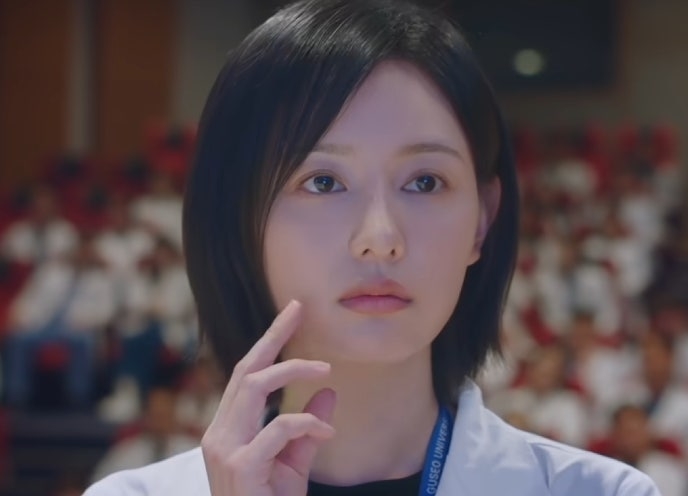
Chinese titles are gaining ground on Tving as well. Six Chinese series — including "Zhe Yi Chao Guo Hua," "Jia Ye," "Jia Wu Qian Cheng" and "Zuo Gu" — have placed in the top 20 of Tving's real-time drama rankings. "Zhe Yi Chao Guo Hua," a romance set during the Republic of China era, also broke into the top 10 on Tving's weekly chart for the first week of September.
Tving has responded by creating a dedicated Chinese drama section within its app.
!["Zhe Yi Chao Guo Hua" [Photo: Tving]](https://wimg.heraldcorp.com/news/cms/2026/09/13/news-p.v1.20260913.85677bde2d5840baa009431e54140098_P1.jpg)
Meanwhile, Chinese-backed short-drama platforms swept the top spots for new app installations in South Korea's entertainment category last month. Short dramas are series made up of brief episodes running roughly one to three minutes each, designed to hook viewers fast — conflicts escalate from the opening scenes, and dramatic twists and cliffhangers are stacked in quick succession to drive viewers to the next episode.
According to Mobile Index, Chinese-backed short-drama platforms claimed all three top spots for new entertainment app installations in South Korea in August. DramaWave led with 840,000 installs, followed by NetShort with 800,000 and DramaBox with 740,000. In just three months, the platforms had overtaken domestic OTT services such as Tving and Coupang Play in the rankings.
"Among Chinese drama fans, there's a saying that once you fall for Chinese dramas, you never go back to anything else — the fandom and loyalty are that strong," an OTT platform official said. "Chinese dramas are expanding so rapidly that the domestic content industry should be genuinely alarmed."
park@heraldcorp.com