'Focus is on creating an environment where companies can actually invest and operate'
'We will make Saemangeum a model for locally driven growth'
Second pre-sale of single-family housing lots in waterfront city planned this month
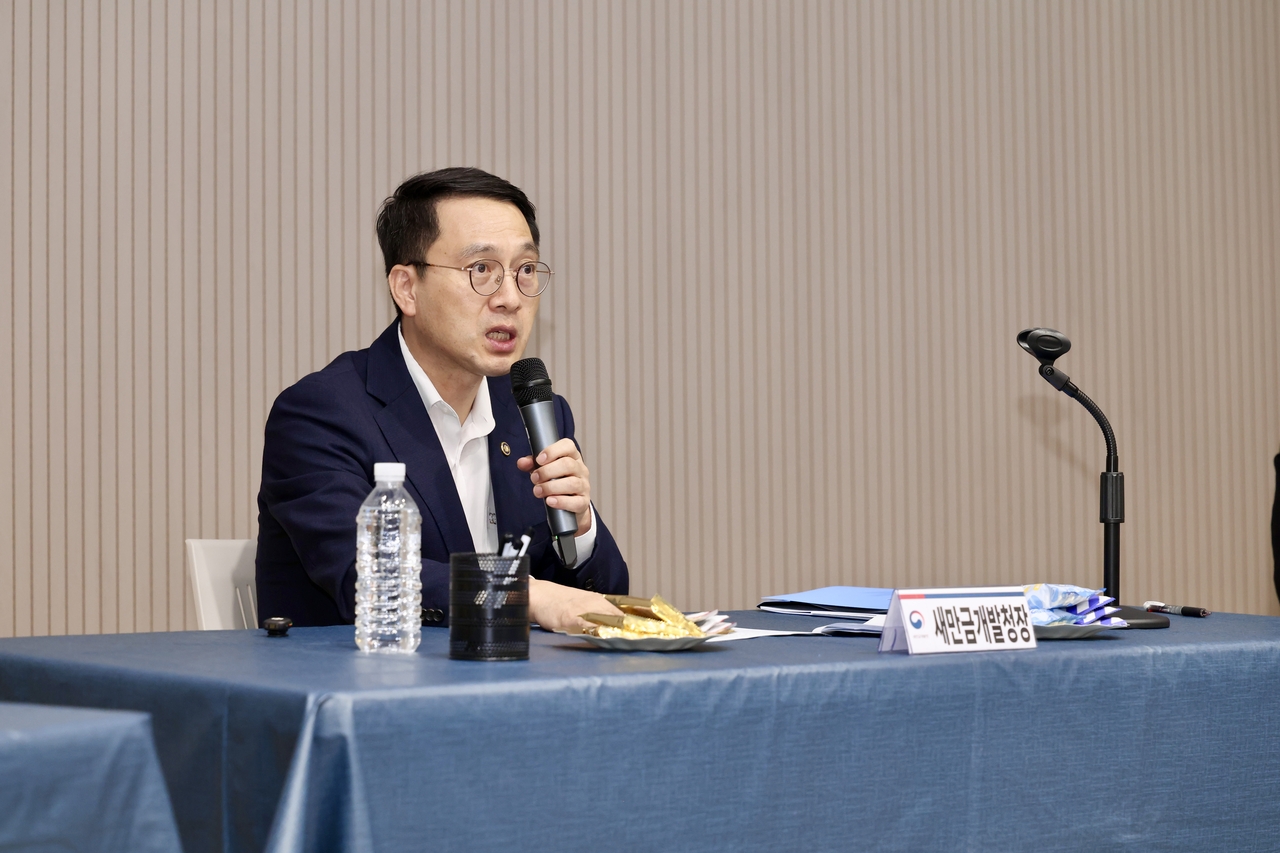
"The focus will not stop at securing budgets and attracting investment — it will be on creating an environment where companies can actually invest and run their businesses. Hyundai Motor Group has announced plans to invest about 9 trillion won ($6.73 billion) to build an advanced industry ecosystem centered on robotics, AI and hydrogen. To fully support that, the Saemangeum Development Authority plans to convert the third block of agri-bio land into energy land and provide it as a solar power site. We will upgrade Saemangeum's industrial structure and establish it as a leading model for locally driven growth."
Saemangeum Development Authority Commissioner Moon Seong-yo made the remarks Thursday at a press briefing held at the Saemangeum Reclamation Museum. His comments signaled a commitment to channeling policy resources into revitalizing the long-troubled Saemangeum development project — one that has seen its master plan revised multiple times since it was first drawn up in 1989, with the seawall completed in 2010.
Along the 33.9-kilometer seawall, tourists, residents and developers alike are showing renewed optimism that reflects the government's determination to accelerate development, a Saemangeum authority official said. Gunsan — which lost momentum after a string of major corporate departures including a shipyard and GM — as well as Buan and surrounding areas are pinning their hopes on Hyundai Motor Group's investment moves, the official added.
The government and the ruling party are both throwing their weight behind Saemangeum. Prime Minister Han Seong-sook chose the zone as her first regional destination after taking office, and Democratic Party of Korea leader Kim Min-seok pledged sweeping budget support at a budget policy conference held in North Jeolla Province on Wednesday, saying he had "200 percent certainty that Saemangeum will become a forward base ushering in a new era for the South Korean, Asian and global economies."
Infrastructure upgrades bring Saemangeum closer to a livable community
Roads and other infrastructure in Saemangeum are gradually taking on the character of a community where people can actually live. Beyond the seawall road, a north-south arterial and an east-west national highway are already in place, and a highway connecting the zone to Jeonju has been completed. "It used to take 50 minutes to an hour to cross the Saemangeum district from one end to the other — now it takes about 20 minutes," an authority official said. A third north-south road network is set to go through a preliminary feasibility study this year, and a new port, railway and airport are planned to follow, giving the zone a comprehensive land, sea and air transport network. The Saemangeum new port is on track to open by the end of this year with two general-cargo berths.
The authority also plans to introduce a demand-responsive transit service to improve mobility for residents and enhance access to the zone.
The most visible sign of Saemangeum's development momentum is the site where Hyundai Motor Group's investment will take shape. The group's 9 trillion won commitment to building an advanced industry ecosystem in robotics, AI and hydrogen is widely seen as both the catalyst and the cornerstone of Saemangeum's full-scale development. Hyundai Motor Group plans to break ground on an AI data center in March next year, followed by phased construction of solar power generation and hydrogen production facilities by the end of 2027.
Related procedures, including architectural review, are set to begin this month. The authority plans to support the group in completing building permits within the year so that Hyundai Motor Group can secure its future growth engines at the earliest opportunity.
Hyundai Motor Group to break ground on AI data center early next year
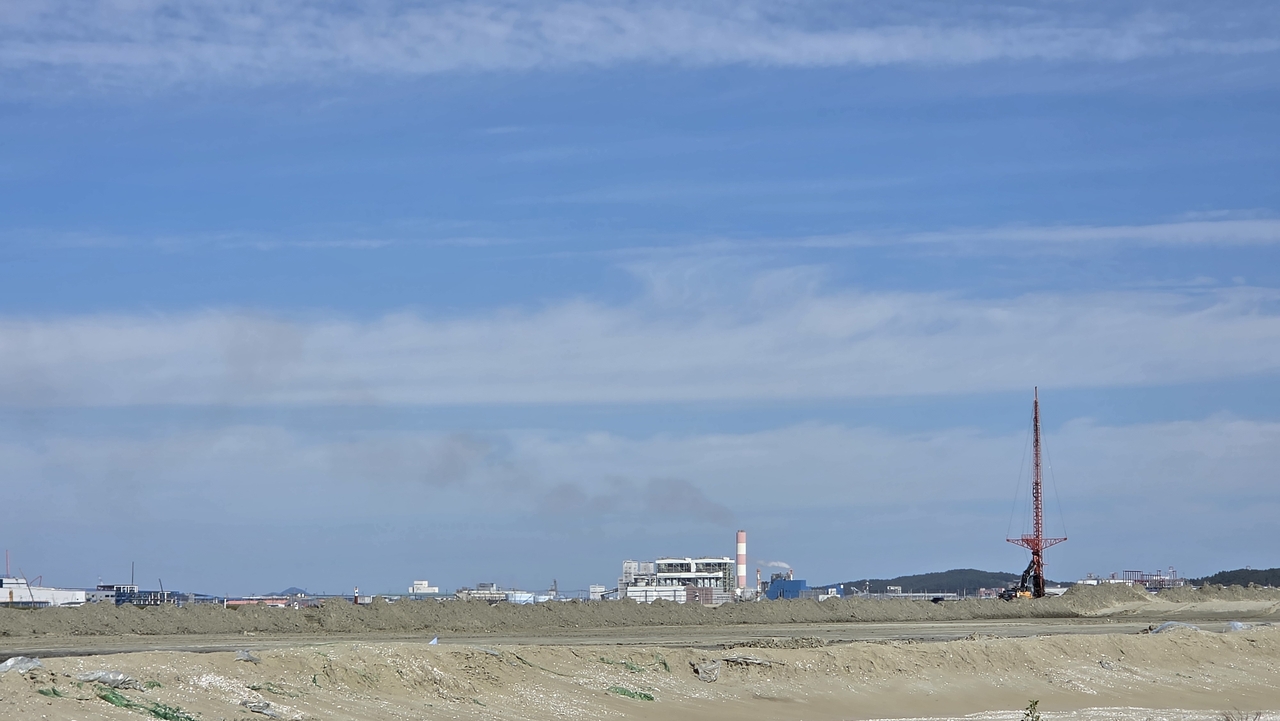
Hyundai Motor Group's total investment in Saemangeum is currently estimated at 8.9 trillion won. The breakdown includes 400 billion won for AI robotics, 5.8 trillion won for an AI data center, 1 trillion won for an electrolysis plant, 400 billion won to support the development of an AI hydrogen city, and 1.3 trillion won for solar power generation.
The AI data center, which carries the largest share of the investment, will be the first to break ground. Equipped with 50,000 GPU units, it will support machine learning for self-driving cars and robots. The solar power project — the second-largest by investment — is a gigawatt-scale facility designed to supply renewable energy to the electrolysis plant, the hydrogen AI city and the data center.
Hyundai Motor Group estimates the investments will generate about 16 trillion won in production-inducing effects and create roughly 70,000 jobs.
Commissioner Moon said the authority is working to expand Saemangeum's renewable energy production capacity from 7 gigawatts to 10 gigawatts to ensure a stable power supply for tenant companies, and is also drawing up a master plan to have the industrial complex designated as an RE100 zone.
Waterfront city where companies and residents grow together takes shape
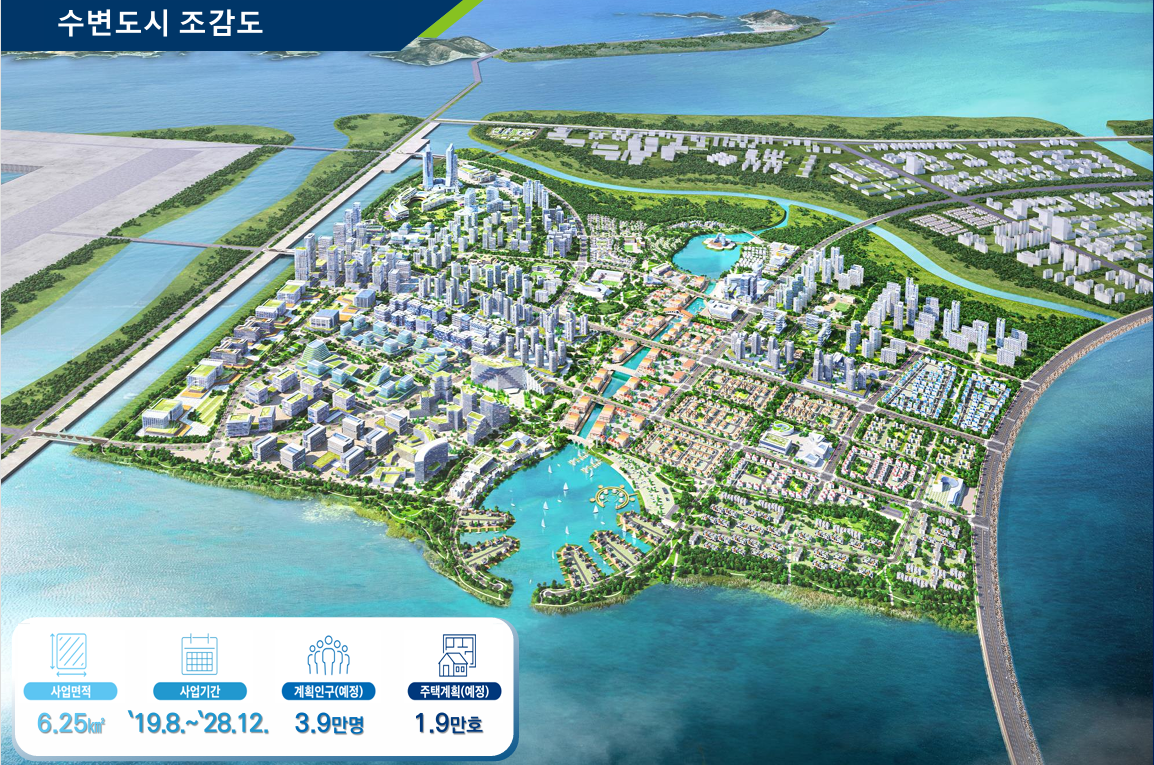
As infrastructure expansion and corporate investment — led by Hyundai Motor Group — become more tangible, the authority is also stepping up efforts to attract residents. The goal is to accelerate development of a waterfront city where companies and residents can live and grow together.
The authority has prepared a smart waterfront city site near the Gogunsan Archipelago, at the midpoint of the seawall, and began selling residential lots last year.
The waterfront city spans 6.25 square kilometers — twice the area of Yeouido — and is planned to accommodate 39,000 residents in 19,000 housing units. Residential land accounts for 21.3 percent of the total, with commercial and business facilities at 5.6 percent and parks and green space at 27.2 percent. The development is marketed on the strength of its living environment, with green space within a five-minute walk and waterfront access within ten minutes.
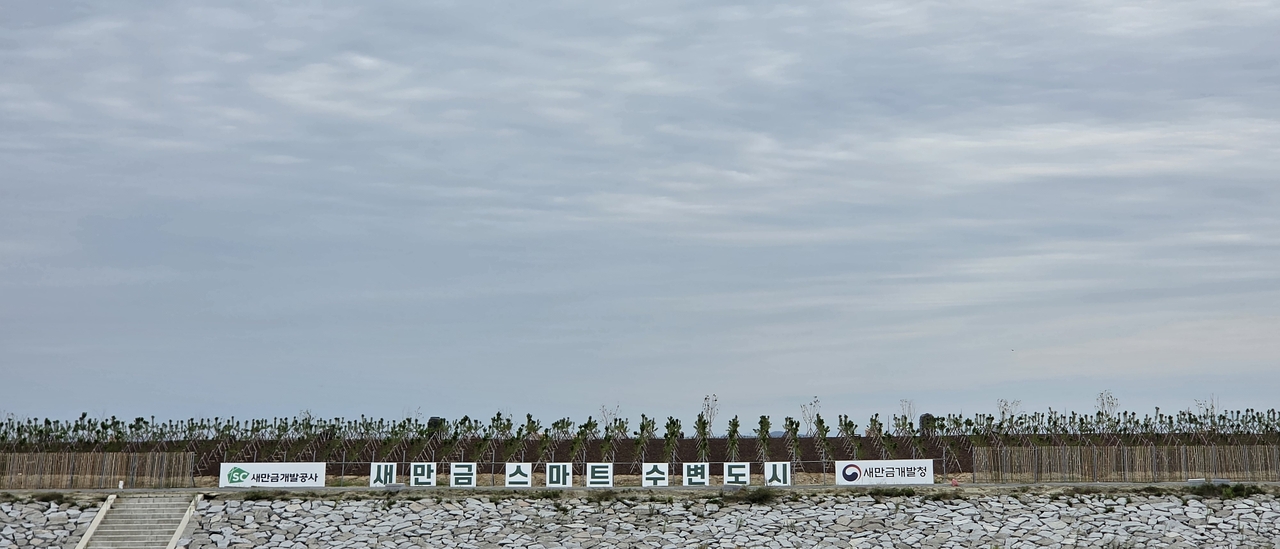
The authority is also planning a "Tri-Port" integrated transport system within a 10-kilometer radius — combining land routes including bus rapid transit and rail, maritime access via the new port, and air connectivity through urban air mobility and a new airport.
Consumer interest in the waterfront city's long-term potential drove fierce competition in last year's housing lot pre-sale, with all available supply taken up. The first round offered 67 single-family housing lots and two neighborhood commercial lots through a lottery and competitive bidding, respectively. The top competition ratio for single-family lots reached 41 to 1.
Saemangeum Development Corporation said 27 percent of bidders came from outside North Jeolla Province, validating the site's competitiveness and future value, and announced it would launch the second pre-sale as early as this month. The offering will include 35 purely residential single-family lots and 10 mixed-use single-family lots with ground-floor retail, all through competitive bidding.
The authority said the second-round lots are located near an education-specialized facility and are being offered following Hyundai Motor Group's investment announcement in February, and it expects strong interest from end-users who see long-term value in Saemangeum. Sales of apartment complex sites are planned to begin from next year onward.
'Saemangeum to grow through public leadership and corporate-driven development'
Commissioner Moon said several other companies — whose names he was not yet able to disclose — are also pursuing investment in Saemangeum beyond Hyundai Motor Group, and that the zone's growth strategy would focus on combining public-led development with corporate-driven growth.
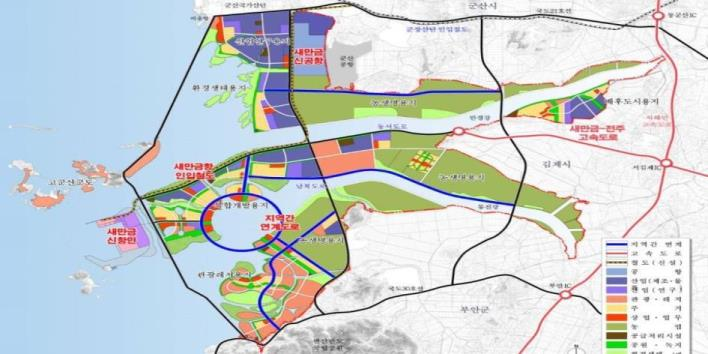
The government's budget proposal for next year allocates 222.2 billion won for Saemangeum — an increase of 7.4 billion won from this year — with the aim of having the public sector take more accountable leadership in driving development, reducing uncertainty in project execution and building necessary infrastructure on schedule.
The authority also plans to work with the Ministry of Land, Infrastructure and Transport to designate the waterfront city as an AI pilot city, and to actively introduce and test physical AI technology across the urban environment, as part of efforts to develop it into a hub for AI and advanced mobility.
Commissioner Moon also stressed the importance of building a sustainable Saemangeum where environmental protection and development go hand in hand, saying the master plan would be revised to reflect that vision.
"Saemangeum will transform into a future industrial city where companies invest and people gather to grow together, centered on advanced strategic industries such as robotics, AI and hydrogen," Moon said. "We will ensure that infrastructure is in place without fail so that corporate investment and development projects translate into real results, and we will do our utmost to make Saemangeum a center of balanced national development and shared regional growth."
smh@heraldcorp.com