A K-Gastronomy Belt connecting Chuncheon's culinary heritage
The working-class origins of dakgalbi
The full-body effort behind authentic makguksu
The unlikely comeback of the ugly potato
![Iron-griddle dakgalbi in Chuncheon [Korail Tourism Development]](https://wimg.heraldcorp.com/news/cms/2026/09/14/news-p.v1.20260913.d076cc9e34564c0195c523ab1e4ad2b5_P1.jpg)
Chuncheon, a city draped along the Soyang River, completes its identity through food — alongside its lakes, romantic atmosphere and train journeys.
Chuncheon dakgalbi and makguksu can be found everywhere now — in the heart of Seoul, in small-town markets across the country — yet people still make the trip to Chuncheon to taste them again. That pull is the city's quiet power. What began as food for the working poor has become a centerpiece of the government's gastronomy initiative and a symbol linking local culture to tourism.
The K-Gastronomy Belt and the 2026 Chicken Road
![Chuncheon landmarks and dakgalbi imagery [Korea Food Promotion Institute]](https://wimg.heraldcorp.com/news/cms/2026/09/14/news-p.v1.20260914.e0f9eb1192514576b80a5e61a12bc777_P1.png)
The Ministry of Agriculture, Food and Rural Affairs and the Korea Food Promotion Institute are developing the K-Gastronomy Belt, a project that weaves together ingredient-producing regions, traditional food culture and local stories into extended-stay tourism experiences. The institute is working toward a roadmap of 30 gastronomy belts nationwide by 2032. The initiative launched with fermented-sauce belts in Sunchang and Damyang, and last year added belts centered on traditional liquor in Andong, ginseng in Geumsan and kimchi in Gwangju. This year's focus is chicken and chicken-based dishes.
The push for what is informally called the K-Chicken Belt stems from the dish's surging global popularity. In a 2025 survey of overseas hansik consumers, Korean-style fried chicken ranked first among the most preferred Korean foods, chosen by 14 percent of respondents — cementing South Korea's reputation abroad as a country that does chicken right.
In response, the ministry and the institute divided this year's chicken belt initiative into two tracks — chicken dishes and chicken-based cuisine — and invited local governments to compete for selection. Chuncheon and Jeju scored highest in the chicken-dish category, while Suwon and Gumi led in the fried-chicken category. Each municipality will roll out its own specialized chicken belt travel packages in sequence.
Dakgalbi's origins in leaner times
![A charcoal-grilled dakgalbi spread available on the Chuncheon chicken belt tour [Korail Tourism Development]](https://wimg.heraldcorp.com/news/cms/2026/09/14/news-p.v1.20260913.15e67365280e4052b70d91865034c84d_P1.jpg)
Chuncheon dakgalbi's selection as a government gastronomy product is rooted in the hardship of the early 1960s. Large poultry farms spread across the Chuncheon and Hongcheon areas during that period, making chicken relatively affordable. To feed customers with little money, tavern owners began slicing meat from the chicken's rib section, marinating it in gochujang and grilling it over a coal briquette fire — and dakgalbi was born.
The dish reached a turning point in the 1970s. Along Chuncheon's Jungang-ro, cooks began placing thick cast-iron griddles over oil-drum stoves. Cabbage, sweet potato and rice cakes — staples grown on nearby farms — were tossed onto the griddle alongside the meat. Even with modest portions of chicken, loading the pan with vegetables meant a group could share a filling meal.
For cash-strapped university students and soldiers on leave from nearby frontline bases, iron-griddle dakgalbi was a godsend. The tradition of finishing the meal by stir-frying rice with the remaining sauce, sesame oil and crushed seaweed — the beloved "griddle fried rice" — also took hold during this era. That spirit of generous sharing drove the dish's spread across the country.
A traditional liquor brewed on patience: 100 days in the jar
Korail Tourism Development and the city of Chuncheon have packaged this culinary narrative into the 2026 Chuncheon K-Chicken Belt travel product. Day-trip options are divided into five themed courses to suit different tastes, and a one-night, two-day immersive package called "Chuncheon Overnight Spread" is also available. The itinerary connects local produce, food, liquor and the stories of the people behind them, offering travelers a deeper encounter with the region's gastronomy and scenery.
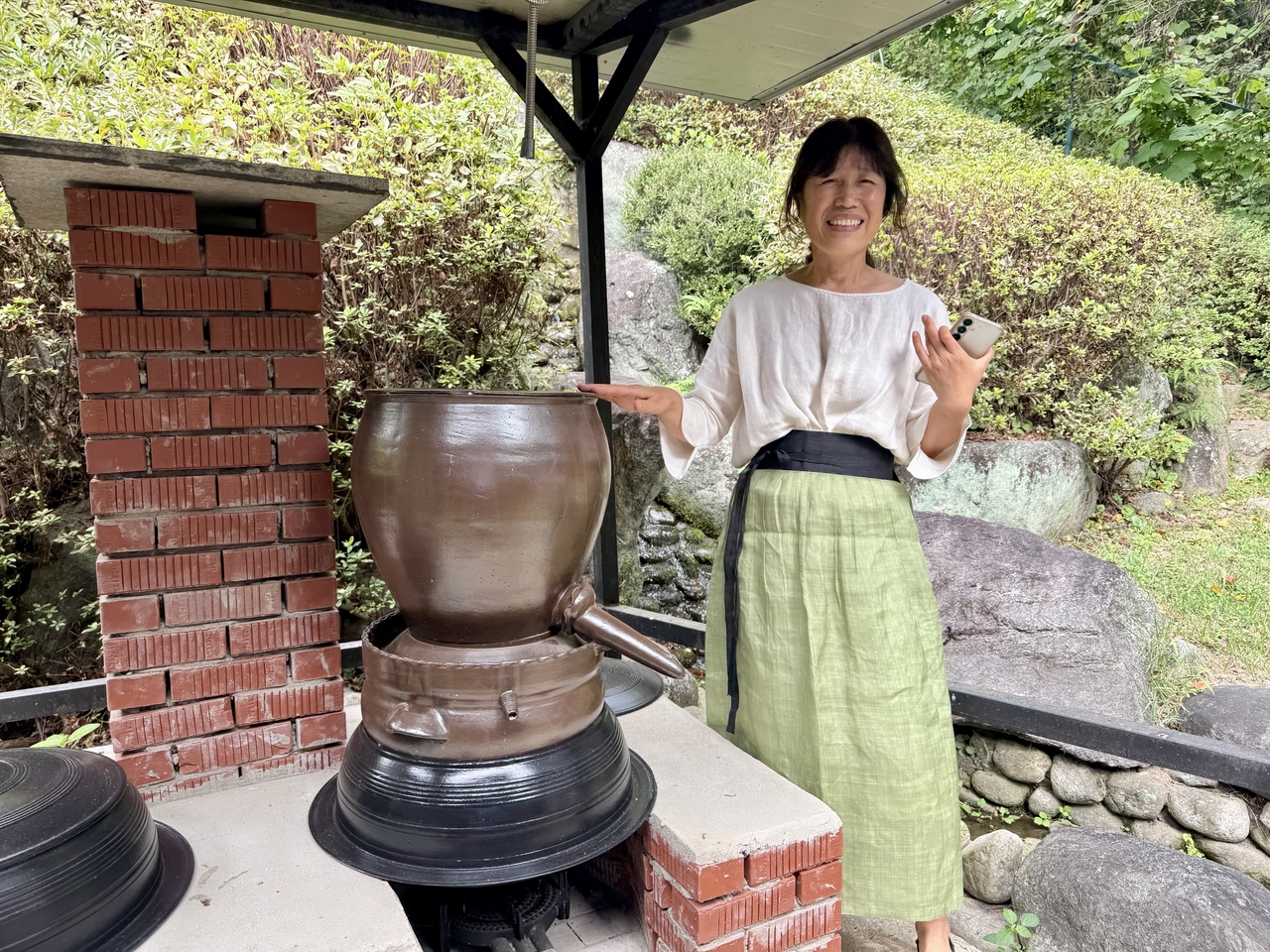
One stop on the itinerary is Jisiul Brewery, which produces a traditional liquor called Hwajeon Iltchwi — a name evoking the pleasure of getting pleasantly drunk together before flowers. The brewery's philosophy borders on uncompromising: no artificial sweeteners or acidulants, only rice, nuruk (a fermentation starter) and water. Rather than stainless-steel fermentation tanks, the brewery uses traditional earthenware onggi jars, whose microscopic pores encourage natural microbial circulation. Every bottle requires 100 days of low-temperature fermentation in onggi followed by two months of aging.
![Hwajeon Iltchwi 18 Baekhwa, a floral-scented traditional liquor [Kim Myung-sang]](https://wimg.heraldcorp.com/news/cms/2026/09/14/news-p.v1.20260913.99de088adee84b02aede88ecb0186ae4_P1.jpg)
Among the brewery's offerings, Hwajeon Iltchwi 18 Baekhwa stands out for its fragrance — crafted with 22 varieties of edible flowers and a traditional distilled spirit. Sweet yet potent, it is the kind of drink that sneaks up on you. The takju Dongjeongchun, at 8 percent alcohol, is fermented almost entirely from the natural starch of rice with virtually no added water, making it remarkably sweet without any sugar or honey. The labor-intensive production process puts the price at around 300,000 won ($223) per bottle, and the liquor is supplied to Korean restaurants in top Seoul hotels.
"Tradition is not a preserved relic of the past — it must evolve flexibly with the times and with how people live in order to survive," said Yoo So-young, owner of Jisiul Brewery. "True continuity means embracing convenience while protecting the original depth and essence."
Makguksu the old way: a full-body effort
![Visitors kneading buckwheat dough at the Chuncheon Makguksu Experience Museum [Korail Tourism Development]](https://wimg.heraldcorp.com/news/cms/2026/09/14/news-p.v1.20260913.3fe400b08625481e80985ce6e3a90552_P1.jpg)
The Chuncheon Makguksu Experience Museum lets visitors discover firsthand the essence of makguksu — noodles made and eaten fresh the moment they are pressed. Visitors can work through the entire process, from kneading buckwheat dough to pressing the noodles.
The experience begins by gradually adding cold water to a fine blend of buckwheat and wheat flour and working the dough by hand. Once the dough is ready, it is time to press the noodles. A ball of dough is loaded into a traditional noodle press that towers nearly to the ceiling. "Everyone push together — one, two, three!" At the instructor's call, several adults throw their full weight onto the press. The frame strains and slowly gives way, and the dough squeezes through in thick, tumbling strands.
![Pressing buckwheat noodles with a lever-style noodle press at the Chuncheon Makguksu Experience Museum [Kim Myung-sang]](https://wimg.heraldcorp.com/news/cms/2026/09/14/news-p.v1.20260913.3a55073d6cdb47c8a574fffefb2f3edc_P1.jpg)
A mouthful of the freshly boiled, cold-rinsed noodles delivers a pleasantly snappy texture followed by a warm, nutty buckwheat aroma. The clean, mild flavor plays off a spicy sauce and crisp vegetables in a combination that surprises with how satisfying it is — no sugar or vinegar needed. Where dakgalbi leaves the palate rich and oily, makguksu cuts through with a bright, peppery freshness, making it the perfect counterpart and an indispensable part of Chuncheon's food identity.
A bumper harvest's bitter lesson — and a potato beer born from it
![Gamja Island, where potato-based beer, pizza and chicken are on the menu [Korail Tourism Development]](https://wimg.heraldcorp.com/news/cms/2026/09/14/news-p.v1.20260913.6bad584f64764812bebca0421d6c8d6e_P1.jpg)
Down a quiet residential alley in Chuncheon's Toegye-dong neighborhood, a 35-year-old red-brick church greets visitors in an unexpected guise. The cross-topped steeple is still intact, but instead of hymns, the space — now home to Gamja Island — is filled with the aroma of fermenting beer.
Behind this unusual pub lies a painful paradox of plenty. Co-representative Ahn Hong-jun, who studied German language and literature at Kangwon National University, was moved to act after witnessing the damage that potato overproduction inflicted on local farmers. When prices crashed, growers could not even recoup shipping costs and plowed their harvests back into the ground.
The problem ran deeper than simple supply and demand. Closer investigation revealed that about 30 percent of potatoes grown in Gangwon Province and across the country were being discarded without ever reaching market — rejected for blemishes or failing to meet size standards. A group of university students rallied around the idea of brewing beer from the discarded potatoes to ease farmers' hardship, and their persistent experimentation eventually produced a working potato beer.
![Dakgalbier at Gamja Island, designed to balance the dish's bold, spicy flavors [Kim Myung-sang]](https://wimg.heraldcorp.com/news/cms/2026/09/14/news-p.v1.20260913.7fa8ee01bc004d07aa0518d5b0098c1f_P1.jpg)
The beers brewed here are notably smooth — the potato's natural starch and dietary fiber give each pour a silky texture and a clean, refreshing finish. Beyond potato, the lineup draws on other Gangwon Province crops including corn and sweet red bean, totaling 16 varieties. The snack menu is equally inventive: dakgalbi pizza and potato chicken cleverly reinterpret Chuncheon's culinary identity on the plate.
Refined hansik and a warm welcome through traditional liquor
![Menu items at Hosu, a hansik dining bar [Korail Tourism Development]](https://wimg.heraldcorp.com/news/cms/2026/09/14/news-p.v1.20260913.e28e5bd53a564a219c6c485aee27171c_P1.jpg)
A women's brewers' cooperative dedicated to promoting Chuncheon's traditional liquor culture and creating a sustainable cycle for local produce runs Hosu, a hansik dining bar. More than 70 percent of the ingredients used in the kitchen come from farms in and around Chuncheon.
![Pumpkin tofu flower mandu [Kim Myung-sang]](https://wimg.heraldcorp.com/news/cms/2026/09/14/news-p.v1.20260914.2cb9ae42b4dc43f787bf4ed9979a727b_P1.jpg)
The table setting impresses visually before the first bite. The pumpkin tofu flower mandu — thinly sliced yellow pumpkin folded into petal-like shapes — uses chewy rice paper in place of dumpling skin and a filling of stir-fried tofu and vegetables instead of meat. One bite delivers a satisfying chewiness and a clean, delicate flavor that rivals any meat dumpling.
Lightly braised cucumber and crispy seasonal vegetable pancakes follow in succession, each sharpening the appetite. The understated elegance of the spread — honest to the land rather than showy in technique — speaks to another dimension of Chuncheon's culinary depth. The restaurant operates entirely on reservations, and booking well in advance is essential; the earliest available slots open in early September.
![Jangho Charcoal Dakgalbi, located on the dakgalbi strip in Sinbuk-eup [Korail Tourism Development]](https://wimg.heraldcorp.com/news/cms/2026/09/14/news-p.v1.20260913.15f738f1f5734ec59034c12433c07720_P1.jpg)
The 2026 Chuncheon K-Chicken Belt travel packages are available for purchase through the Korail Tourism Development travel portal. Day-trip options come in five themes — rice table, noodle table, drinks table, play table (family) and play table (couples and friends) — starting at 67,000 won ($50). On Oct. 16, a special ITX-Cheongchun train service will run to coincide with the Chuncheon Makguksu Dakgalbi Festival.
The one-night, two-day "Chuncheon Overnight Spread" package will run twice: Oct. 23-24 and Oct. 30-31. Prices start at 224,000 won per person based on double occupancy. All packages are sold on a first-come, first-served basis and may sell out early.
terry@heraldcorp.com