Built in-house by staff at no extra cost, with all data processed on a closed network — tool to expand to acquisition tax reviews and delinquency checks
Gangnam-gu has developed an in-house AI program that analyzes ownership information in real estate registry documents in under one second.
Starting this month, the district will use the program to conduct a comprehensive review of its property tax assessment ledger.
Accurate property tax assessment requires that the owners and ownership shares listed in the assessment ledger match what is recorded in the registry. Previously, staff had to go through registry documents line by line and calculate ownership shares manually. When a property's ownership had been divided among multiple parties through inheritance or gifts, officials had to trace the full chain of transfers from the outset — a process that could take tens of minutes per case, making it impractical to review every record individually.
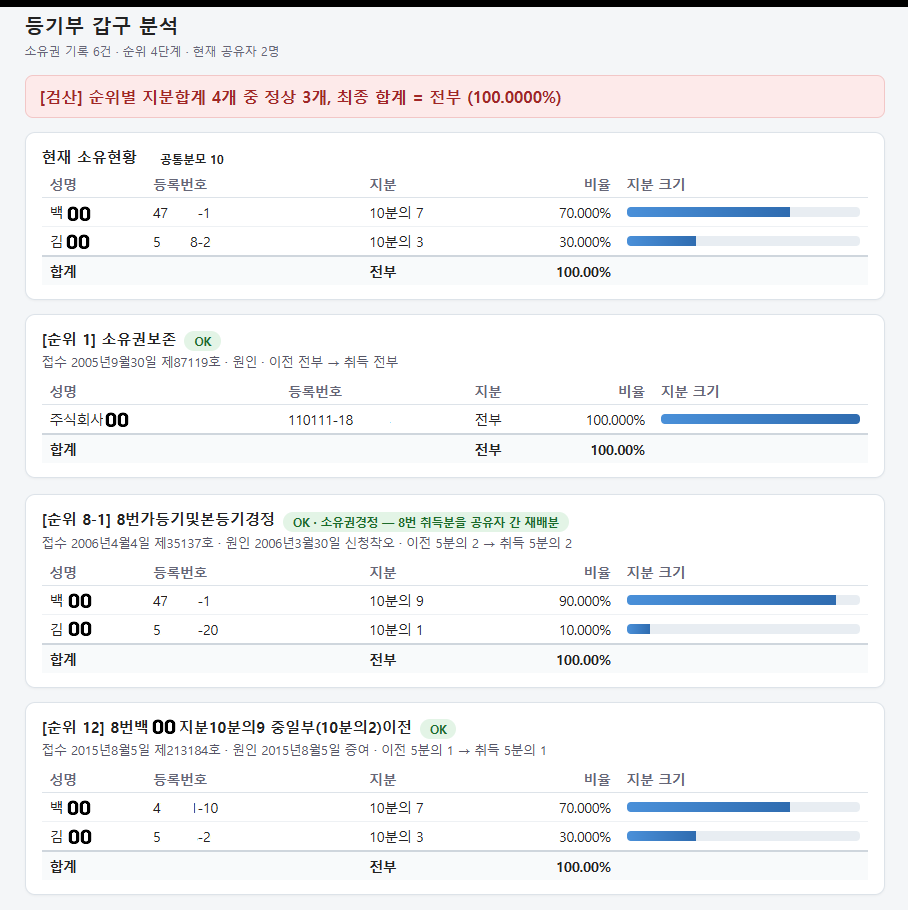
The new program automates that process. When a registry document retrieved from the electronic system is fed in, the program breaks down the ownership section by ranking number, automatically traces how shares passed from one rank to the next, and filters out entries unrelated to ownership — such as provisional registrations, seizures, cancellations and notation changes — to deliver, in under one second, the current ownership status (owner, share and percentage), the ownership history by ranking number, and a share verification table.
Each time a ranking number changes, the program automatically checks whether the ownership shares add up to 100 percent. If they do not, it flags the specific ranking where the discrepancy occurred, so staff only need to review that entry.
Particularly notable is that district staff built the program entirely using AI, with no outside contract or additional budget. AI was used only during the development phase to formalize the rules for reading ownership succession; the actual analysis of rights is carried out by the program applying those fixed rules, leaving no room for variable interpretation. Registry data is processed exclusively on a closed network and never leaves it, and the district separated the rule-building phase from the data-handling phase to strengthen information security.
Gangnam-gu completed the program's setup this month and plans to apply it first to cases that are most burdensome to verify — jointly owned properties and those where shares have been divided through inheritance or gifts — as part of a broader effort to clean up the property tax assessment ledger. Verification results will be preserved as the basis and record for each correction. From October, the district plans to expand the program's use to ownership verification tasks including acquisition tax filing reviews and checks on the rights status of properties with outstanding tax arrears.
The district expects the tool to cut the time needed to verify ownership rights from tens of minutes per case to one second, and to shift from spot-checking a sample of records to reviewing the entire dataset. By catching incorrect owners or ownership shares in advance, the program should reduce erroneous property tax assessments and cut the administrative burden of recalculating or refunding taxes after the fact.
"Property tax must be levied on the basis of accurate ownership and share information for residents to trust it," Gangnam-gu District Mayor Kim Hyun-ki said. "We will thoroughly overhaul the assessment ledger using a program we built ourselves with AI, at no cost to the budget." He added that the district would continue to pursue innovation and advance a taxpayer-centered, trustworthy tax administration.
seouldream01@heraldcorp.com