![The Korea Exchange after-market is open for trading at the KRX building in Yeouido, Seoul, on Monday. Korea Exchange launched the after-market session covering the Kospi and Kosdaq markets from 4 p.m. to 8 p.m. that day. [Yonhap]](https://wimg.heraldcorp.com/news/cms/2026/09/15/rcv.YNA.20260914.PYH2026091418660001300_P1.jpg)
"Honey, what are you looking at?" "Oh, nothing." Mr. Kim, a 38-year-old office manager who used to sneak peeks at his mobile trading app from a bathroom stall during work hours, settled onto his living room sofa Monday evening and pulled out his smartphone. It was past 7 p.m., but he could still buy and sell Samsung Electronics shares — because Korea Exchange had just launched its new after-market, allowing real-time trading until 8 p.m. after the close of the regular session.
KRX opened the new session Monday, replacing the previous after-hours single-price auction system with a continuous order-matching after-market running from 4 p.m. to 8 p.m. With 38 brokerages participating on the first day, the KRX after-market recorded 1.8 trillion won ($1.34 billion) in trading value — equivalent to 6.6 percent of KRX's total trading value for the day. Trading volume reached 72.24 million shares.
The KRX after-market's first-day volume narrowly surpassed that of NXT, which has operated a similar after-hours session since March last year. NXT runs its after-market from 3:40 p.m. to 8 p.m. — 20 minutes earlier than KRX's 4 p.m. start. NXT's after-market trading value on Monday came to 1.79 trillion won.
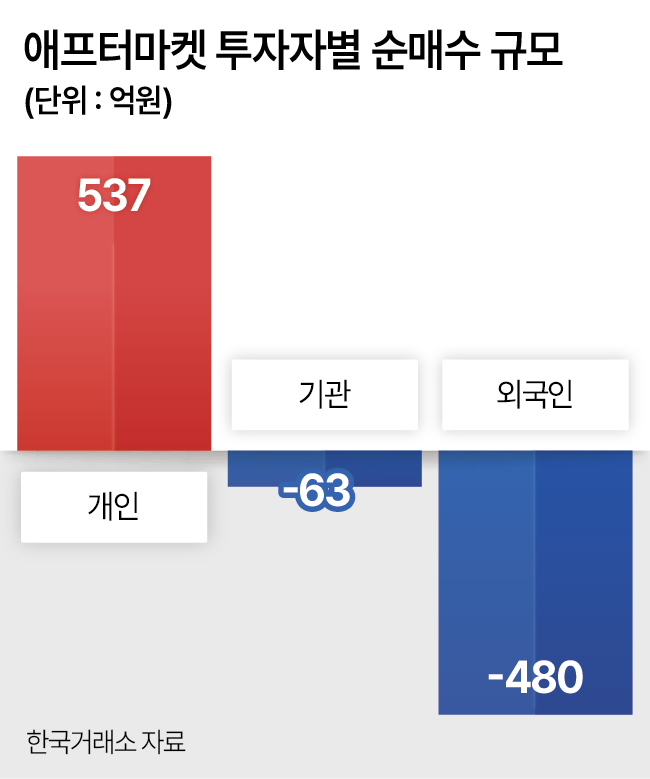
Retail investors effectively drove the first day of after-hours trading. Having already net-purchased more than 3 trillion won worth of shares during the regular session, they continued buying after the close. Retail investors accounted for 93 percent of total after-market trading value — about 1.67 trillion won. Institutional investors made up just 2.1 percent, or about 38 billion won, while foreign investors accounted for 3.9 percent, or about 70 billion won. In net terms, retail investors posted net purchases of 53.7 billion won, while institutions and foreign investors recorded net selling of 6.3 billion won and 48 billion won, respectively.
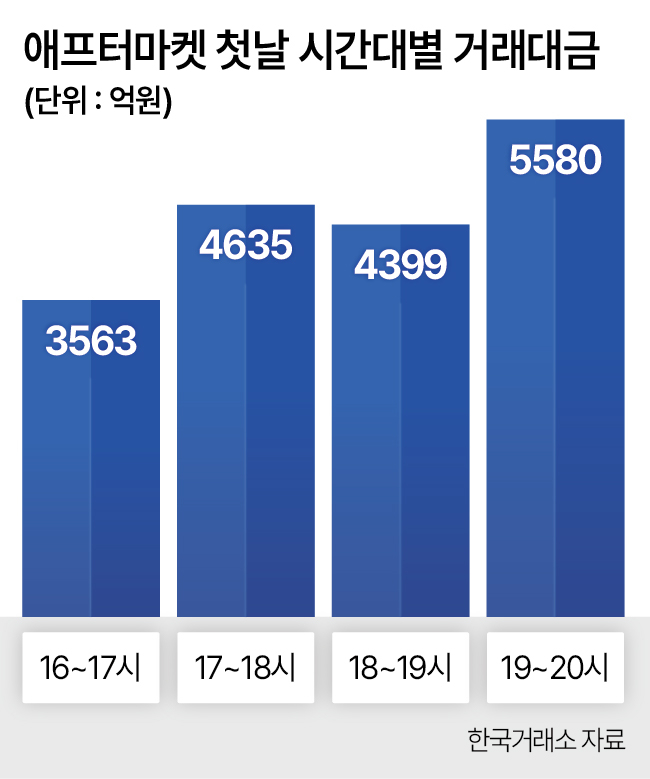
Trading was heaviest in the final hour before the 8 p.m. close, with the 7–8 p.m. slot accounting for 30.7 percent of total after-market volume — roughly one-third of the day's total. The 4–5 p.m. slot made up 19.6 percent, followed by 5–6 p.m. at 25.5 percent and 6–7 p.m. at 24.2 percent.
Mobile devices dominated trading activity. Some 73 percent of after-market transactions were executed via MTS or other wireless terminals, meaning more than seven in 10 trades were placed on a mobile device. The share handled through HTS, the PC-based home trading system, stood at 21 percent.
The launch of the KRX after-market significantly expanded the universe of stocks available for evening trading. Under the previous after-hours single-price auction system, trading was limited to roughly 600 listed stocks; the new session covers most Kospi and Kosdaq listings. On Monday, 2,501 stocks were eligible for after-market trading, and actual trades occurred in 96 percent of them — 2,413 stocks. Those stocks represented 99 percent of total market capitalization.
Overall price volatility was lower in the after-market than during the regular session. The high-low price range for individual stocks came to 2.9 percent on the Kospi and 4.6 percent on the Kosdaq, both below the regular-session figures of 4.1 percent and 5.8 percent, respectively. Still, volatility-interruption circuit breakers were triggered 1,637 times across individual stocks, indicating some price swings in specific names.
Among large-cap stocks, major semiconductor names extended their regular-session losses into the after-market. Samsung Electronics fell an additional 500 won, or 0.20 percent, to 248,500 won, widening its full-day decline from 4.05 percent to 4.24 percent. SK hynix dropped a further 14,000 won, or 0.82 percent, to 1.68 million won, pushing its daily loss from 6.35 percent to 7.12 percent.
Separately, a smart order routing error affected Mirae Asset Securities and Samsung Securities during the NXT pre-market session Monday morning. The SOR system compares trading conditions on KRX and NXT and routes orders to whichever market offers better terms for investors. Of the 14 brokerages using NXT's SOR, only those two experienced the glitch. Industry observers suggested the error may have stemmed from system changes made to extend SOR coverage to 8 p.m. in line with the KRX after-market launch. Both brokerages responded by routing their SOR orders through KRX after 4 p.m., and the KRX after-market session proceeded without any major system disruptions.

kacew@heraldcorp.com