Q2 global semiconductor sales top $425 billion, an all-time high
Memory chip share surges from 45% to 54%, crossing 50% threshold for first time
Semiconductor demand seen holding firm despite AI slowdown debate
Samsung Electronics, SK hynix combined operating profit forecast to rise sevenfold this year
![Samsung Electronics' headquarters in Seocho, Seoul, and SK hynix's main campus in Icheon, Gyeonggi Province. [Yonhap]](https://wimg.heraldcorp.com/news/cms/2026/09/15/news-p.v1.20260818.c1d8eb458d41475298a4e62d2117727f_P1.png)
Calls for slowing the pace of AI development have been growing among the heads of major AI companies, but the semiconductor industry — the backbone and biggest beneficiary of the AI boom — continues to post record-breaking growth.
Memory chips, the core component of AI hardware including HBM, have surged so sharply that their share of total global semiconductor sales has crossed 50% for the first time.
Analysts say that while concerns about AI may temporarily slow development and investment, they are unlikely to alter the broader upward trajectory of the semiconductor market.
Global semiconductor sales exceeded $425 billion (572 trillion won) in the second quarter, hitting an all-time high, according to market research firm Omdia. The quarter-on-quarter growth rate of 31.4% was the highest since Omdia began tracking the data. Cumulative semiconductor sales for the first half of this year reached $752 billion (about 1,013 trillion won).
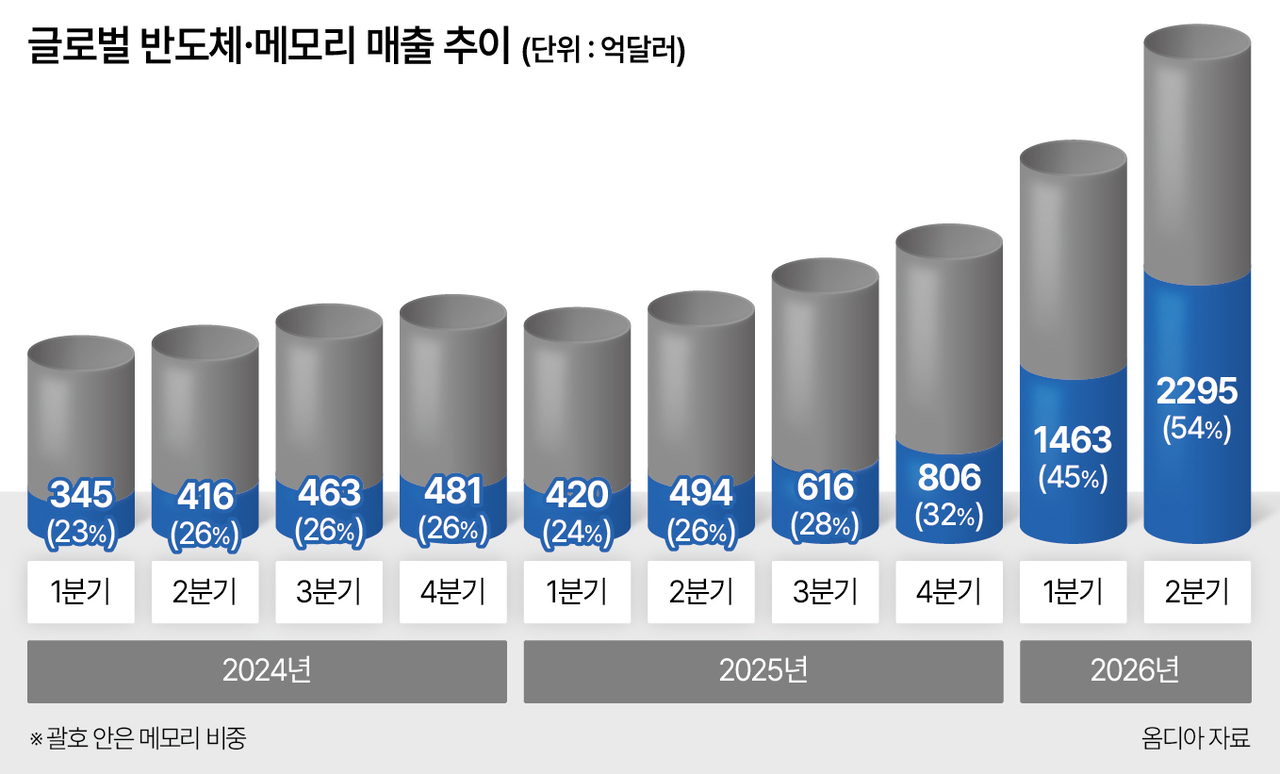
Memory chips drove the market's revenue growth in the second quarter, with their share of total global semiconductor sales crossing 50% for the first time.
Memory chip sales jumped from $146.3 billion in the first quarter — 45% of the total — to $229.5 billion in the second quarter, pushing the segment's share up to 54%.
Analysts attribute the surge to memory makers prioritizing high-value products such as HBM and server DRAM to meet soaring AI demand. A shift in production portfolios also left supply unable to keep pace with demand, pushing up average selling prices and further boosting revenue.
"DRAM, NAND and NOR flash memory all posted their highest second-quarter growth rates on record and achieved all-time quarterly revenue highs," Omdia said.
The AI-driven semiconductor boom is also extending beyond memory chips. The non-memory segment grew more than 10 percent quarter-on-quarter in the second quarter, overcoming typical seasonal headwinds.
Historical data from 2002 to 2025 shows that non-memory chips averaged just over 3 percent growth in the second quarter, making this year's performance exceptionally strong by comparison.
The microprocessor market, a key component of AI infrastructure, also expanded rapidly. MPU sales rose 16 percent quarter-on-quarter in the second quarter, far outpacing the typical seasonal growth rate of around 1 percent. AI data center investment is now lifting demand not only for HBM and DRAM but also for processors and other non-memory chips.
![Anthropic CEO and co-founder Dario Amodei speaks at an AI-related forum. Anthropic, which turned profitable in the second quarter of last year, is expected to post a second consecutive quarter of adjusted operating profit. [Getty Images]](https://wimg.heraldcorp.com/news/cms/2026/09/15/news-p.v1.20260914.54f2b3ac107346149946081ca9aa70c3_P1.jpg)
Amid the record growth, voices within the global AI industry have been calling for a slowdown, warning that humanity could lose control of AI systems and face existential risks. The debate has raised concerns about potential fallout for the domestic semiconductor sector.
Anthropic CEO Dario Amodei has led a chorus of warnings from top AI executives, joined by OpenAI CEO Sam Altman, xAI CEO Elon Musk and Google DeepMind CEO Demis Hassabis, all of whom have cautioned about the dangers of rapid AI advancement and called for slowing the pace of development.
Financial strain from massive AI investment is also adding weight to the slowdown argument. Capital expenditure by major technology companies has swelled to levels approaching their own cash generation capacity as competition to build AI data centers intensifies, and more firms are turning to corporate bond issuances and equity raises to fund additional investment.
UBS forecast that capital expenditure growth among major hyperscalers will slow from 76 percent this year to around 6 percent by 2028. The projection does not imply an absolute decline in investment, but rather that the explosive pace of growth seen recently cannot be sustained indefinitely.
Still, analysts expect the industry's upward trajectory to continue, even if the tempo slows temporarily, given that the AI development race is intertwined with the broader US-China technology rivalry.
President Donald Trump dismissed the AI slowdown argument, calling concerns about AI dangers "a hoax" and criticizing moves to slow AI development as politically motivated or driven by Chinese interests. Nvidia CEO Jensen Huang also said the United States can maintain its lead while developing AI safely at the same time.
Omdia's analysis shows that real demand in the semiconductor market remains on a steep growth curve. Of the 97 quarters Omdia has tracked since the first quarter of 2002, only 10 have seen quarter-on-quarter revenue growth exceed 10 percent. The four most recent consecutive quarters — from the third quarter of last year through the second quarter of this year — all posted double-digit quarter-on-quarter growth.
Omdia expects the trend to continue into the third quarter, projecting global semiconductor sales will surpass $500 billion (about 673 trillion won) and set yet another all-time record. That would represent growth of at least 17 percent from the $425 billion recorded in the second quarter.
Cumulative global semiconductor sales for the first three quarters of this year are forecast to exceed $1.25 trillion (about 1,683 trillion won) — roughly 50 percent more than total semiconductor sales for all of last year. Omdia said record quarterly revenues and a strong market environment are expected to persist for now.
Market consensus estimates put Samsung Electronics' operating profit for this year at around 392 trillion won and SK hynix's at 265 trillion won. Last year, Samsung Electronics posted operating profit of about 43.6 trillion won and SK hynix 47.21 trillion won, for a combined total of just over 90 trillion won. If the forecasts hold, the two companies' combined operating profit would reach 657 trillion won this year — more than seven times last year's figure.

go@heraldcorp.com