Bond-equity ETFs, which grew on the back of demand from retirement pension accounts, are losing their defensive edge. Rising interest rates have pushed bond prices lower, and a simultaneous equity market correction has weakened the diversification benefit of holding both asset classes together.
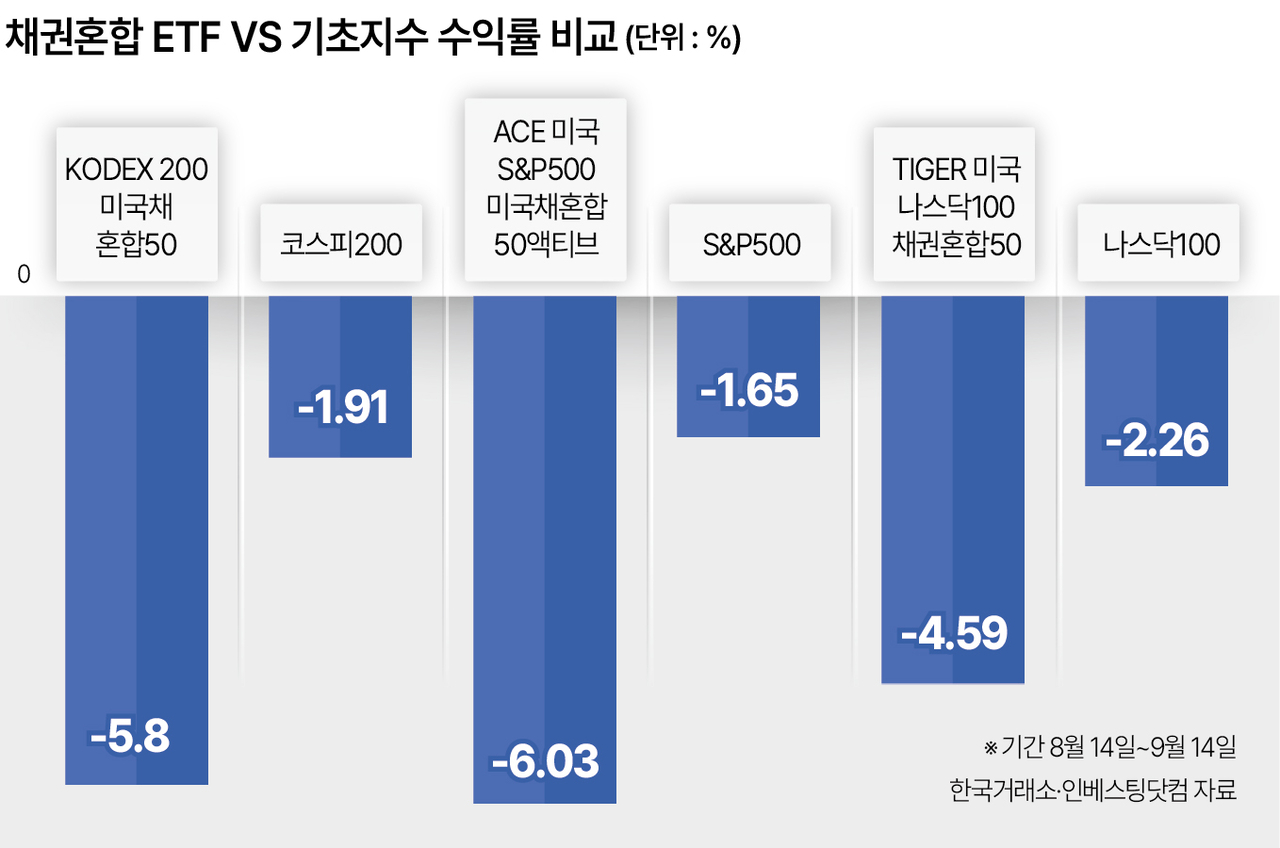
According to Korea Exchange data released Tuesday, the ACE US S&P500 Bond Mixed 50 Active ETF fell 6.03 percent over the past month — a decline 4.38 percentage points steeper than the S&P 500 index's drop of 1.65 percent over the same period.
The KODEX 200 US Bond Mixed 50 ETF slid 5.8 percent, outpacing the KOSPI 200's decline of 1.91 percent. The TIGER US NASDAQ 100 Bond Mixed 50 ETF fell 4.59 percent, or 2.33 percentage points more than the NASDAQ 100's drop of 2.26 percent.
Bond-equity ETFs hold both stocks and bonds to reduce portfolio volatility. Single-stock bond-equity ETFs can allocate up to 30 percent of their holdings to equities. Domestically listed examples include the KODEX Samsung Electronics Bond Mixed ETF and the ACE Nvidia Bond Mixed ETF.
Index-tracking bond-equity ETFs can raise their equity allocation to as much as 50 percent. A relaxation of retirement pension regulations at the end of 2023 lifted the equity cap for index-type bond-equity ETFs from 40 percent to 50 percent.
The KODEX 200 US Bond Mixed 50 ETF holds the KOSPI 200 and US 10-year Treasury futures in a 50-50 split. The TIGER US NASDAQ 100 Bond Mixed 50 ETF likewise divides its holdings equally between the NASDAQ 100 and government bonds.
Bond-equity ETFs are designed to reduce volatility by exploiting the historically low correlation between stocks and bonds. Recently, however, inflation fears and concerns over deteriorating fiscal positions in major economies have pushed interest rates higher, causing stocks and bonds to fall together more frequently. As the correlation between the two asset classes has risen, the diversification benefit has weakened — bonds have failed to cushion equity losses, and some bond-equity ETFs have posted steeper declines than the underlying stock indexes.
Products holding US Treasuries have been hit particularly hard. According to Investing.com, the yield on the 10-year US Treasury note climbed above 5 percent during trading Monday (local time), up from 4.69 percent on Aug. 14. When yields rise, existing bond prices fall, as newly issued bonds offer higher rates and make older, lower-yielding bonds less attractive.
Surging Treasury yields also weigh on equity markets. When the yield on US Treasuries — the benchmark safe-haven asset — approaches 5 percent, the relative appeal of riskier equities diminishes.
Park Woo-yeol, a researcher at Shinhan Securities, said at a press briefing at Korea Exchange in Yeouido, Seoul, that the classic 60-40 stock-bond strategy "is an old theory that no longer works well in today's market." He added: "There was an expectation that bonds would provide a buffer when stocks fell, but recently we are seeing stocks and bonds rise together and fall together."
The bond-equity ETF market has expanded rapidly this year. According to Korea Exchange, the number of bond-equity ETFs — excluding target-date fund ETFs — stood at 66 as of Friday, with net assets totaling 18.55 trillion won ($13.8 billion), up nearly 12 trillion won from 6.89 trillion won at the start of the year.
The range of products has also broadened. Six bond-equity ETFs combining Samsung Electronics or SK hynix shares with bonds have listed this year alone, and products pairing Kosdaq index exposure with bonds have recently entered the market as well.
The growth of bond-equity ETFs has been driven by the expansion of the retirement pension market. According to the Financial Supervisory Service, retirement pension reserves reached 501.4 trillion won at the end of last year, surpassing 500 trillion won for the first time after growing by about 70 trillion won from the prior year-end.
Defined-contribution and individual retirement pension accounts are subject to a 70 percent cap on risky asset investments. Qualifying mixed-asset products with an equity allocation of 50 percent or below are classified as safe assets and can be held at up to 100 percent of a retirement account's balance.
Investors who have maxed out the 70 percent risky-asset limit have increasingly turned to bond-equity ETFs to deploy the remaining 30 percent, accelerating inflows into the segment. The ETF market has absorbed demand from retirement pension investors seeking to maintain equity exposure while using bonds to dampen volatility.
An official at one asset management firm said investors should look beyond the equity allocation ratio when evaluating these products. "Since these are used as safe assets within retirement pension accounts, you also need to examine what bonds are held and how sensitive the product is to changes in interest rates," the official said.

moon@heraldcorp.com