Nominee says Gwacheon apartment was bought for actual residence
Pledges broad consultation on electric vehicle production tax credit
Stays tight-lipped on leveraged ETF meeting and national pension fund vote
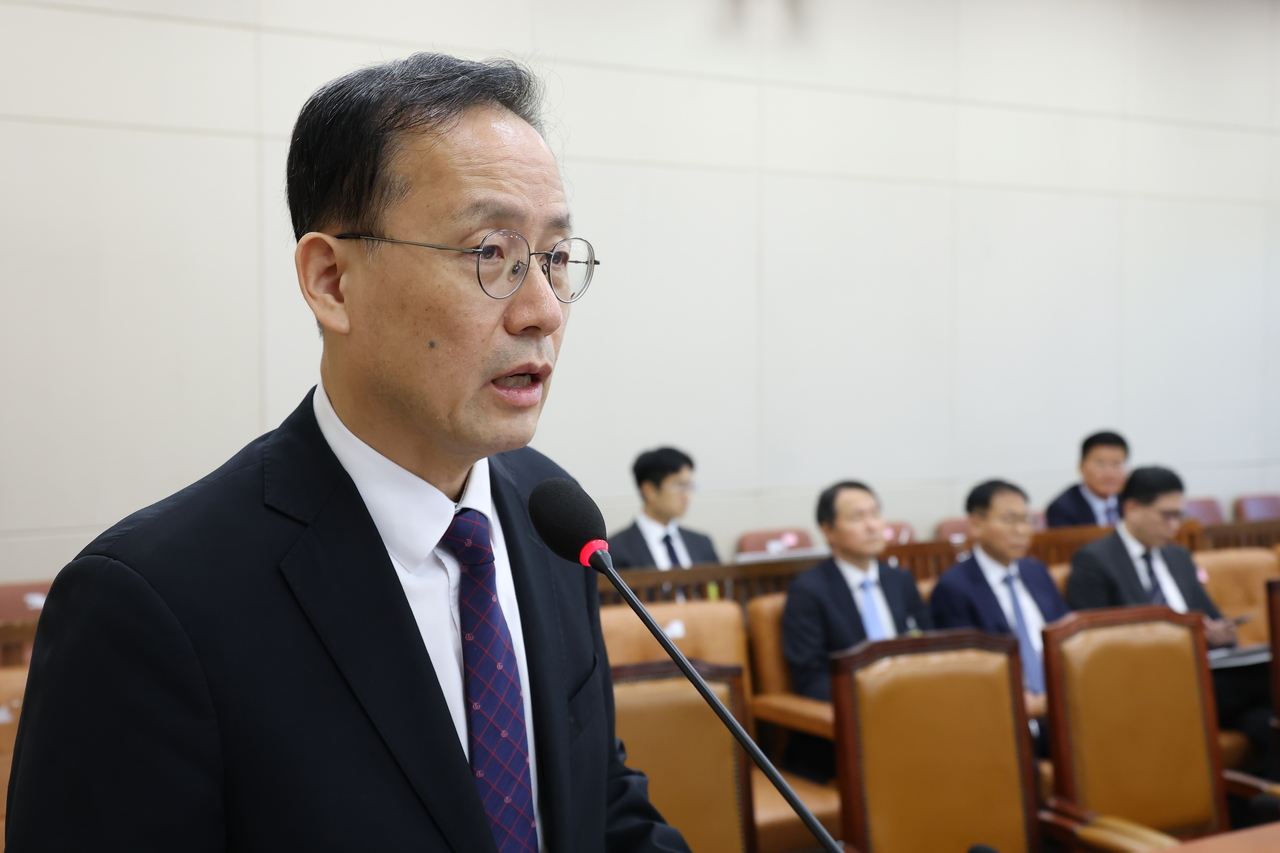
Lee Hyung-il, nominee for deputy prime minister and minister of economy and finance, expressed regret Tuesday over controversy surrounding his ownership of an apartment in Gwacheon, Gyeonggi Province, which records show he was registered as residing in for only four months over 17 years. "Regardless of the reasons, I am deeply sorry for the controversy caused by my non-residency and for falling short of the public's expectations," he said.
Lee made the remarks at his confirmation hearing before the National Assembly's finance and economy planning committee, after People Power Party lawmaker Park Soo-young raised questions about his housing situation.
According to the confirmation hearing request submitted to the National Assembly, Lee purchased the Gwacheon apartment in February 2009 and held it for 17 years, but his registered residency there totaled only four months — two months in 2012 and two months in 2018. The apartment has since been demolished as part of a reconstruction project.
Lee said he had bought the apartment with the genuine intention of living there. "Around January 2009, while I was living in Pyeongchon, I was notified to report for duty at Cheong Wa Dae," he said. "Because of the culture at the time — where you had to show up from the crack of dawn — I felt I needed to be somewhere close, so I quickly found a jeonse rental in Gwacheon in February 2009."
"Since I had decided to make Gwacheon, where the Government Complex is located, my place of residence, I bought an apartment there around April that suited my circumstances and that I intended to live in," he said. "However, because I had already secured a jeonse rental and was living there, I could not move into the purchased unit."
On questions about whether the purchase amounted to gap investment, Lee explained the sale price and jeonse deposit at the time. When Democratic Party of Korea lawmaker Moon Jin-seog asked about the figures, Lee said the sale price was around 420 million won ($312,000) and that he had found a tenant paying a jeonse deposit of about 110 million won. Moon remarked that the arrangement seemed "a bit ambiguous to call gap investment," to which Lee replied, "I bought it without any loans at the time."
Lee again apologized over the non-residency controversy, saying he was "sorry for causing concern to the public," but added: "I have been a single-home owner my entire life and held it for a long time. I wanted to keep living there, but circumstances made it difficult."
On the direction of housing policy, Lee reaffirmed a residency-first principle, saying he believed "it is necessary for a housing culture centered on actual residence to take root."
On the question of including electric vehicles in the domestic production tax credit, Lee said he would gather opinions from industry and the field comprehensively after taking office.
He explained that electric vehicles had been excluded from the production tax credit because the policy was designed to support sectors with a weak domestic production base. "From that perspective, the secondary battery sector is far more vulnerable, so supporting the production tax credit for secondary batteries would allow the benefits to flow through the value chain to electric vehicles, robots, energy storage systems and other sectors — making secondary battery support more efficient and effective," he said.
He added that any decision on electric vehicle support would require careful and comprehensive review of the original intent behind the tax regime, trade risks, and the policy direction of any purchase subsidies or fiscal support already in place.
"Recent global changes have pushed up the market share of imported electric vehicles, and I take seriously the industry's urgent message that the next two to three years are a critical period for the EV sector," Lee said. "If I am confirmed as deputy prime minister, I will gather opinions from multiple angles — looking at the impact on employment and regional economies in the auto industry, views from the field, and the tax principles underlying the system."
Lee declined to give specific answers about a closed-door meeting convened by the presidential office during the process of introducing single-stock leveraged ETFs. When People Power Party lawmaker Ahn Sang-hun asked whether Lee had attended the meeting and voiced opposition to the introduction of leveraged ETFs, Lee said the gathering "was a meeting convened by Cheong Wa Dae" and that "the attendees and key contents are not currently being disclosed."
Lee also declined to reveal the position he had taken at a meeting of the national pension fund management committee regarding a proposal to raise the target allocation for domestic shares. "That meeting was voted to remain confidential for four years, given the circumstances at the time and the significant impact it could have on financial market stability," he said. "I am not in a position to disclose what was discussed inside."
y2k@heraldcorp.com