Semiconductor supply to begin in earnest in 2028
Production of rare gases launched in Gwangyang in May
Capacity built to meet roughly half of domestic demand
Supply talks underway with major European and US satellite firms
Neon surged 27-fold, xenon tripled after Russia-Ukraine war
Rare gas joins lithium as part of strategic resource push
![Posco Group Chairman Cho Hyun-joon delivers a commemorative address at the completion ceremony for Posco Air Solution's high-purity rare gas production factory at the Dongho-an site of the Gwangyang steelworks in South Jeolla Province on June 17. [Posco Group]](https://wimg.heraldcorp.com/news/cms/2026/09/15/news-p.v1.20260915.3f8087cafd864f889279e544175a2f75_P1.png)
Posco Group is moving to develop rare gases as its next strategic resource business, following lithium and rare earths. Posco Air Solution began producing xenon, krypton, neon and helium in Gwangyang this year and plans to supply the semiconductor industry in earnest from 2028, with a target of 200 billion won ($149 million) in annual sales by 2030.
Kim Dae-yeon, chief executive of Posco Air Solution, recently laid out this business roadmap through an investor relations channel, according to industry sources Tuesday.
"It takes about a year for semiconductor customers to verify gas quality and suitability for their processes," Kim said. "We plan to complete quality verification next year and begin full-scale supply of rare gases for semiconductors from 2028."
Kim set the 2030 annual sales target at 200 billion won but added the caveat that the figure is based on current prices, leaving open the possibility that revenue could exceed the target if prices rise due to growing demand or renewed supply chain disruptions from geopolitical factors.
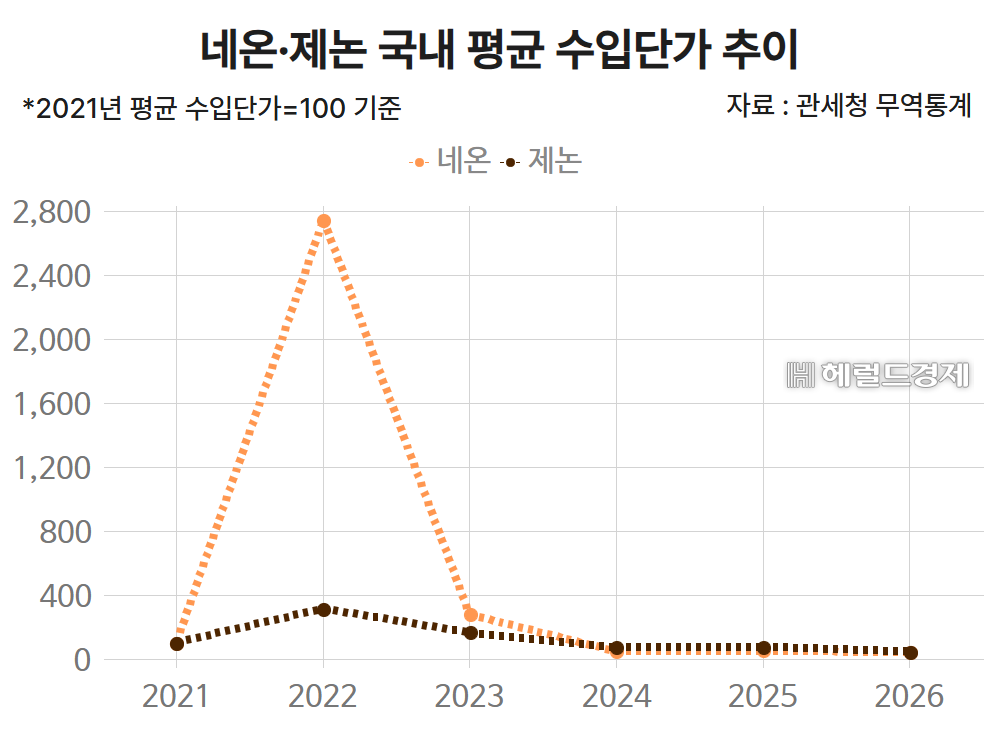
Rare gas prices have in fact surged several times over — and in some cases dozens of times — when supply chain shocks occur. According to Korea Customs Service trade statistics, the average import price of neon entering South Korea jumped 27.4-fold, from $58.7 per kilogram in 2021 — just before the Russia-Ukraine war — to $1,612.4 in 2022. Over the same period, xenon rose 3.1-fold, from $2,925 to $9,136 per kilogram.
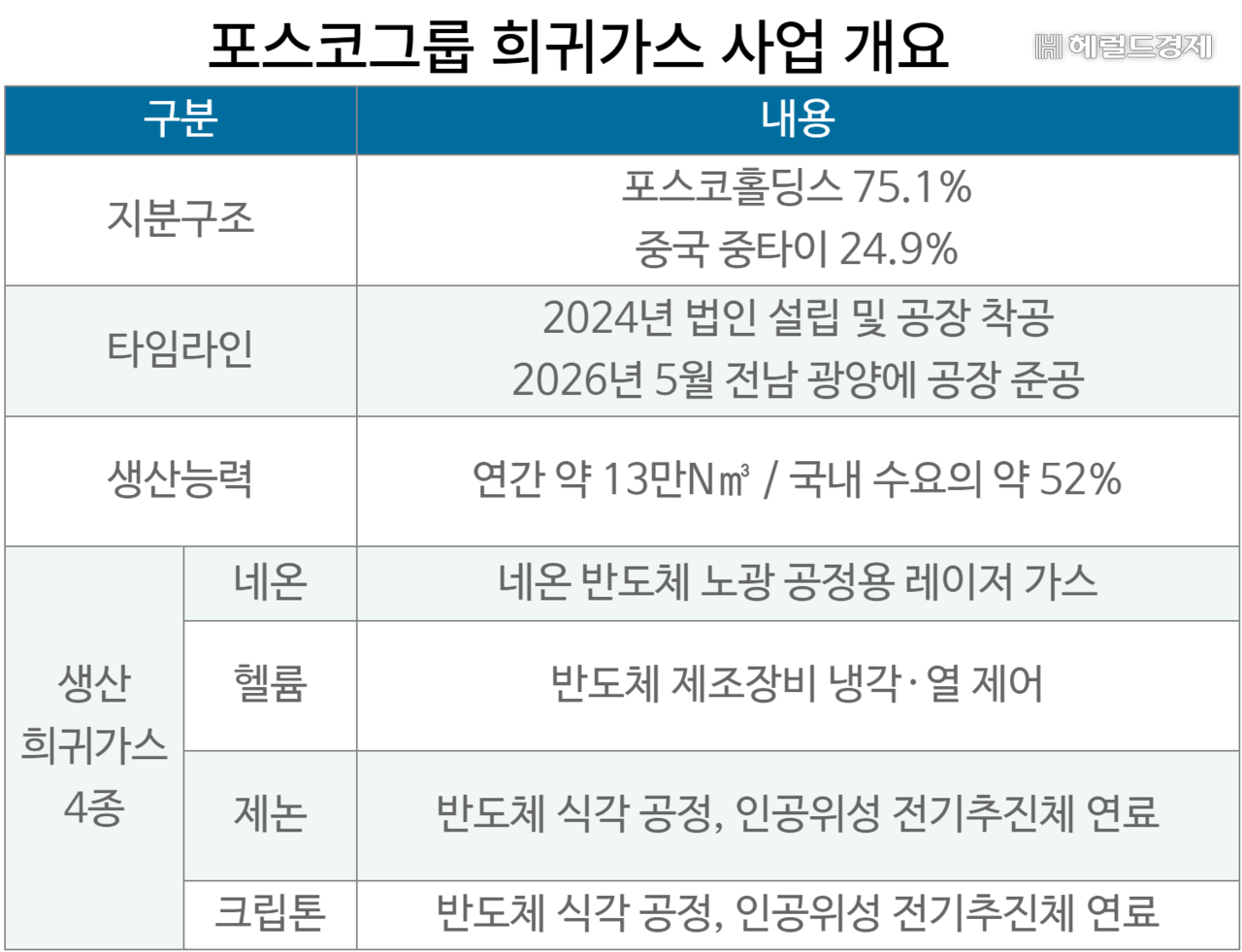
Posco Air Solution completed its production factory in Gwangyang, South Jeolla Province, in May and began mass production of four rare gases: xenon, krypton, neon and helium. The company is a joint venture in which Posco Holdings holds a 75.1 percent stake and China's Zhongtai holds the remaining 24.9 percent.
Rare gases exist in only trace amounts in the atmosphere but are indispensable materials for advanced industries. Neon is used in laser gases for semiconductor lithography processes, while helium is used for cooling and thermal control in semiconductor equipment. Xenon and krypton are also used in semiconductor etching processes.
Xenon and krypton are also used as fuel for electric propulsion systems in satellites. The gases are ionized and then rapidly expelled using an electric field to generate thrust. Xenon offers the advantage of high propulsion efficiency, while krypton is gaining wider use for its cost-effectiveness.
Posco Air Solution has been moving quickly to target the aerospace market since the factory opened. The company had been in discussions with the Korea Aerospace Research Institute even before the facility was completed, and supplied prototype xenon and krypton produced at opening for performance tests conducted in June. The gases were subsequently certified in July as suitable fuel for satellite electric propulsion systems. On July 21, the company also became the first in Asia to obtain AS9100 certification, the aerospace quality management system standard.
Discussions on entering overseas markets have also begun. "We have supplied samples to most domestic satellite companies," Kim said. "We are also in early-stage talks with major satellite companies in Europe and the United States on product supply terms and conditions."
![Posco Air Solution CEO Kim Dae-yeon (left) and Lloyd's Register Korea branch CEO Lee Il-hyeong pose for a photo at an aerospace and defense quality management system certification ceremony held at Posco Center on Aug. 6. [Posco Air Solution]](https://wimg.heraldcorp.com/news/cms/2026/09/15/news-p.v1.20260807.01b4493e645447a59b0533d29c2f651d_P1.jpg)
Posco's steelmaking operations underpin its ability to enter the rare gas business. Steel production requires large volumes of oxygen to raise the temperature of molten iron and remove impurities, and nitrogen to evenly mix components and protect equipment — meaning steelworks are already equipped with large-scale oxygen production facilities.
Posco Group envisions a value chain in which raw materials secured from Posco are separated and refined to produce rare gases such as xenon, krypton and neon, which are then supplied to the semiconductor and aerospace industries. This is part of the "lithium-plus" strategy championed by Posco Group Chairman Cho Hyun-joon, which aims to expand the group's strategic resource businesses from lithium — including cathode and anode materials, recycling and rare earths — to rare and specialty gases.
The company also aims to contribute to supply chain stability for South Korea's advanced industries by localizing rare gas production. The country has until now relied almost entirely on imports for rare gases. During the Russia-Ukraine war in 2022, Russia restricted rare gas exports to unfriendly nations, making price spikes and supply instability a reality. After Ukrainian supplies were cut off, dependence on China again increased.
![From left: Posco President Lee Hee-geun, Gwangyang Mayor-elect Park Sung-hyun, Posco Group Chairman Cho Hyun-joon and Gwangyang Mayor Jeong In-hwa tour Posco Air Solution's high-purity rare gas production factory in Gwangyang, South Jeolla Province, on June 17. [Posco Group]](https://wimg.heraldcorp.com/news/cms/2026/09/15/news-p.v1.20260915.1029a4ba74d244d78787c4b8ddba7142_P1.png)
The government has designated rare gases as a supply chain stabilization item and has been pursuing domestic R&D, production capacity expansion, recycling and stockpiling, and diversification of import sources. Posco Group's strategy aligns with this broader push for supply chain self-reliance.
"Rare gases are absolutely essential for semiconductors and satellites, but the number of countries that can supply them is limited," Kim said. "If supply is disrupted, it is not just a matter of price — it could have a significant impact on South Korea's advanced industries and semiconductor sector."
Posco Air Solution's current production capacity is sized to meet roughly half of domestic demand based on 2024 figures. Posco Group plans to review further capacity expansion depending on future market demand and profitability.
"Posco's 'resource patriotism' strategy, which started in steel, is expanding beyond secondary battery materials into core resources for semiconductors and aerospace," an industry official said. "Localizing rare gas production carries significance both as a new business and as a means of stabilizing the advanced industry supply chain."

kwater@heraldcorp.com