Conversion window for legacy apartment subscription accounts extended by one year
Rising cancellations shrink key funding source for Housing and Urban Fund
Move aims to shore up finances ahead of expanded public housing supply
![A citizen examines a model at a show unit for a newly built apartment complex. [Yonhap]](https://wimg.heraldcorp.com/news/cms/2026/09/15/news-p.v1.20251018.8bee12fe7adc4517983b88da63a8e316_P1.jpg)
The government will extend by one year the deadline for holders of legacy housing subscription accounts — including apartment subscription deposits, installment savings accounts and public housing savings accounts — to convert them into the all-in-one housing subscription savings account. The move comes as a surge in account cancellations, driven by rising pre-sale prices and higher interest rates, has eroded the balance of housing subscription savings accounts, a key funding source for the Housing and Urban Fund.
One more year to convert to all-in-one housing subscription account
According to government sources Tuesday, Korea Housing and Urban Guarantee Corporation recently asked the Ministry of Land, Infrastructure and Transport to approve an amendment to its operational guidelines that would extend the conversion window by one year.
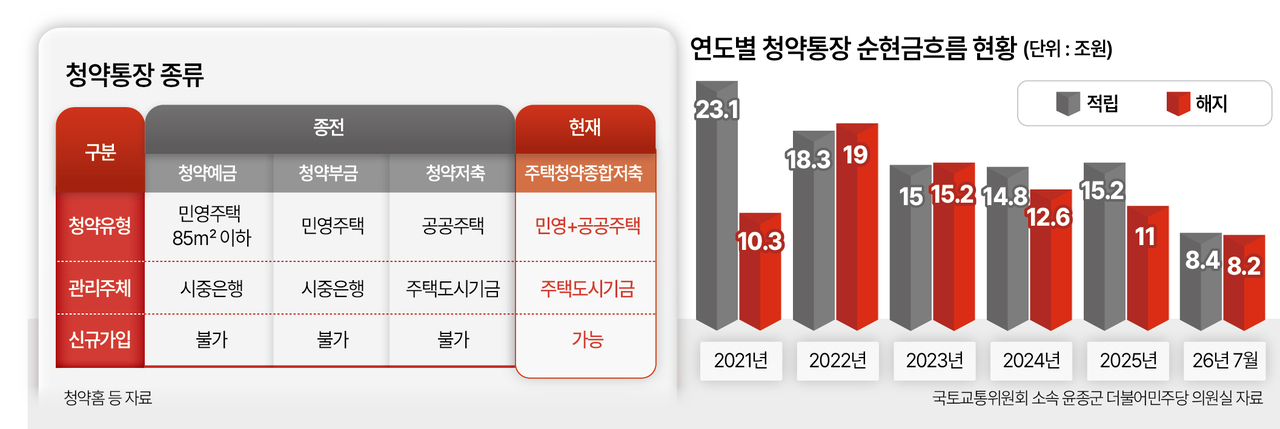
Housing subscription accounts used when applying for apartment pre-sales fall into four main categories: the apartment subscription deposit account, the installment savings account, the public housing savings account and the all-in-one housing subscription savings account. The deposit and installment accounts can only be used to apply for privately built housing, with the installment account further restricted to units of 85 square meters or smaller. The public housing savings account is limited to public housing applications.
The all-in-one housing subscription savings account, by contrast, allows holders to apply for both public and private housing, giving subscribers a broader range of options. The Ministry of Land, Infrastructure and Transport had previously raised housing subscription account interest rates in September 2024 and, at the same time, allowed holders of the older account types to convert them into the all-in-one account.
The initial conversion window was set to run through September 2025 but was extended by one year, meaning the deadline is now approaching at the end of this month. "The intent is to encourage conversion to the all-in-one account and expand subscription opportunities for prospective buyers," a housing finance industry official said.
Warning signs for Housing and Urban Fund ahead of public housing push
The government's decision to extend the conversion deadline is rooted in the need to shore up the Housing and Urban Fund. While apartment subscription deposit and installment accounts are held at commercial banks, converting them into the all-in-one account channels those funds into the Housing and Urban Fund.
The public housing savings account has long served as a core funding source for the Housing and Urban Fund, but a sharp drop in new subscribers and a rise in cancellations have set off alarm bells. A shrinking fund would leave the government with less financial capacity to build public rental housing, offer low-interest home loans and provide financing for housing developers — all key pillars of housing stability for lower-income households.
Data submitted by Korea Housing and Urban Guarantee Corporation to the office of Democratic Party lawmaker Yun Jong-gun, a member of the National Assembly's Land, Infrastructure and Transport Committee, showed that as of July, housing subscription accounts held 8.4 trillion won ($6.24 billion) in deposits, but 8.2 trillion won had been withdrawn through cancellations, leaving a net increase of just 200 billion won. That is a sharp decline compared with net increases of 2.2 trillion won in 2024 and 4.1 trillion won in 2025.
The contribution of subscription account deposits to the Housing and Urban Fund has also been shrinking. Data obtained through Korea Housing and Urban Guarantee Corporation by the office of Democratic Party lawmaker Jang Jong-tae showed that in 2025, subscription account deposits contributed approximately 15.2 trillion won to the fund — only 400 billion won more than the previous year's 14.8 trillion won. Compared with 2020, when contributions reached 21.2 trillion won, the figure has fallen by 6 trillion won, or 28.3 percent.
![An apartment subscription applicant checks lottery results on the housing subscription portal using a laptop. [Image generated with ChatGPT]](https://wimg.heraldcorp.com/news/cms/2026/09/15/9/news-p.v1.20260904.6a5b476932e14e9c85d460f07997b1b1_P1.png)
The government appears to be seeking to draw in subscription account holders who have yet to convert in order to bolster the Housing and Urban Fund. With the government signaling its commitment to breaking ground on large-scale public housing projects and strengthening the residential safety net, the move is an effort to secure the necessary funding in advance.
For account holders, converting to the all-in-one account would not only open up eligibility for all housing types but also bring a higher interest rate, income deduction benefits and the ability to combine a spouse's account tenure — advantages the government has highlighted to encourage the switch.
However, some have noted that even with expanded subscription eligibility, the incentive to convert may be diminished because subscription credits for newly eligible housing types are counted only from payments made after conversion. For example, a holder who made 240 months of payments into a public housing savings account and then converted and made 12 additional payments would have all 252 months of payments and amounts recognized for public housing applications, but only the 12 post-conversion months counted for private housing applications.
Park Ji-min, head of Wolyong Apartment Subscription Research Institute, said the government's primary goal is to increase public pre-sales on new residential land including third-generation new towns, so prospective buyers looking to improve their chances of winning a subscription lottery would be better off converting to the all-in-one account. "However, in speculative overheating zones, applicants need to have held a subscription account for at least two years to qualify for first-priority status," Park said. "So those targeting Seoul subscriptions would be better off keeping their existing deposit or installment account."
hss@heraldcorp.com