Herald Business-Daeryuk Aju labor and safety law forum
Choi Hong-gi, Korea Employment and Labor Education Institute professor
Harassment-linked illness or death can qualify as serious industrial accident
Subordinates can be perpetrators if they exploit relational advantage
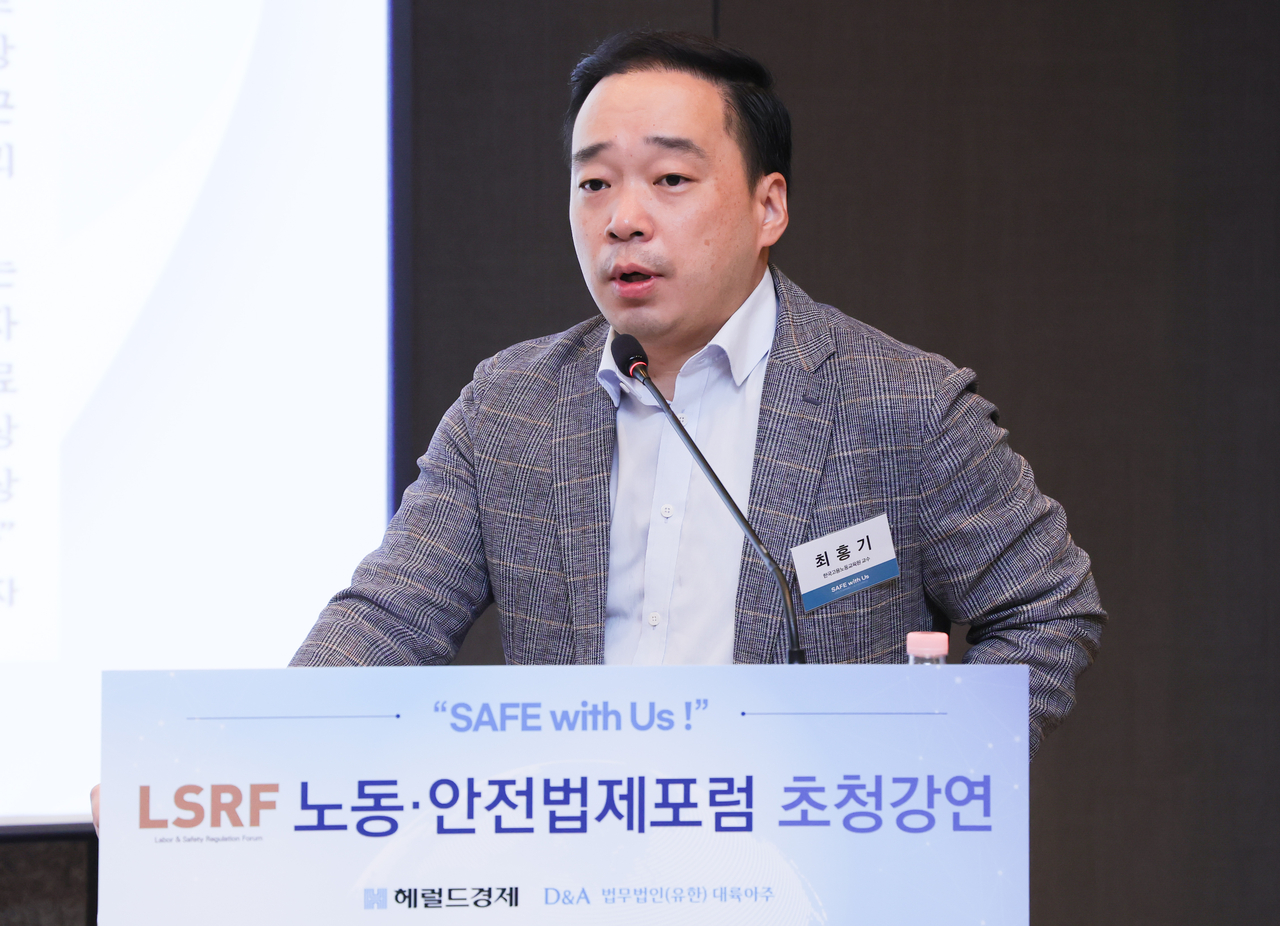
Workplace harassment should be treated not as a simple interpersonal conflict but as a legal and organizational risk that companies must manage proactively, an expert said Wednesday. With cases of subordinates using collective or relational leverage to harass their superiors on the rise, companies need to build prevention and management systems covering the entire organization regardless of rank, he said.
Choi Hong-gi, a professor at the Korea Employment and Labor Education Institute, made the remarks at an invited lecture during the "Labor and Safety Law Forum on Serious Accident Prevention," co-hosted by The Herald Business and law firm Daeryuk Aju at The Plaza hotel in Jung-gu, Seoul. "Workplace harassment is a hazardous risk factor that arises within the workplace," Choi said. "Rather than responding after an incident occurs, it is important to build a system that diagnoses, prevents and manages the risk in advance."
Choi, who lectured on "Key Issues and Practical Responses to Workplace Harassment Through Recent Cases," previously served as a visiting researcher at the Presidential Future Planning Committee and as an expert member of the Economic, Social and Labor Council. He currently sits on the specialized harassment judgment committees at the Busan and Daejeon Employment and Labor Offices and serves as a public-interest member on the Gangwon Province Regional Labor Relations Commission.
Choi urged companies to treat workplace harassment as an occupational safety risk. "If the perpetrator is a manager or officeholder within the company, the company itself could be held jointly liable for failing to actively prevent and manage the behavior," he said. "Not only the individual but also the company can be held liable for damages, which is why risk must be managed as a matter of prevention."
He also said workplace harassment can go beyond organizational conflict to constitute a serious industrial accident risk. "If a worker dies or develops a causally linked illness as a result of harassment, it can be recognized as a serious industrial accident," Choi said. "That makes workplace-level prevention and hazard management essential."
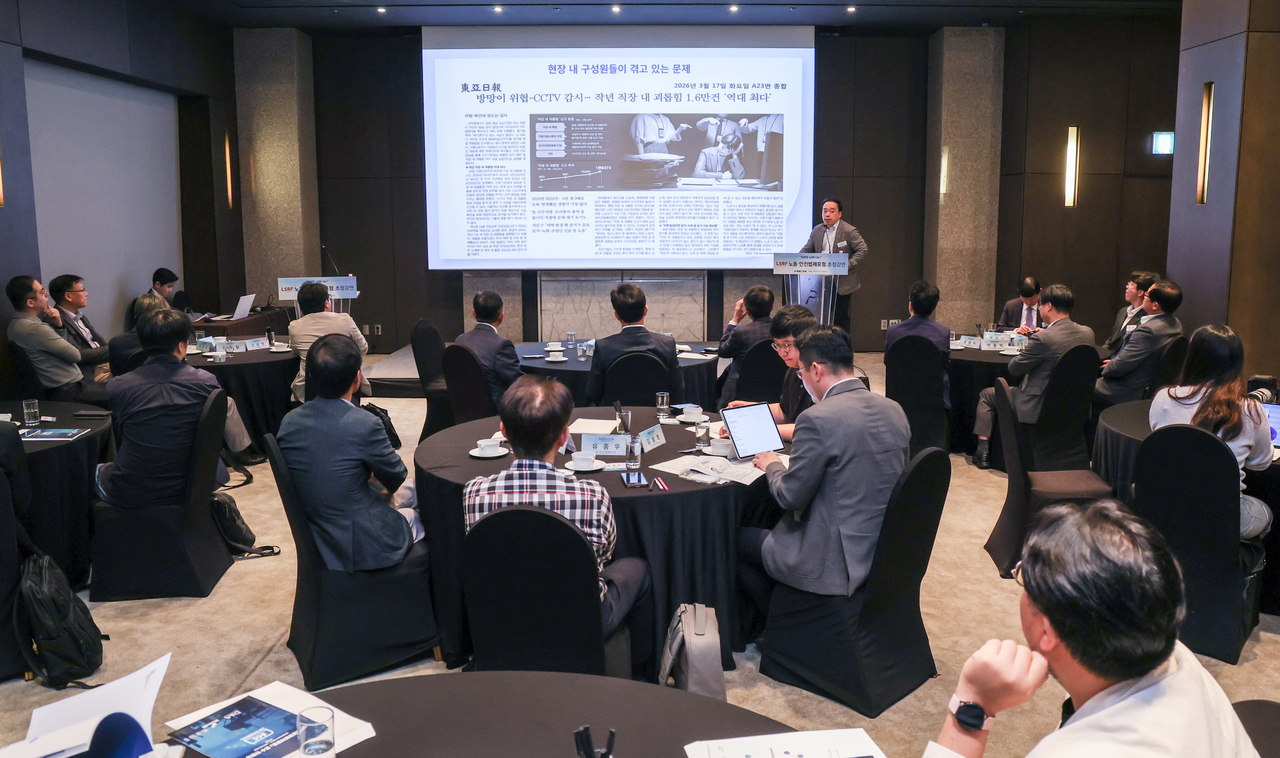
Cases that break from the traditional pattern of superiors harassing subordinates are also becoming more common. "The typical pattern is a superior harassing a subordinate, but cases of subordinates harassing superiors are increasing," Choi said. "Because subordinates are often a group or a majority while the superior or officeholder is an individual, a relational advantage stemming from numbers can be established."
Court rulings have also shown a growing tendency to interpret "relational advantage" broadly, looking beyond formal rank. Choi cited cases in which subordinates were found to have committed harassment by demeaning or insulting a superior's title, spreading discord, or pressuring the superior to join a union. He also noted that using a superior's internal reputation or workplace standing against them — in effect exerting influence over that person — can constitute harassment when the severity and repetitiveness of the conduct are taken together.
However, Choi stressed that not every unpleasant experience or conflict at work qualifies as harassment. "Distress is not harassment," he said. "Harassment is a new category of unlawful conduct regulated by law, and there must be substantial grounds to conclude that labor rights or personal rights have been violated." He added that simply feeling displeased or dissatisfied does not establish harassment, and that the legal threshold recognized by the courts is considerably higher.
He also said that when assessing whether harassment has occurred, individual acts should not be evaluated in isolation but in their full context. Private errands or instructions with no legitimate business purpose can be recognized as harassment, and even work-related conduct can become problematic if carried out through verbal abuse, insults or other means that fall outside accepted social norms. By contrast, a superior returning a document for approval or ordering corrections to fix a work error — where legitimate business necessity and proportionality are present — would generally not be considered harassment.
Choi also called on companies to establish clear principles around the misuse or abuse of the right to file harassment complaints. "The law broadly protects the right to file complaints, but it does not recognize complaints that are not legitimate," he said. "There are cases in which disciplinary dismissal has been upheld where an employee pressured a company by threatening to file a harassment complaint in order to receive unemployment benefits, or where an employee filed a false complaint and fabricated evidence to avoid disciplinary action."
He said companies should make clear the CEO's commitment to eradicating harassment, update their employment rules and internal regulations, and conduct advance checks on organizational culture, work practices, and departments, job categories or age groups where incidents recur. "Workplace harassment training should move beyond explaining concepts and instead provide specific guidance on the company's own rules, prohibited conduct, and the reporting, investigation and response process," Choi said.
"Workplace harassment is not simply a matter between individuals — it is an organizational issue," he said. "Examining whether the organization's communication style, leadership, division of duties, and allocation of authority and responsibility are functioning properly, and diagnosing and improving organizational culture, is the fundamental purpose the system is designed to serve."
eyre@heraldcorp.com