Owner-occupancy exemptions account for just 4% of land-transaction permit applications in Seoul
North of Han River districts trail Gangnam 3 and Yongsan-gu at 3.8% vs. 5.7%
Ruling party pushes to extend exemption period, but experts see limited impact
![Apartment buildings in Seongdong-gu, Seoul, seen on Tuesday. [Herald Business DB]](https://wimg.heraldcorp.com/news/cms/2026/09/16/news-p.v1.20260909.f53aab7b7c304e7ea09122a705664785_P1.jpg)
Although the government extended its owner-occupancy exemption within land-transaction permit zones in May — effectively allowing the purchase of tenanted apartments — the market has seen little actual activity in such transactions. The trend is especially pronounced north of the Han River, where loan-dependent first-time buyers have shown little appetite for tenanted listings, put off by the difficulty of coordinating move-in dates with existing tenants and the added burden of financing. End-users appear to be concentrating on properties where they can move in immediately.
According to the Seoul Metropolitan Government, owner-occupancy exemption applications accounted for 4.5 percent — 135 cases — of the 3,012 new land-transaction permit applications filed for Seoul apartments in August, a rate that held flat for two consecutive months. That figure is sharply lower than the 21.7 percent share — 4,906 cases — recorded between March and the first week of May, when multi-home owners were actively listing properties.
The share of tenanted-listing transactions is higher in high-priced apartment clusters such as the Gangnam 3 districts and Yongsan-gu than in the 10 districts north of the Han River. In August, the owner-occupancy exemption rate among land-transaction permit applications stood at 5.7 percent, or 20 cases, in the Gangnam 3 districts and Yongsan-gu, compared with 3.8 percent, or 56 cases, in the 10 northern districts.
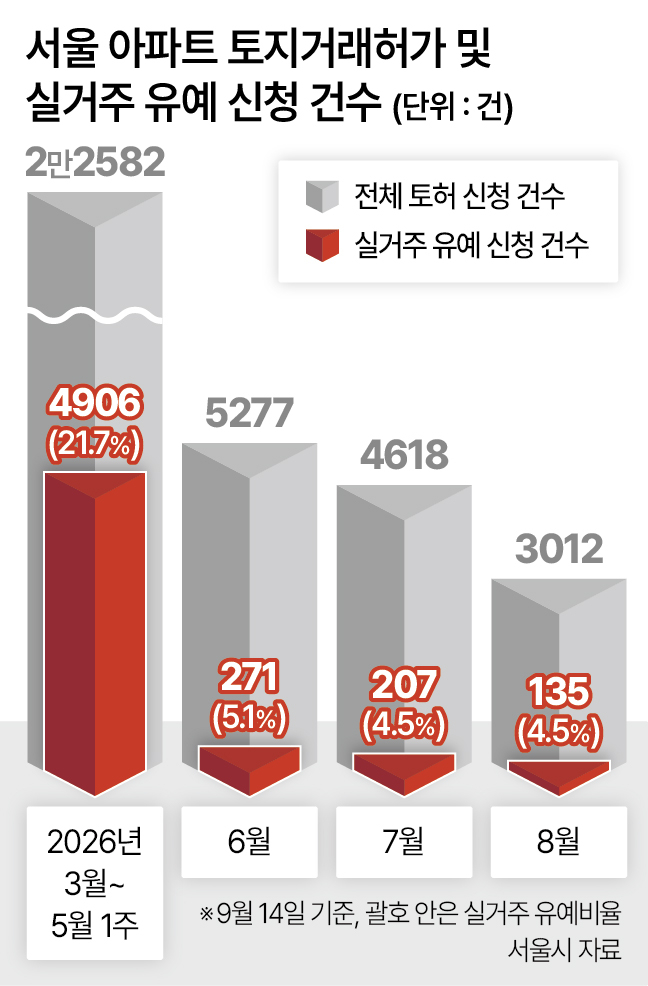
About half of August's 1,471 land-transaction permit applications came from districts north of the Han River, yet exemption requests there lagged behind Gangnam — a sign that loan-dependent buyers without homes of their own are gravitating toward listings where they can move in right away.
Purchasing a tenanted apartment is more complicated than a standard transaction: the buyer must time the move-in to the tenant's lease expiration and must satisfy stricter eligibility and financing requirements.
Even in Gangnam, the share of tenanted-listing transactions has declined since June. The owner-occupancy exemption rate in the Gangnam 3 districts and Yongsan-gu fell from 9.6 percent in June to around 5 percent from July onward. Experts say that although the government opened a path for tenanted-listing sales, practical obstacles prevented a meaningful increase in supply, and transaction volume has since contracted.
"Multi-home owners largely finished listing their properties around May, so what remains is mainly stock from single-home owners who do not live in the unit," said Yoon Ji-hae, head of the research lab at Real Estate 114. "The absolute total volume of tradable listings has not grown."
Nam Hyeok-woo, a real estate researcher at Woori Bank, said restrictions on eviction-fund loans have limited the number of deals that can close on tenanted properties. "Sellers can also transact more smoothly and command relatively higher asking prices when the unit is vacant, so record-price deals keep clustering around empty homes," he said.
The Seoul Metropolitan Government noted that the share of exemption applications has remained low even after the eligible pool was expanded, and said the government's decision has not translated into a clear increase in housing transactions. After the government announced its tax reform package, the number of Seoul apartment listings climbed back above 70,000 this month, according to the real estate platform Asil, but much of the new supply is concentrated in high-priced clusters such as the Gangnam 3 districts and the Han River belt. Even when those properties come to market as tenanted listings, their high price tags make financing difficult, putting them out of reach for most first-time buyers.
The Democratic Party of Korea proposed to the government on Tuesday that the current two-year owner-occupancy exemption applied within land-transaction permit zones be extended through 2031. The party said the move was intended to ease housing insecurity for existing tenants and give more flexibility to those unable to occupy their units immediately, as a "triple rise" — simultaneous increases in home prices, jeonse and monthly rent — continues to intensify.
Industry insiders, however, expect even that measure to have only a limited effect. "If a large complex of 1,000 units once had 100 tradable listings, land-transaction permit rules and lending restrictions have now cut that number to just a few dozen," Yoon said. "Extending the owner-occupancy exemption does not increase the absolute supply of listings — it simply adds another detour for transactions, so the real-world impact will be minimal."
hope@heraldcorp.com