- Joint team beats 112 rivals at ECCV 2026, achieving 90.7% destination success rate
- Self-correcting AI resumes search when robot takes a wrong turn, with applications in guidance and logistics physical AI
A South Korean robot AI technology that understands spoken instructions and navigates unfamiliar spaces on its own has claimed first place at an international competition. The technology is expected to serve as a core component of physical AI — systems that understand and act on human commands in real-world environments — for applications ranging from guide robots for the visually impaired to manufacturing and logistics robots.
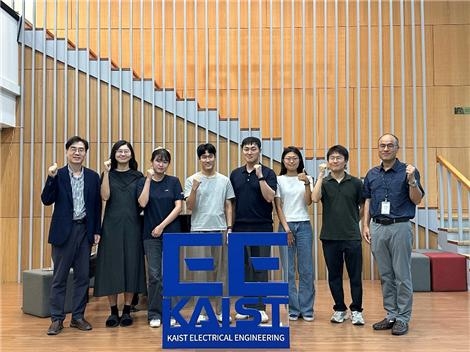
The Electronics and Telecommunications Research Institute (ETRI) announced Wednesday that a joint team it formed with KAIST won first place among 112 competing teams at the VLNVerse Challenge, held as part of ECCV 2026, a leading international computer vision conference in Malmö, Sweden.
Vision-and-language navigation, or VLN, enables a robot to understand natural-language commands, survey its surroundings through a camera, and travel to a destination on its own — without requiring anyone to manually input a route or build a detailed map in advance. The robot finds its way by simultaneously processing spoken instructions and the physical space in front of it.
ETRI's Field Robotics Research Laboratory and the research team of Myung Hyun, a professor in the Department of Electrical Engineering at KAIST, competed as the joint team URL-FRRS. The team recorded an average success rate of 90.7% across two tasks: "object search," in which the robot determines its own route given only a destination, and "detailed navigation," in which it sequentially interprets and carries out multi-step instructions. Although the second-place team posted the same success rate, URL-FRRS claimed the top spot based on an earlier submission time under the competition rules.
The researchers developed a technology called CoRe-VLN, which lets the robot detect its own errors when it stops at the wrong location and resume searching for the destination. Rather than immediately ending its mission upon judging that it has arrived, the robot captures images in all four directions. A multimodal AI then re-checks whether the location matches the instructed destination — verifying the color and material of the target object and confirming that it is actually nearby.
If the robot determines it has not reached the correct destination, it generates a new route and resumes its search. The entire sequence — navigate, verify arrival, re-search on error — runs autonomously. An added advantage is that the technology can be applied without additional training of existing navigation AI models.
Large-scale AI computing infrastructure also played a role. Through an advanced GPU support project run by the Ministry of Science and ICT and the National IT Industry Promotion Agency, ETRI received access to 32 Nvidia H200 GPUs, which it used to train and validate an AI model with 8 billion parameters.
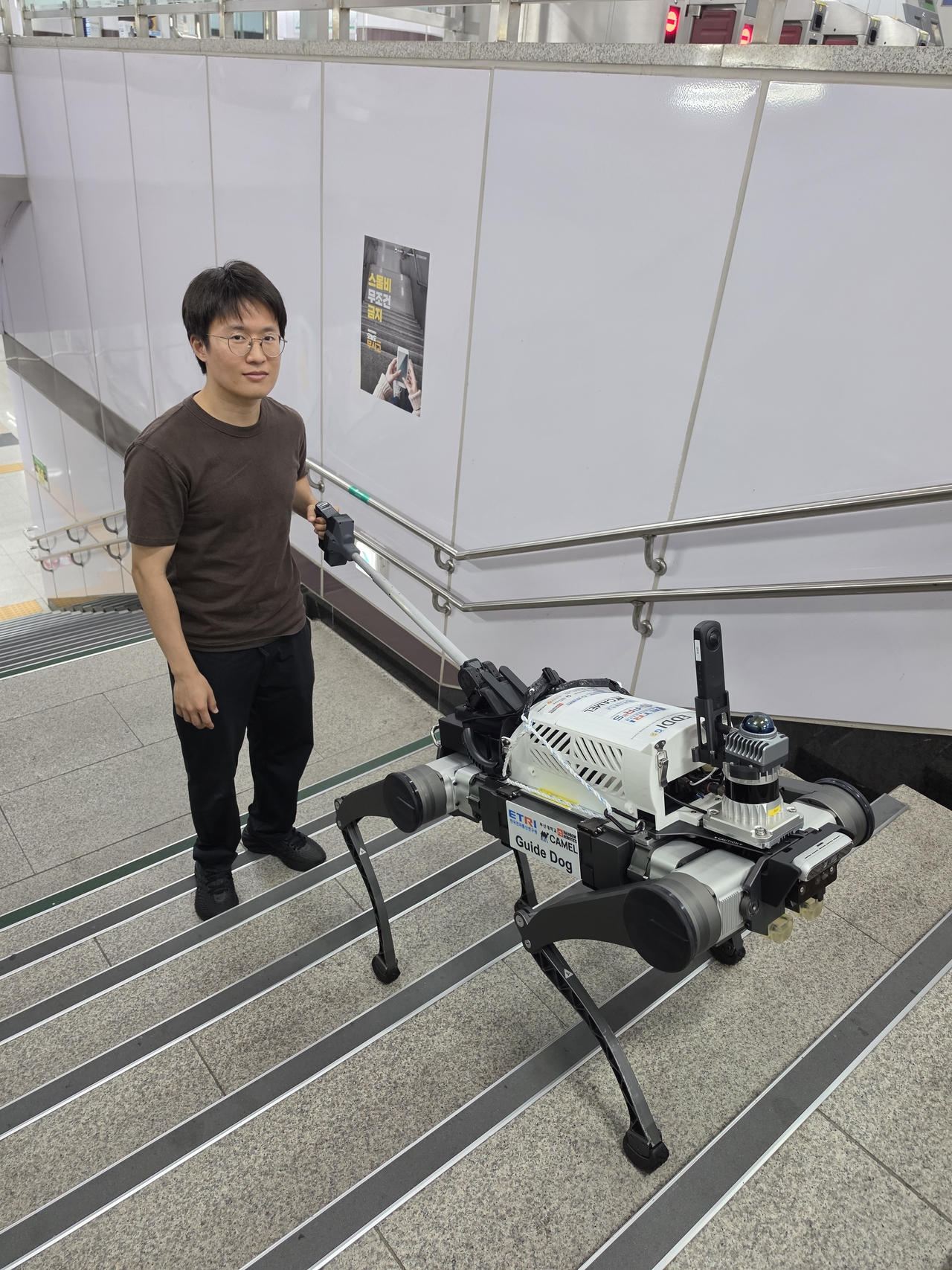
ETRI plans to apply the technology to a guide robot for the visually impaired being developed under its "Guide Dog" project. When a user says something like "let's go left" or "find the entrance," the robot assesses both the surrounding space and the user's intent to navigate to the destination.
The team's next goal is to lighten the AI model — currently achieving the 90.7% success rate on a server-based implementation — so that it can run in real time on domestically developed AI semiconductors.
"A robot's ability to confirm whether it has arrived correctly, and to search again if it has gone to the wrong place, is an essential technology for a guide robot to translate a visually impaired person's words into safe movement," said Choi Seung-min, head of ETRI's Field Robotics Research Laboratory.
"This could serve as a core technology for a wide range of service robots that share spaces with people, including delivery and guidance applications," said Myung, the KAIST professor.
nbgkoo@heraldcorp.com