District-unit plan change announced Thursday — floor area ratio overhaul improves development conditions
Smart city, carbon neutrality and design innovation incentives expanded to promote public-interest development
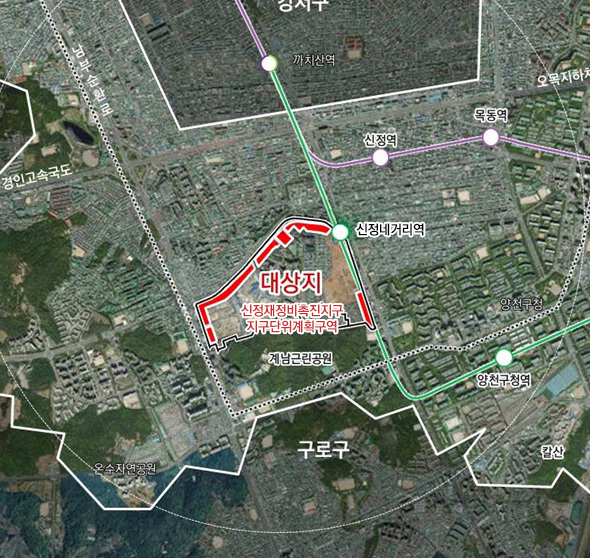
Yangcheon-gu is moving to sharply improve development conditions around Sinjeong Sageori Station, accelerating efforts to revitalize the Sinjeong area and strengthen its role as a residential hub.
The district announced Thursday that it will officially notify a district-unit plan amendment covering the preservation management zone within the Sinjeong Redevelopment Promotion District — a change that includes an overhaul of the floor area ratio system and an expansion of incentives.
The amendment targets the preservation management zone within the Sinjeong Redevelopment Promotion District around Sinjeong Sageori Station. A preservation management zone is an area that falls within a redevelopment promotion district but does not meet the designation requirements for a redevelopment promotion project, or must be maintained as existing urban fabric; individual construction and improvement within such zones are managed systematically through a district-unit plan.
Through this district-unit plan revision, the district has taken a concrete step toward fulfilling its ninth elected-term campaign pledge to "cultivate Sinjeong as a regional vitality hub," laying the groundwork to stimulate private development and the renovation of aging buildings around Sinjeong Sageori by raising floor area ratios and expanding incentives.
The most significant change is the overhaul of the floor area ratio system. In third-category general residential zones, the base floor area ratio rises from 230 percent to 250 percent, and the allowable floor area ratio increases from 250 percent to 275 percent. In quasi-residential zones, the base ratio climbs from 300 percent to 400 percent, with the allowable ratio rising to a maximum of 440 percent. The restructured system is designed to improve land-use efficiency and create better conditions for new construction and renovation of aging buildings.
Incentives to encourage public-interest development are also being expanded. Developers who incorporate current urban policy directions into their building plans — smart city features, carbon neutrality, design innovation and green ecological urban design — will be eligible for allowable floor area ratio incentives based on applicable criteria.
In addition, the criteria for relaxing the maximum floor area ratio under individual statutes — such as the installation of publicly accessible open space and green building certification — will be applied more broadly, encouraging diverse private building plans while securing public benefits.
Furthermore, small-scale buildings in second- and third-category general residential zones will receive a temporary additional floor area ratio relaxation of up to 50 percentage points for three years. Rental housing within residential zones will also benefit from additional floor area ratio relaxation based on the mandatory rental period, measures aimed at stimulating individual construction and strengthening the supply base for long-term rental housing.
Beyond the Sinjeong Sageori plan amendment, the district intends to continue updating urban management plans tailored to local conditions across the Sinwol and Sinjeong areas, progressively strengthening each residential zone's role as a hub. Unreasonable regulations that have impeded development will be revised to reflect local conditions, and the expanded floor area ratios and incentives will be used to support the simultaneous renovation of aging buildings, improvement of the residential environment and revitalization of commercial districts.
"We are rationally improving district-unit plan regulations and expanding the development foundation so that key hubs in the Sinwol and Sinjeong areas can grow in line with local conditions," Yangcheon-gu District Mayor Lee Gi-jae said. "We will actively support efforts to ensure that this Sinjeong Sageori plan amendment serves as a catalyst for renovating aging buildings and activating local development, so the area can evolve into a convenient residential zone where commerce and housing coexist in harmony."
seouldream01@heraldcorp.com