Government and ruling camp review supply options including Camp Coiner site; 12,000 units seen immediately available, with up to 28,000 possible in the medium to long term
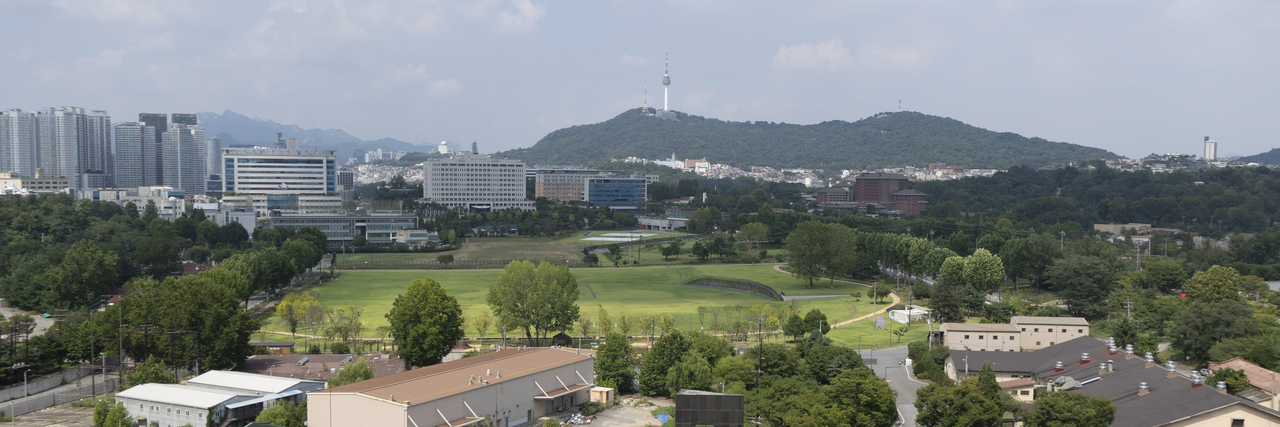
The government is reviewing plans to expand housing supply in the Yongsan area, including on the Camp Coiner site returned by the US military. Even without converting the Yongsan Children's Garden into residential land, the government could immediately supply more than 12,000 units by using sites it already controls — including the former Defense Acquisition Program Administration (DAPA) headquarters, military apartment complexes, officer quarters and Camp Coiner. If medium- to long-term candidate sites are also included, the total could exceed 28,000 units, giving fresh momentum to discussions on Yongsan housing supply.
Yongsan Park seen able to yield 12,000 units immediately, 28,000 over the longer term
Democratic Party lawmaker Yun Jong-gun, a member of the National Assembly's Land, Infrastructure and Transport Committee, released estimates Thursday based on data submitted by the Ministry of Land, Infrastructure and Transport. Applying floor-area ratios equivalent to quasi-residential and second-class general residential zones to some of the government's Yongsan sites and building apartment units of 82.95 square meters each could yield a total of 12,453 units immediately, the estimates showed.
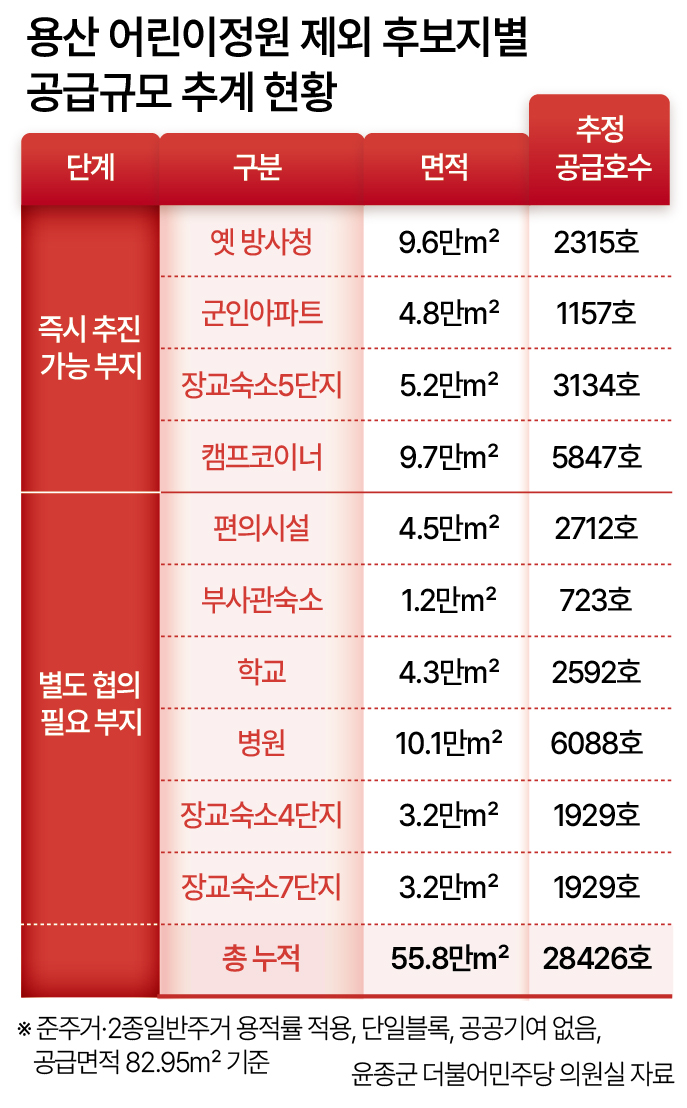
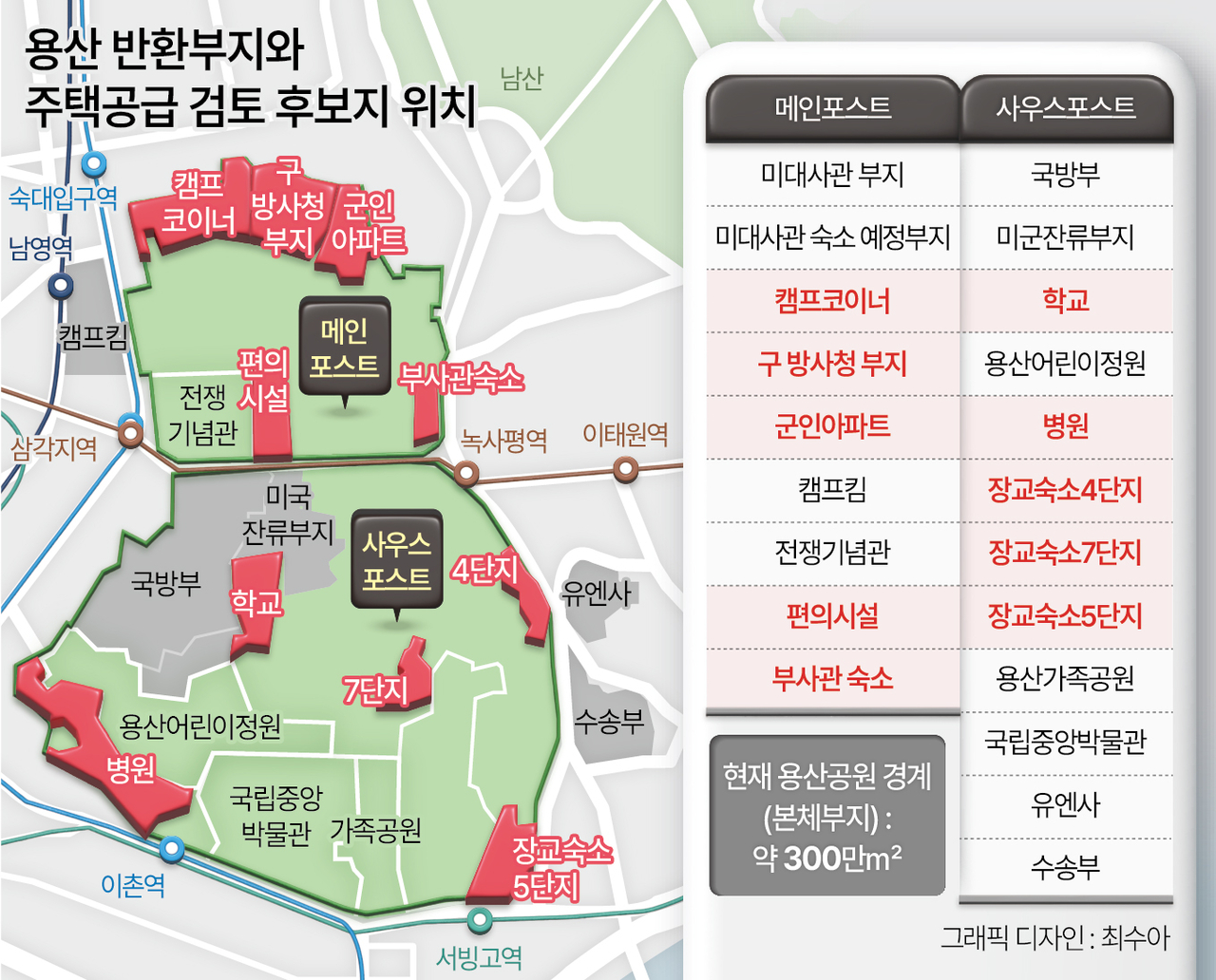
The first-phase candidate sites for rapid supply are Camp Coiner, Officer Quarters Complex 5, the former DAPA headquarters site and military apartment complexes.
Camp Coiner, returned in 2022 and covering about 97,000 square meters, is estimated to yield about 5,847 units. Officer Quarters Complex 5 could provide 3,134 units, the former DAPA headquarters site 2,315 units, and the military apartment complexes 1,157 units. Combined, the four sites total 12,453 units.
Particularly notable is that more than 10,000 units can be secured without converting the Yongsan Children's Garden into residential land. The children's garden has long been the most sensitive point in Yongsan housing discussions, with concerns that development there could damage the surrounding landscape, including views from the National Museum of Korea.
Expanding the candidate sites to include medium- to long-term options would push the total above 28,000 units.
Adding amenity facilities near the War Memorial of Korea, non-commissioned officer quarters, schools, a hospital and Officer Quarters Complexes 4 and 7 as additional candidate sites could yield a further 15,973 units, according to the lawmaker's office. Combined with the first-phase sites, the total would reach 28,426 units.
However, some of the additional candidate sites require soil decontamination, relocation of existing facilities or consultations with the US military, making it difficult to advance those projects in the short term. Within the government, officials are said to be discussing prioritizing sites where conditions are relatively more favorable and pursuing the rest in stages.
Yun said the unit figures were "a simple estimate to gauge the potential scale of supply based on each site's area, applicable floor-area ratio and public rental housing type," but added that "even if the supply volume is adjusted downward due to factors such as views, preservation facilities, infrastructure, roads and building layout, a 10 percent reduction would still allow 25,600 units and a 20 percent reduction 22,700 units — meaning at least 20,000 units can be supplied."
Minister nominee Hong vows site visit with housing experts; Seoul consultations in focus
Voices within the ruling camp continue to call for using the returned Yongsan sites to supply public housing for young people and newlyweds. The sites are seen as a strong housing supply option because they represent large-scale public land in a prime Seoul location where the central government can determine the development plan directly, without relying on private redevelopment projects.
Democratic Party lawmaker Kim Nam-geun argued at the confirmation hearing for Land Minister nominee Hong Ji-sun on Wednesday that the government should engage more actively with the Seoul Metropolitan Government on Yongsan housing supply. "The previous land minister and Seoul worked to address Seoul's housing shortage, but I get the impression the ministry was too passive," Kim said. "There are things the central government needs to obtain through consultations with Seoul, and I do not think taking a negotiating posture is the right approach for the central government."
Earlier, Kim had also argued at a Democratic Party Seoul chapter special committee meeting on housing supply policy that the government should consider supplying 13,000 to 20,000 youth housing units on the outer edges of the main Yongsan Park site.
As discussions between the government and the ruling camp on Yongsan housing supply resurface, consultations with the Seoul Metropolitan Government are seen as the key variable going forward. The central question is how much of the site can be used for housing while preserving the existing plan to develop Yongsan Park as a public green space.
Whether the government will move into full-scale on-site reviews and Seoul consultations after Hong takes office is also drawing attention. At Wednesday's confirmation hearing, when Yun proposed that Hong visit the Yongsan Park site together with housing experts, the nominee said, "I will look into doing that."
Experts agree that any plan premised on building housing in Yongsan Park requires extensive deliberation and broad social consensus. Some also say the overall urban development framework — including expanding both housing and green space — must be considered together.
Lee Chang-moo, a professor of urban engineering at Hanyang University, said Yongsan Park is "land where no one knows what will happen once ground is broken," adding that "it is not a place where supply can be accelerated, given secondary issues such as soil contamination." He added that "the entire framework of Yongsan urban development, including the Yongsan International Business District, would need to be revised," and that "sufficient deliberation and social consensus appear to be necessary."
hss@heraldcorp.com