6 billion won worth of meth, yaba seized
Drugs hidden in food packaging, cosmetics containers
17 detained; Interpol red notices issued for 3 overseas ringleaders
![Yaba tablets collected from a Thai distributor by police investigators. [Seoul Metropolitan Police Agency Metropolitan Investigation Unit Drug Crime Investigation Unit]](https://wimg.heraldcorp.com/news/cms/2026/09/17/news-p.v1.20260917.38ec4f1f161742aba2723b863d3d4835_P1.jpg)
Police arrested 30 people in connection with three separate drug smuggling and distribution cases involving approximately 6 billion won ($4.39 million) worth of narcotics smuggled into South Korea from Cambodia, the Philippines, Thailand and other parts of Southeast Asia.
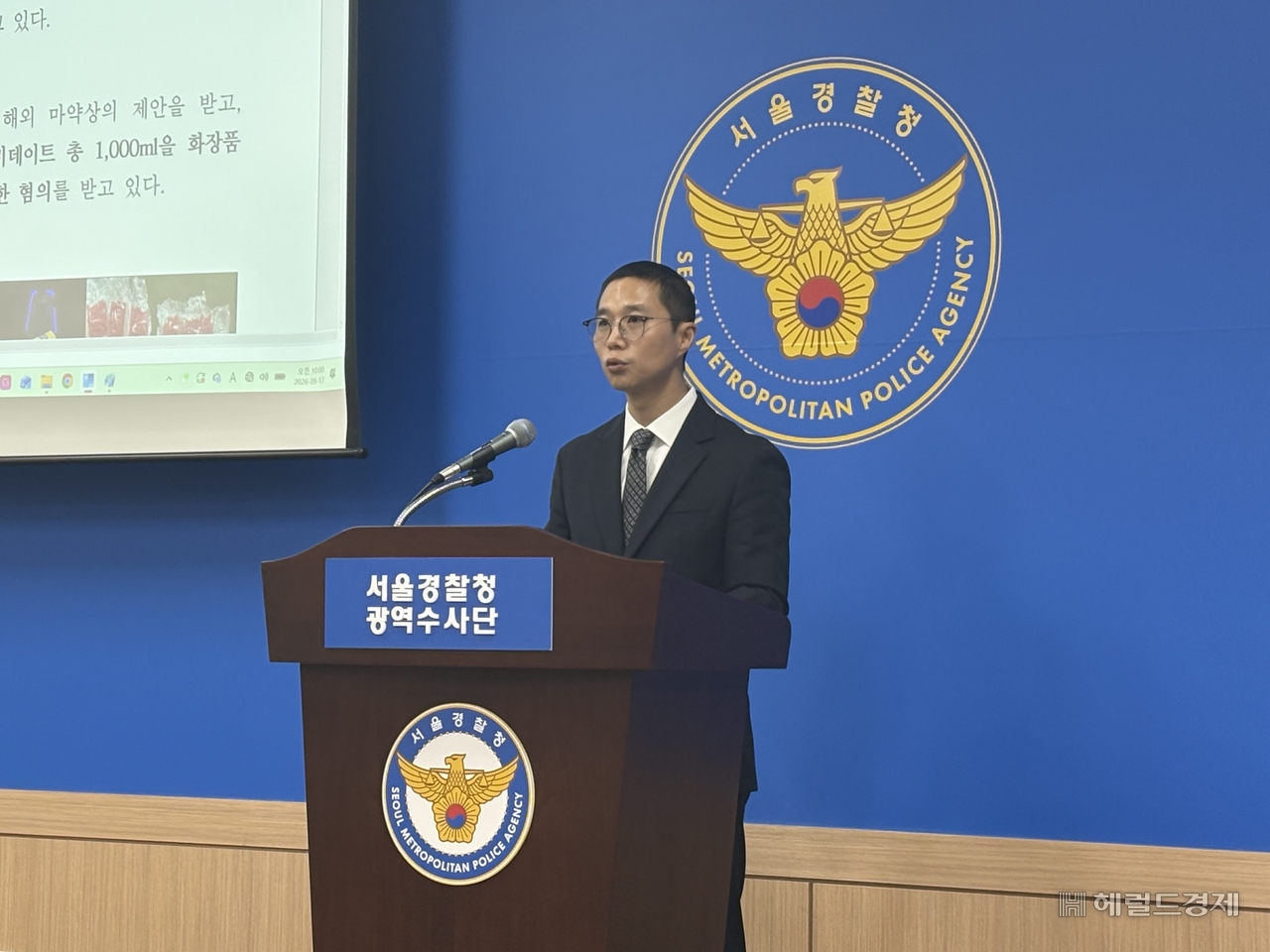
The Seoul Metropolitan Police Agency Metropolitan Investigation Unit announced Thursday that it had booked all 30 suspects — seven smugglers, 13 distributors and 10 users — on charges including violations of the Narcotics Control Act, and detained 17 of them. Seized in the operation were 1.25 kilograms of methamphetamine, 500 grams of ketamine, 2,000 yaba tablets and 500 milliliters of etomidate, with a combined street value of about 6 billion won. Police also recovered 27.45 million won in criminal proceeds.
The largest of the three cases involved methamphetamine and ketamine. A suspect in his 40s, identified only as A, is accused of recruiting couriers via social media at the direction of an overseas drug dealer based in Cambodia, then smuggling 1.25 kilograms of methamphetamine and 500 grams of ketamine into Incheon International Airport from Cambodia, the Philippines and Thailand. A total of 25 people were arrested in that case — five smugglers, 10 distributors and 10 buyers and users — and 12 were detained.
The group concealed drugs inside sunflower seed packets or on their bodies. In July last year, 800 grams of methamphetamine was divided among eight sunflower seed packets, placed in shopping bags and handed off between smugglers in front of Juan Station in Incheon's Michuhol-gu. "One suspect concealed drugs on their body, using tape to secure them to the groin or hiding them inside underwear," a police official said.
Distribution within South Korea relied on a "dead drop" method, in which drugs were hidden at designated locations for buyers to retrieve. "Distributors were to receive 30,000 won per delivery, while smugglers were promised 2 million to 3 million won per run — but in most cases they did not receive the full amount agreed upon," the official said.
In a separate yaba case, a Thai national in his 30s identified as B is accused of receiving 2,000 yaba tablets smuggled into the country by an overseas Thai ringleader, concealing them in snack boxes and distributing them to Thai nationals living in South Korea. All three distributors arrested in the case are Thai nationals — B is in his 30s and the other two are in their 20s — and all three were detained. The overseas ringleader is believed to be a Thai national in his 40s.
After entering the country, the yaba was distributed via dead drops in Jeungpyeong, North Chungcheong Province, and other locations. One Thai suspect, who was in the country illegally, hid yaba at a specific location in Jeungpyeong and was arrested by undercover investigators while fleeing the scene on a motorcycle.
In the etomidate case, a suspect in his 40s identified as C is accused of agreeing to a proposal from an overseas drug dealer based in Thailand, recruiting a junior acquaintance as a courier and smuggling a total of 1,000 milliliters of etomidate into Incheon International Airport by concealing it in cosmetics containers. Both smugglers were detained. "The crime was carried out in two separate runs, and 500 milliliters of etomidate was intercepted during the second," a police official said.
The methamphetamine-ketamine and yaba investigations were launched based on intelligence about Southeast Asia-originating drug smuggling and distribution provided by the National Intelligence Service. Police cracked the etomidate case by sharing their own intelligence with customs authorities, leading to the suspects' interception at the point of entry. Police have issued Interpol red notices for three overseas ringleaders and are tracking the identity and whereabouts of one additional ringleader. A tipster in the etomidate case received a reward of 10 million won.
"We plan to pursue the arrest and repatriation of overseas ringleaders and strengthen cooperation with relevant agencies, including the National Intelligence Service and customs authorities, to block the flow of foreign narcotics into the country," said Hwang In-gi, chief of Drug Crime Investigation Section 2 at the Seoul Metropolitan Police Agency Metropolitan Investigation Unit.
jookapooka@heraldcorp.com