"Unilaterally treating Seoul's liability as a foregone conclusion is highly inappropriate"
"Safety confirmed through inspections by Ministry of Land, Infrastructure and Transport and Korea National Railway"
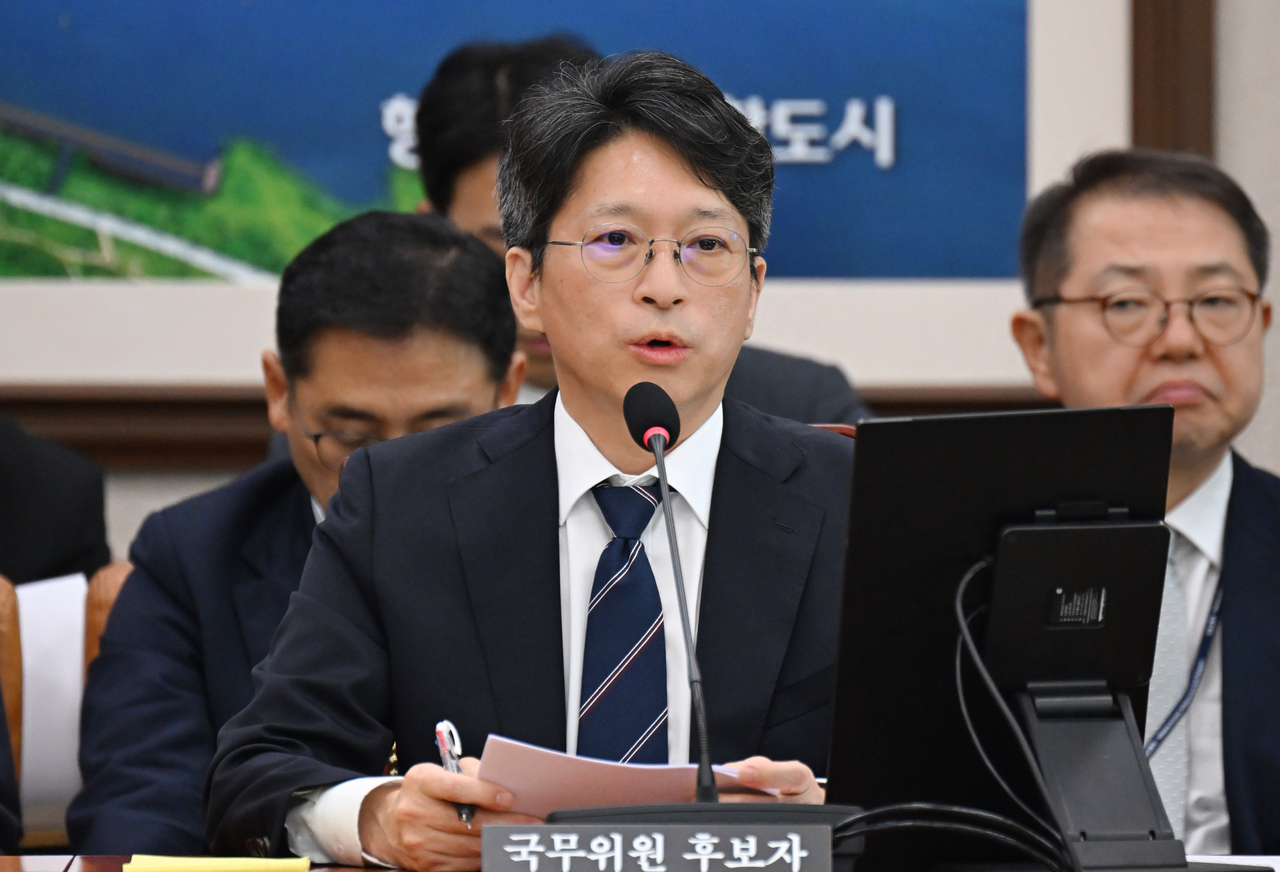
The Seoul Metropolitan Government on Wednesday strongly criticized remarks by Hong Ji-sun, nominee for minister of land, infrastructure and transport, who said she would seek damages from the city over losses stemming from missing rebar at GTX-A Samsung Station.
City spokesperson Lee Min-kyung issued a statement calling it "highly inappropriate" to unilaterally treat Seoul's liability as a foregone conclusion and announce plans to seek damages before any objective verification of the cause and responsibility for the losses had been completed. "We express deep regret," Lee said.
According to Lee, GTX-A Samsung Station had originally been scheduled to begin non-stop train passage in August this year. After the missing rebar was discovered in November 2025, the city conducted its own safety inspection and in December of that year drew up a reinforcement plan. In March 2026, the city prepared a detailed construction plan and shared the specific reinforcement measures and future schedule with Korea National Railway on April 24 and with the Ministry of Land, Infrastructure and Transport on April 29.
"Above all, the assessment of structural safety was not Seoul's alone," Lee said. "The Ministry of Land, Infrastructure and Transport and Korea National Railway also confirmed safety through their own direct inspections." The ministry conducted an emergency nighttime inspection on April 29, while Korea National Railway carried out an emergency safety inspection by outside experts from May 6 to May 8, both confirming no structural safety problems. Facility verification tests that had been temporarily suspended were subsequently resumed, with a total of 94 trial train runs completed through May 19. A vibration measurement conducted May 5 at the request of the Korea Infrastructure Safety Corporation recorded a maximum vibration velocity of 0.069 centimeters per second. A separate measurement carried out July 15 and 16 by the Korea Concrete Institute — commissioned by the ministry and Korea National Railway using a test train — recorded 0.049 centimeters per second.
"Both measurements came in at roughly one-quarter or less of the 0.3-centimeter-per-second standard for railway facilities, repeatedly confirming that the impact of train passage on the structure is negligible," Lee said.
"If the structure had been in a genuinely dangerous state, would the Ministry of Land, Infrastructure and Transport have been able to resume trial runs on its own?" she said. Lee argued that the ministry had delayed the start of reinforcement work even after safety had been confirmed through inspections by relevant agencies — during what she described as a politically sensitive period ahead of an election — and had extended the original inspection period, which was set to end July 20, by four months to Nov. 20. "As a result, the reinforcement work that could have been completed in July and the Samsung Station non-stop passage originally scheduled for August were both delayed," she said.
Lee said it was "utterly brazen" for the ministry and Korea National Railway to confirm structural safety themselves, resume trial runs, and then delay related procedures for an extended period under the pretext of additional verification, only to demand that Seoul's taxpayers foot the resulting costs. "If a claim for damages is actually filed, Seoul will clearly distinguish between responsibility for the missing rebar and responsibility for the additional inspections and schedule delays," she said. "We will respond firmly to any attempt to shift onto Seoul taxpayers the additional costs incurred by the Ministry of Land, Infrastructure and Transport's own decisions."
cook@heraldcorp.com