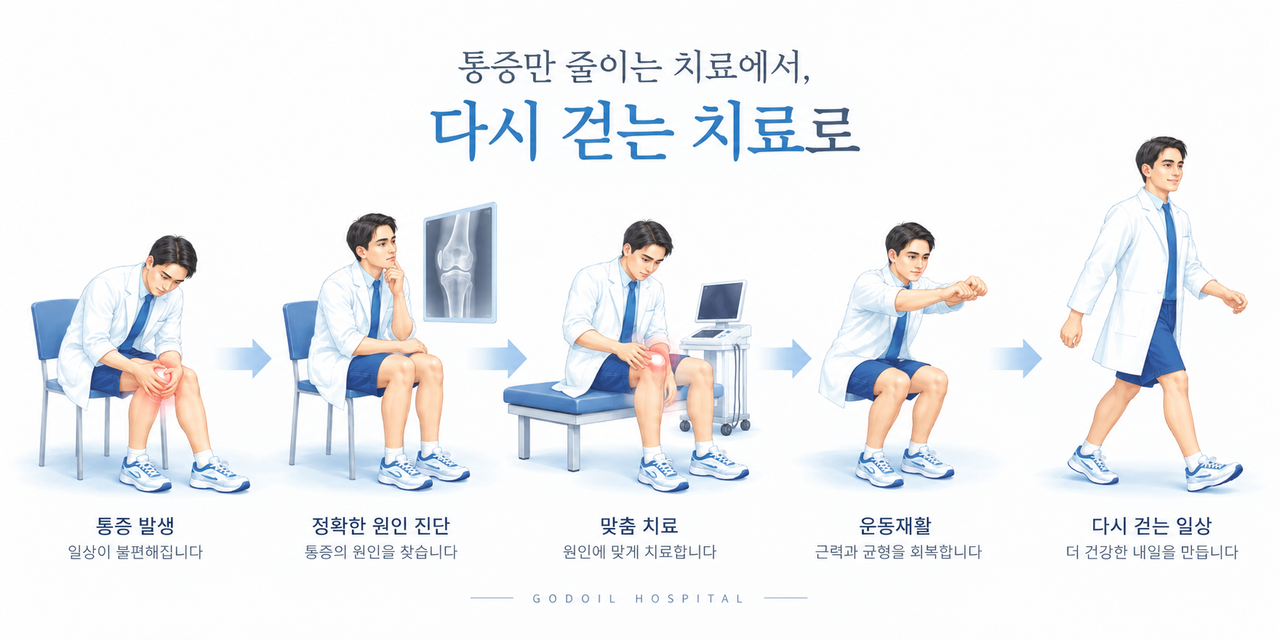
In a super-aged society, the goals of spine and joint treatment are changing. Simply reducing pain is no longer enough — restoring the function that allows patients to walk again, climb stairs and maintain an independent daily life for as long as possible has become the priority.
The key is not to focus only on the area where pain is felt, but to identify the underlying causes in detail. Back or neck pain does not always originate from a herniated disc. A range of structures — including the facet joints, neural foramina, ligaments, peripheral nerves, deep muscles and fascia — can all contribute to pain.
Go Do-il, director of Godo-il Hospital and a neurosurgery specialist, said the current trend is toward strengthening an integrated treatment system that builds on non-surgical spine care and connects it to knee joint-preservation treatment, exercise rehabilitation, and strength, balance and gait management. "An approach that incorporates when pain worsens, which postures and movements aggravate it, and in which direction numbness spreads — all reflected together through physical examination, imaging and functional assessment — is increasingly emphasized," he said.
For example, a patient whose legs hurt after about five minutes of walking but who feels better quickly upon sitting may be showing signs of neurogenic intermittent claudication associated with lumbar spinal stenosis, rather than simple muscle pain. Conversely, even when an MRI shows a disc protrusion, the primary source of pain may lie in a different structure. That is why symptoms and movement must be assessed alongside imaging, not instead of it.
"Rather than judging back pain based on a single MRI finding, it is important to look at the posture and movements that trigger pain, neurological symptoms and gait function together to identify the true cause," Go said. "After controlling pain through non-surgical treatment, an important goal is to restore core and lower-body strength, balance and gait function so patients can move again."
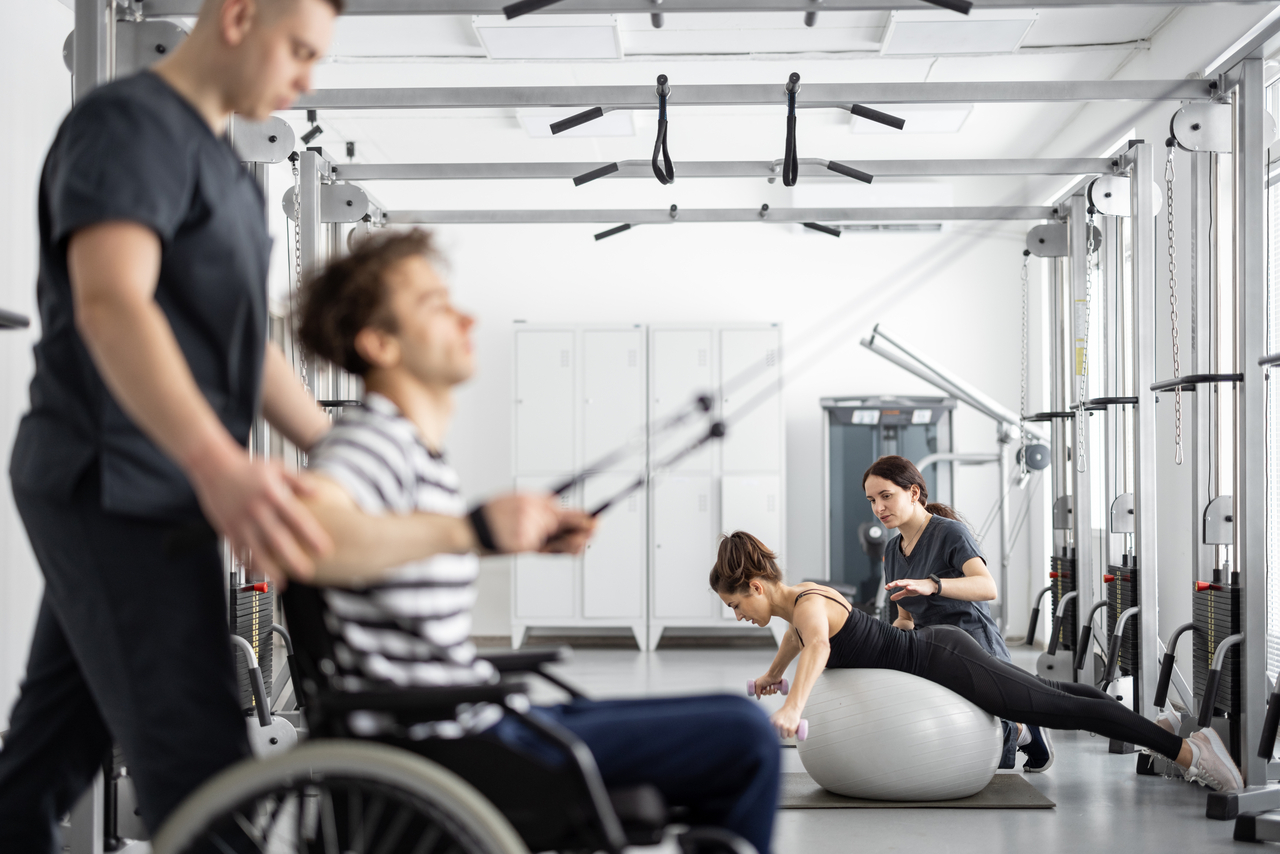
Once pain subsides, the focus must shift to restoring movement. Even after a procedure or injection reduces pain, patients who have long avoided movement may find that their thigh and gluteal muscles have weakened and their balance and walking ability have declined. Rehabilitation following pain management is essential to break the vicious cycle in which reduced activity leads back to muscle loss and recurring pain.
Depending on the patient's condition, non-surgical pain treatment should be followed by a stepwise program connecting manual therapy and exercise rehabilitation with core and lower-body strengthening and flexibility and balance training. For older patients in particular, assessment should go beyond pain scores to include real-life functional measures — whether the patient can rise from a chair unaided, walk a set distance steadily, change direction and stand on one foot.
For knee treatment, what matters is not the most acclaimed therapy but the one suited to each patient's knee. Treatment options for degenerative knee osteoarthritis have expanded well beyond medication, physical therapy, and hyaluronic acid (HA) or steroid injections to include polynucleotide (PN), collagen, platelet-rich plasma (PRP), bone marrow aspirate concentrate (BMAC) and autologous adipose-derived stromal vascular fraction (SVF). But a wider range of options does not mean every treatment is necessary.
"It is important to select the appropriate treatment based on the stage of arthritis, the state of inflammation, the condition of the cartilage and meniscus, the patient's age, activity level and treatment goals," Go said. "Hyaluronic acid assists joint lubrication and shock absorption, while steroids are used to rapidly control inflammation." PN and collagen-based treatments may also be considered depending on symptoms and indications. PRP is prepared by separating platelet-rich plasma from the patient's own blood, while BMAC involves concentrating the patient's own bone marrow aspirate and injecting it into the joint cavity.
BMAC is commonly referred to as a "stem cell injection," but the precise term is "intra-articular injection of bone marrow aspirate concentrate." Its indications and limitations must be clearly explained to patients, and neither PRP nor BMAC should be oversimplified as treatments that restore worn cartilage to its original state or guarantee outcomes for all patients. The goal is to help appropriate candidates improve pain and function, and then — through rehabilitation — to allow them to use their own joints for as long as possible.
Autologous adipose-derived SVF offers another option for knee joint preservation. Autologous adipose-derived stromal vascular fraction is obtained by harvesting the patient's own adipose tissue, then processing and separating it to yield a cellular component. It is distinct from cultured stem cell therapy and may be considered as one joint-preservation option for degenerative knee osteoarthritis, taking into account the patient's stage of arthritis, symptoms, age and activity level.
SVF is likewise not a treatment to be applied uniformly to all patients. The goal is not to assert that worn cartilage will be restored to like-new condition, but rather to help appropriate candidates improve pain and function, and to connect that with exercise rehabilitation and strength and gait management so they can use their own joints for longer. Actual application must follow relevant regulations and permitted indications and protocols, with the expected benefits and limitations fully explained to the patient before a decision is made.
Bang Hyeong-sik, director of orthopedic surgery at Godo-il Hospital, said knee osteoarthritis treatment cannot be reduced to a single injection that works for every patient. "Treatment must be chosen by weighing the stage of arthritis, the degree of inflammation, the condition of the cartilage and meniscus, and the patient's age and activity level," he said. "Joint-preservation treatments such as PRP, BMAC and autologous adipose-derived SVF should also be applied to carefully selected patients and combined with rehabilitation and strength training, with the aim of improving pain and function and enabling long-term use of the patient's own joint."
Go said the priority is not to look for a single procedure as the solution, but to build a system that connects the entire process from pain reduction to restored movement — treating the spine, knee and muscle as one mobility system. "We plan to expand our clinical framework by adding joint-preservation treatment, exercise rehabilitation, and sarcopenia and fall prevention to our existing strengths in non-surgical spine care, so that we can manage the real-life functional needs of older patients," he said.
kty@heraldcorp.com