Government announces official introduction of mifepristone as early as the first quarter of next year
Experts warn black market demand will persist
Social stigma, cumbersome procedures cited as barriers
![A pregnancy test and medication. [Getty Images Bank]](https://wimg.heraldcorp.com/news/cms/2026/09/19/news-p.v1.20260916.b1ff5c41976141c596dc9fa1e9b60500_P1.jpg)
"Yes, it's illegal. But the people buying it are women who have no choice — they come to us because of an unwanted pregnancy." — an illegal mifepristone seller
Seven years after the Constitutional Court ruled South Korea's abortion ban unconstitutional, the government has confirmed it will officially introduce the abortion pill mifepristone (Mifegyne). Authorities announced the drug will be brought in through the necessary regulatory procedures as early as the first quarter of next year. For the first two years after introduction, however, it will only be dispensed by doctors at hospitals and other medical institutions following an in-person examination.
Will the existing black market disappear once the drug is legalized? Experts are skeptical. They say demand from women who seek out the drug discreetly — to avoid the social stigma attached to abortion — will not simply vanish.
Brisk black-market trade: 'Yes, it's illegal — but I sell to women who have no other choice'
On Thursday, promotional posts offering mifepristone for sale were easy to find online. A mifepristone sales site discoverable through a simple portal search had new user reviews posted as recently as Monday.
The reviews included comments such as "I was too young and too scared to have a baby" and "This is my fifth time using it. Mifepristone is reliable and clean for me. No strain on my body either." The authenticity of the reviews cannot be verified, but the underground market clearly operates in an organized fashion.
A reporter reached out to one seller through Telegram, an encrypted messaging app. The seller asked how the pregnancy had been confirmed — whether by a home test kit or an ultrasound — before providing a price list by package. Delivery from overseas, the seller said, takes about five days.
When asked whether the product was genuine, the seller said: "Yes, it's illegal. Mifepristone hasn't been approved in Korea. I've been running through one site for over seven years. The products are European, but since it's illegal I can't go into detail."
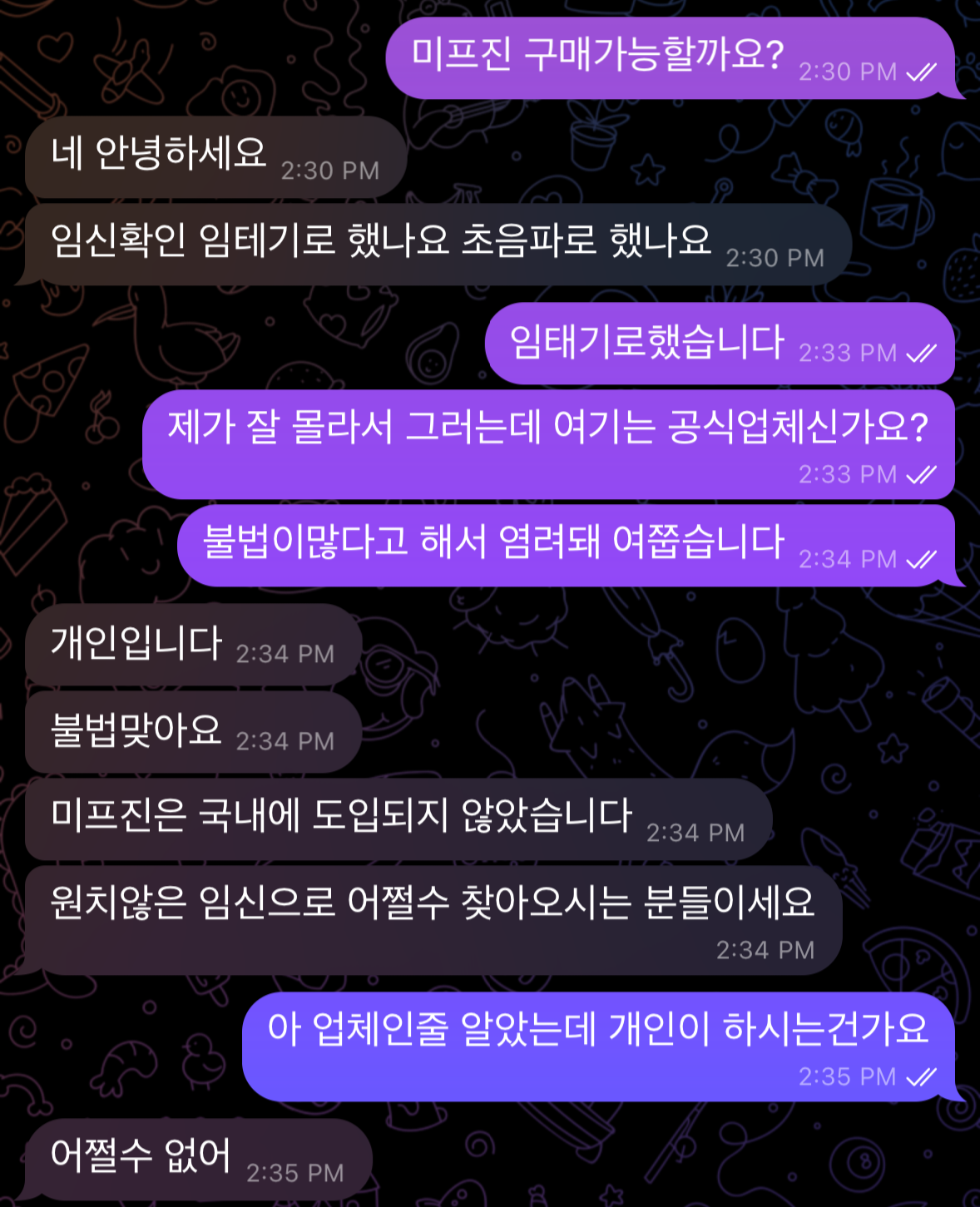
When the reporter asked whether the seller would continue operating after mifepristone is officially introduced in Korea, no reply came.
Posts offering to transfer mifepristone were also easy to find. All such transactions are punishable as violations of the Pharmaceutical Affairs Act.
Another danger of the black market is that buyers have no way to verify whether what they receive is genuine. The pills could turn out to be counterfeits with no connection to pregnancy termination at all.
Kim Dong-sik, a researcher at the Korean Women's Development Institute, said there had been cases where a woman took pills she had purchased but experienced no effect. "A few days later she went to a hospital for an ultrasound and the fetus was still there," he said. The woman ultimately underwent a surgical abortion.
![Counterfeit mifepristone seized by the Daejeon Metropolitan Police Agency. [Daejeon Metropolitan Police Agency]](https://wimg.heraldcorp.com/news/cms/2026/09/19/news-p.v1.20260907.3e8b13cc90864bdcaf3289e0f8658512_P2.jpg)
There have also been arrests for selling counterfeit pills. In 2020, the Daejeon Metropolitan Police Agency arrested a group for illegally distributing Chinese-made fake pharmaceuticals passed off as American mifepristone, in violation of the Pharmaceutical Affairs Act. The group purchased each set for 80,000 won ($58) through Chinese smugglers and resold them for 380,000 won. Using this scheme, they defrauded more than 300 people and made 130 million won in criminal proceeds.
Mifepristone black market: 'People will still seek it out'
Experts believe underground trade will persist even after women can legally obtain a prescription.
Kim Jeong-hye, a senior researcher at the Korean Women's Development Institute, said she expects black-market activity to continue. "Hospitals are still telling women, 'Bring your boyfriend, your husband, your parents,'" she said. "If that doesn't change after the drug is introduced, the problem will remain."
![User reviews posted on a mifepristone sales site, including one claiming to be a fifth-time user. [Mifepristone sales site]](https://wimg.heraldcorp.com/news/cms/2026/09/19/news-p.v1.20260917.098214a8d1fe49cfb6ad936d231e8a82_P2.png)
Kim also pointed to the gestational limit on when the drug can be used. "Nine weeks is too short," she said. "Research on abortion gestational ages by region shows that in rural and fishing communities the average is close to 10 weeks. Because that is an average, quite a few women will be past the nine-week cutoff."
Because the government has set the permissible window at under nine weeks, women who exceed that limit will have little choice but to turn to the black market.
Social stigma is another obstacle. Kang Gyeong-yeon, secretary-general of the Pharmacists for a Healthy Society, said many women are still reluctant to visit an obstetrics and gynecology clinic. "If the drug is dispensed and administered on-site at a hospital, it will essentially require a form of admission," she said. "The inconvenience of that process, combined with the stigma, means some women will choose not to go to a hospital at all."
Kim said the degree of social stigma surrounding abortion in Korea would have a considerable influence on how the situation unfolds. "How much of that stigma remains in society will matter a great deal going forward," she said.
20ki@heraldcorp.com
newday@heraldcorp.com
jookapooka@heraldcorp.com