Four new regional hubs to transform Seoul into a 'multi-core city'
Moonlit outdoor markets to expand citywide; 40 waterfront cultural spaces by 2030
Nighttime recast as economic hours as city redraws its jobs map
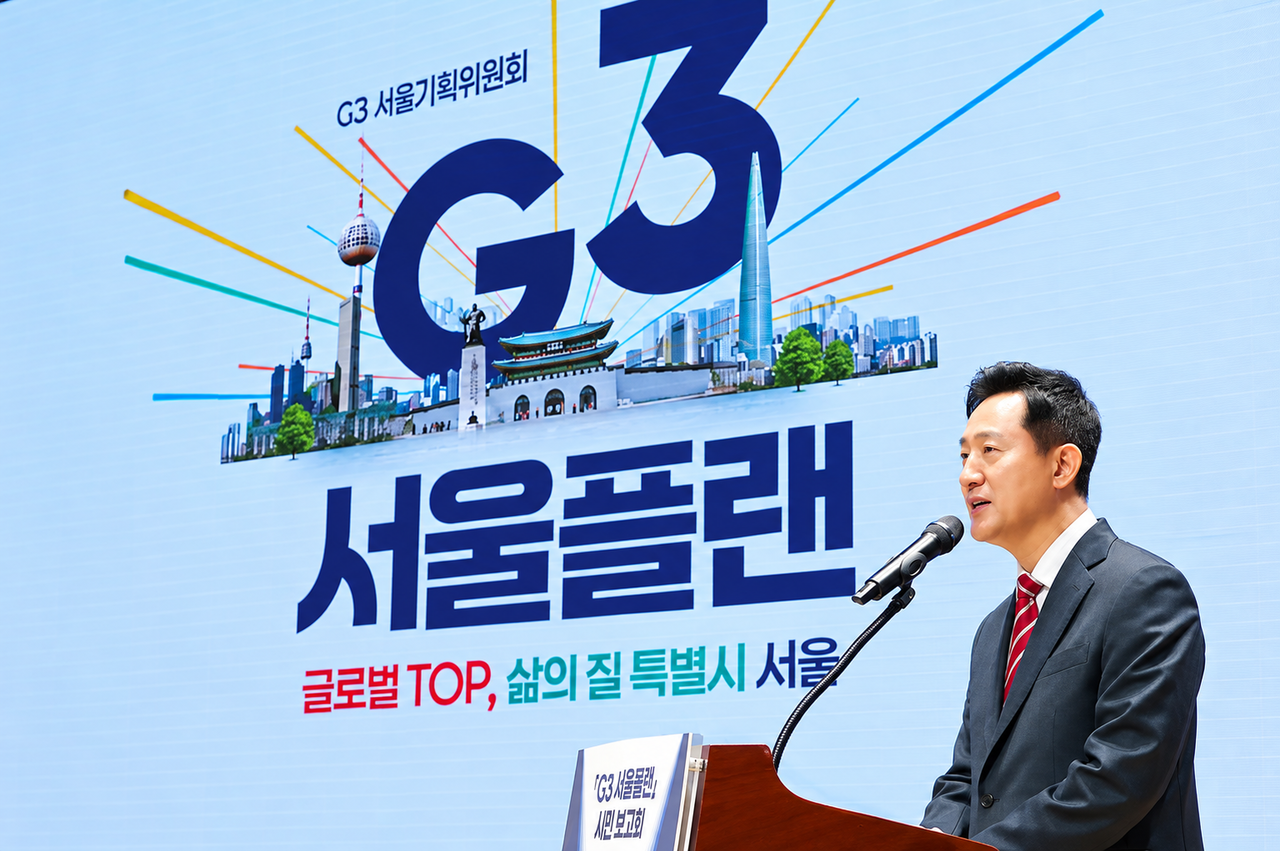
The heart of the Seoul Metropolitan Government's G3 Seoul Plan is not simply its 86.1 trillion won ($62.4 billion) price tag. A closer look at the blueprint reveals a sweeping ambition to restructure the city's residential, industrial, transportation and cultural functions — shifting from a model concentrated in a single downtown core to a "multi-core city" built around multiple interconnected hubs.
Particularly notable is the plan to cultivate four new "regional urban centers" — Sangam-Susaek, Gasan-Guro, Changdong-Sanggye and Godeok-Gangil — alongside the existing three downtown hubs of the city center, Yeouido and Gangnam. "Youth Future Towns," designed to integrate housing, employment and community services in a single location, will also be developed across each zone. The strategy aims to create new growth axes throughout residential areas rather than concentrating the city's core functions in any one district.
The city's industrial map will also be redrawn by zone under the "NEXT Economy" framework: the northeastern zone will focus on biotech and medical industries; the northwestern zone on media and entertainment; the central zone on K-culture and global business; the southeastern zone on AI and robotics; and the southwestern zone on finance and advanced industries. Planned facilities include a biotech and medical research and development support center in Hongnŭng and a unicorn startup hub in Seongsu for the northeast, and a Seoul AI Tech City in Yangjae and a robotics cluster in Suseo for the southeast.
Seoul that never sleeps: City launches push toward 24-hour economy
Another significant shift centers on the night. The Seoul Metropolitan Government is pursuing a "24-hour vitality economy," treating nighttime not merely as a tourism window but as a full economic period in its own right.
The city plans to expand late-night programming at the Han River, Namsan and Dongdaemun Design Plaza, and to roll out its signature "Moonlit Outdoor Market" concept — currently being piloted at five locations this year — to all 25 autonomous districts. The "Seoul Mulbitnaru" waterfront cultural spaces will grow to 40 sites by 2030. Late-night bus services and CCTV infrastructure will be expanded in tandem, with the goal of channeling tourists' longer nighttime stays and spending into local commercial districts.
Several resident-facing initiatives also stand out. In preparation for an era of 30 million foreign tourists, the city will build "OK-Seoul," a unified platform linking overseas mobile payment services, public transit, tax refunds and tourist information. Storage facilities for strollers and travel luggage will be added at traditional markets and other major commercial areas. Age-appropriate play spaces will be created for children from infancy through adolescence, and Seoul-style kids' cafes will diversify beyond indoor formats to include outdoor and day-trip options.
Housing policy, too, underscored not only the number of units to be supplied but also reducing project delays. A "standard processing deadline system" will apply to 85,000 units in key strategic redevelopment zones slated for ground-breaking by 2028, with a progress-promotion committee chaired by the second administrative deputy mayor tasked with managing bottlenecks at each stage.
The city's "Moa Housing" program — a small-lot consolidation scheme — will manage 146 project sites in phases, with 62 of them comprising 14,000 units targeted for ground-breaking by 2028. Sites experiencing delays will receive a mobile rapid-response team composed of specialists in architecture, law, accounting and property appraisal.
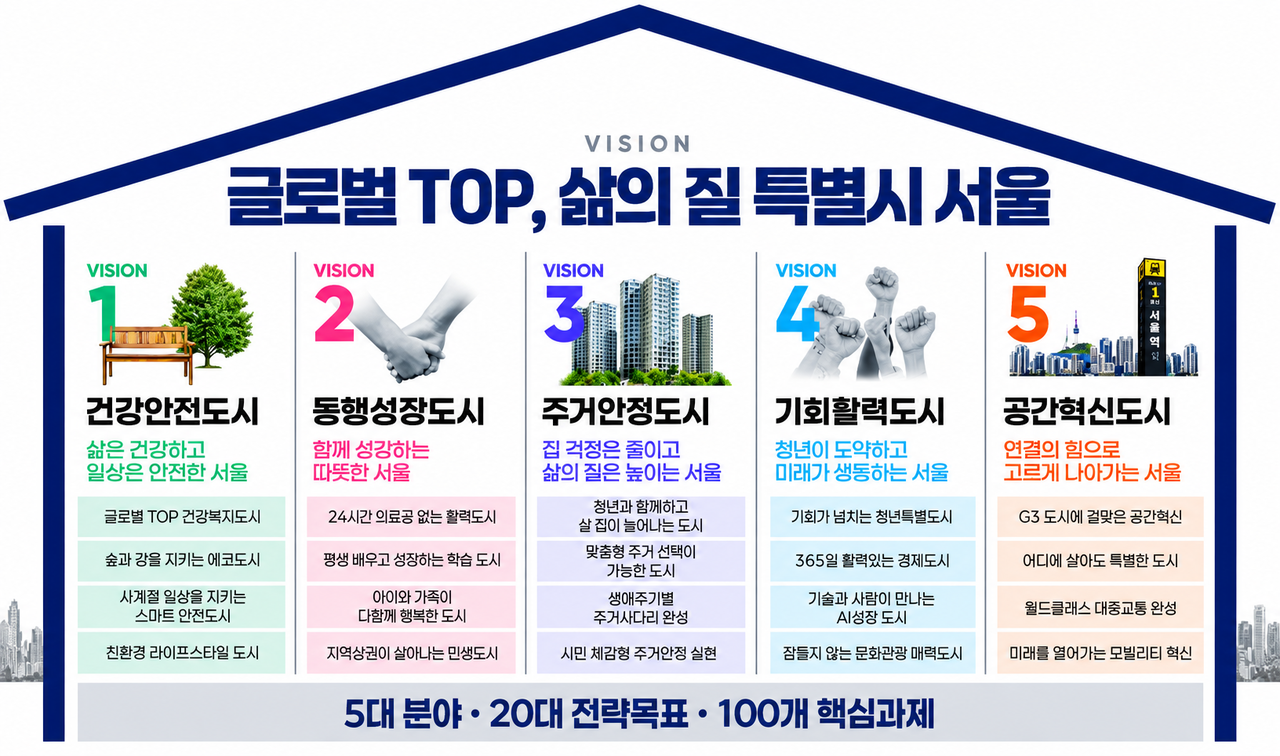
High-impact projects to deliver early results as city accelerates execution
The financing structure behind the 86.1 trillion won plan also warrants attention. City funds account for 53.7 trillion won, or roughly 62 percent of the total, with 9.2 trillion won coming from the national government and 23.2 trillion won from private and other sources. How reliably the city can secure national and private funding as planned will be a key variable in whether projects proceed on schedule.
The Seoul Metropolitan Government says it intends to place greater weight on execution management than on plan announcements. By year-end, each of the 100 priority tasks will be assigned its own targets, timeline, funding and performance indicators, with the Office of Planning and Coordination overseeing progress. Projects with a direct impact on residents — covering housing, health, safety, education and transportation — are slated to produce early results, while AI, future industries, global talent and the cultural economy will receive longer-term investment.
The process of developing the G3 Seoul Plan itself was designed to differ from conventional administrative planning. The G3 Seoul Planning Committee, launched in late June, brought together 100 private-sector experts from academia, media and civil society, who held 108 meetings and conducted 16 field visits over roughly 70 days. The 100 priority tasks were then shaped by translating those on-the-ground discussions into concrete project plans across the city government's various departments and bureaus.
Ultimately, the success of the G3 Seoul Plan will hinge less on the 86 trillion won investment figure than on how effectively the 100 projects translate into tangible improvements in residents' daily lives and neighborhood conditions. The city plans to release task-by-task implementation plans with specific timelines and performance benchmarks when it finalizes the strategy at year-end.
7toy7@heraldcorp.com