Inaugural tree-planting ceremony set for Oct. 23 under 'one household, one tree' initiative; residents who buy through Seoul Forest Cooperative receive 50% cost support; shaded garden path completed near Han River Mangwon entrance
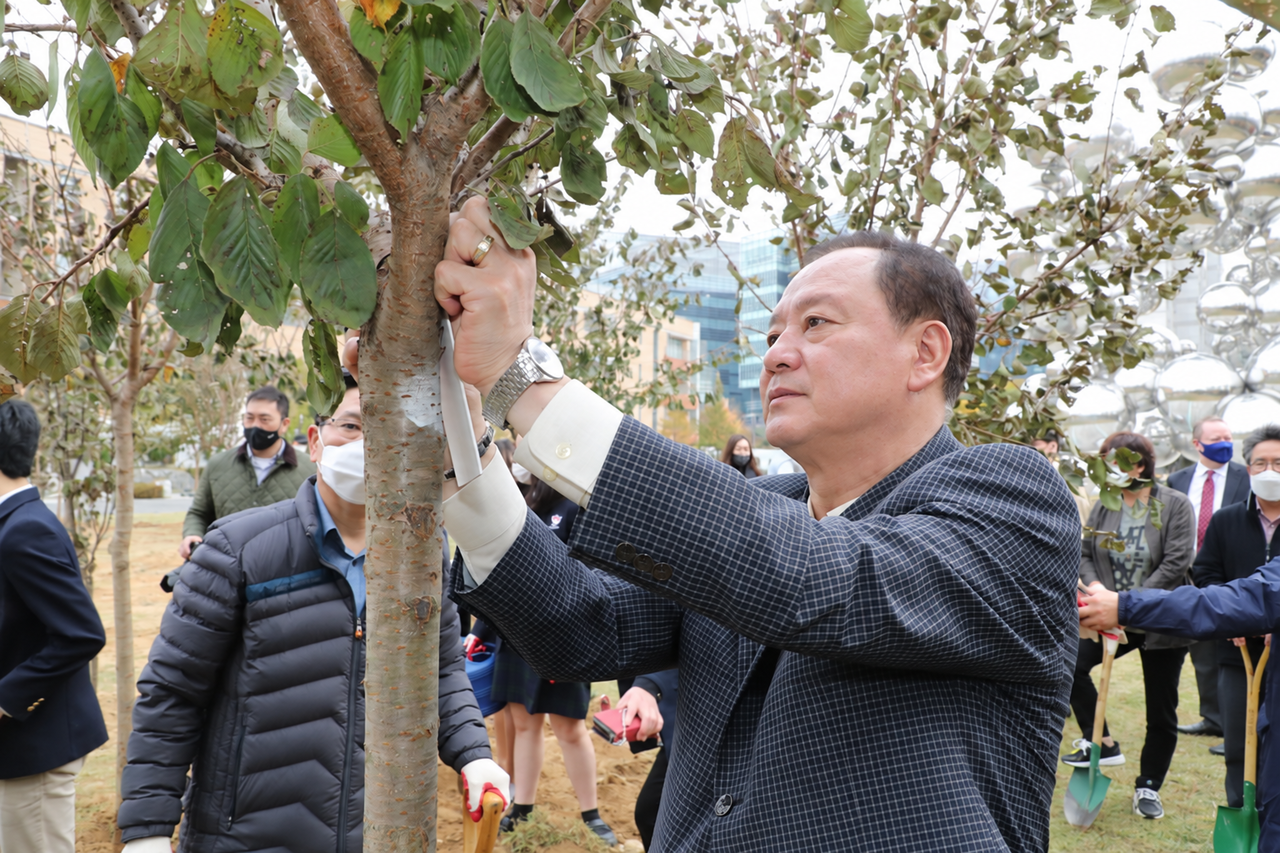
Mapo-gu District Mayor Yu Dong-gyun is reviving the "5 million trees" planting campaign he launched during his first term, carrying it forward into his current term in office.
The district is formally rolling out a project called "5 million trees again," aimed at expanding green space and urban shade in residential areas and fostering a culture in which residents plant and tend trees as part of daily life.
The first community participation initiative is a "one household, one tree" program. The district will hold its inaugural tree-planting ceremony on Oct. 23.
The program invites residents to mark meaningful family milestones — marriage, the birth of a child, school enrollment — by planting and caring for a single tree. Participants may plant in parks, green belts and unused plots of land, and a commemorative plaque bearing the planter's name and story will be installed at each site.
The planting ceremony will be held once per quarter, four times a year, with 50 trees planted at each event.
Residents wishing to take part may download an application form from the Mapo-gu website beginning Tuesday and submit it by email to the relevant official, or apply by scanning a QR code posted on the site.
Participants may purchase their preferred tree species and bring it on the day of the event. Those who have difficulty buying or transporting a tree may order through the Seoul Forest Cooperative, listed on the Mapo-gu website, and receive the tree at the event venue.
The cooperative offers a range of species, including Korean fringe tree, Yoshino cherry, kousa dogwood, cornelian cherry, Japanese apricot, Acer triflorum, Japanese yew, Korean maple, whitebeam and rugosa rose.
Through partnerships with civic organizations and other external support, the district will cover 50 percent of the purchase price for participants who buy their trees through the Seoul Forest Cooperative. All participants will also receive tree stakes, soil conditioner and a commemorative plaque.
On the day of each event, community gardeners who have completed district-run training will be on hand to guide participants on proper planting techniques and tree care. These community gardeners regularly tend local parks and gardens as part of the district's residential green-space management program.
"Research shows that suicide rates decline as residential green space increases, which means urban trees and greenery play a vital role in residents' emotional well-being and quality of life," Yu said. "I hope this tree-planting ceremony becomes an opportunity to commemorate precious family moments through trees and to nurture residential green space together with our community."
As part of the broader tree-planting project, the district has also transformed the road leading to the Han River's Mangwon entrance into a garden path lined with flowers and trees.
On Sept. 4, the district completed a 2.5-kilometer "shaded garden path" along World Cup-ro and Yanghwa-ro. The project was designed to expand urban greenery, reduce fine dust and the summer heat-island effect, and create a more pleasant walking environment.
The stretch is frequently used by residents heading to Han River Park, but zelkova tree roots had been pushing up through the surface and lifting paving blocks, posing a hazard to pedestrians.
In response, the district invested 320 million won ($232,000) in special adjustment grants from the Seoul Metropolitan Government to repair the street-tree root systems and create the garden path.
Along the walkway, the district created 60 small pocket gardens — totaling 141.5 square meters — in unused strips of land, and 13 ribbon-shaped green belts connecting roadside green zones, covering 184 square meters. A total of 1,414 trees and shrubs, including zelkova and hydrangea, along with 4,605 flowering plants, were planted throughout the area.
Beneath the street trees, the district installed special boundary devices and frames to prevent soil erosion caused by protruding roots and to retain rainwater for moisture management. The measures are intended to stop the roots from resurfacing in the future.
The district plans to go beyond simply planting trees, implementing sustained and systematic follow-up care to improve the survival and establishment rate of trees and flowers and strengthen the ecological function of the urban forest. It also intends to secure diverse funding sources to continue expanding residential urban green space.
On Sept. 1, the district submitted a supplementary budget proposal to the district council allocating 167.15 million won across four projects, including the "5 million trees again" initiative.
seouldream01@heraldcorp.com