![The real-time won-dollar exchange rate is displayed on a screen at the dealing room of Hana Bank's headquarters in Jung-gu on Wednesday. [Yonhap]](https://wimg.heraldcorp.com/news/cms/2026/09/21/rcv.YNA.20260916.PYH2026091602450001300_P1.jpg)
Korean retail investors have returned to buying US stocks as the won-dollar exchange rate climbed again. After net selling more than 900 billion won ($650 million) the previous week, domestic investors net purchased more than 1.5 trillion won in US equities last week, driven by growing preference for dollar-denominated assets amid expectations of continued dollar strength.
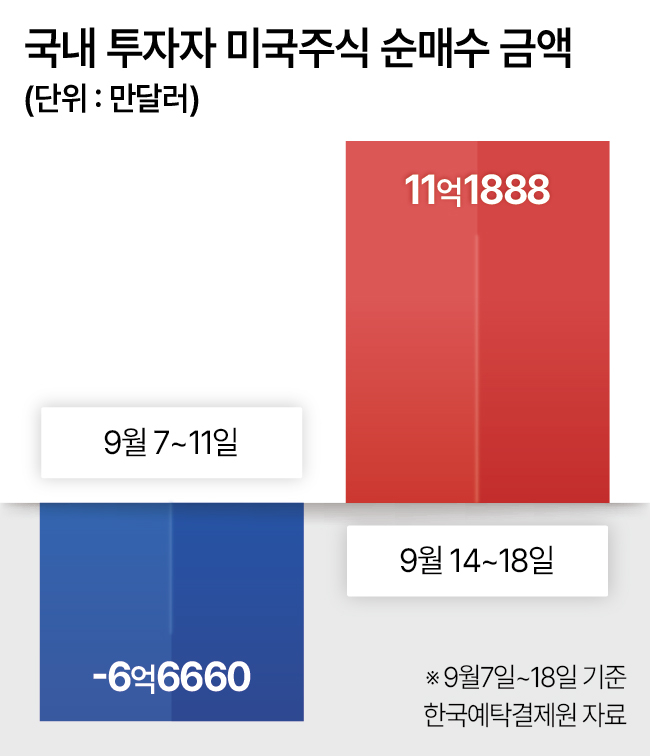
According to the Korea Securities Depository, domestic investors net purchased $1.12 billion worth of US stocks from Sept. 14 to Sept. 18. That marks a sharp reversal from the previous week (Sept. 7–11), when they net sold $666.6 million.
Fueled by last week's heavy buying, the cumulative net position in US stocks for September swung from net selling of $131.01 million as of Sept. 11 to net purchasing of $987.87 million as of Sept. 18.
The shift in retail investors' trading direction tracked movements in the exchange rate. After surging to 1,559 won per dollar in June, the rate fell to 1,345 won on Sept. 11. With exchange rate volatility rising and concerns about currency losses from a stronger won, domestic investors had been selling US stocks.
The mood changed once the dollar began strengthening again. The won-dollar rate climbed from 1,348 won on Sept. 14 to 1,390 won on Sept. 18 — a jump of more than 40 won in just four trading days. As the rate approached the 1,400-won level again, buying interest in US stocks revived.
"High oil prices, a stronger dollar, a weaker yen, expanded net selling of domestic stocks by foreign investors, and delays in reaching a Korea-US investment deal all contributed to the sharp rise in the won-dollar rate," said Park Sang-hyun, a researcher at iM Securities.
Expectations that the exchange rate could continue rising are also stoking demand for dollar assets. The Federal Reserve raised its benchmark interest rate at the September FOMC meeting and left the door open to further hikes, adding to upward pressure on the dollar. Elevated global oil prices are also cited as a factor weighing on the won.
"The Fed has raised its benchmark interest rate, signaled it could raise it further, and oil prices keep climbing — all of which are fueling strong-dollar pressure," said Moon Da-woon, a researcher at Korea Investment & Securities. "Given the current external environment, upward pressure on the exchange rate is likely to remain elevated through the midterm elections in early November."
Last week's buying by retail investors was concentrated in technology shares. The top net-purchased stock was the Direxion Daily Semiconductor Bull 3X ETF (SOXL), which tracks three times the daily return of the Philadelphia Semiconductor Index, with net purchases of $456.77 million. Amazon ($80.27 million), the ProShares UltraPro QQQ ETF (TQQQ), which tracks three times the daily return of the NASDAQ 100 index ($51.81 million), and Nvidia ($45.54 million) also ranked among the top net purchases.
US markets posted mixed results last week, weighed down by the Fed's rate hike and debate over slowing the pace of AI development. The Dow Jones Industrial Average fell 1.69 percent and the S&P 500 declined 0.08 percent for the week of Sept. 14–18, while the NASDAQ Composite rose 0.72 percent.
Securities analysts lean toward the view that US markets will continue a gradual recovery. "Once the Fed's measured policy normalization is confirmed, market interest rates are expected to stabilize," said Kim Hwan, a researcher at NH Investment & Securities. "In that case, the US stock market should see a gradual rebound underpinned by solid fundamentals."
"US markets have held up relatively well despite rising oil prices, the Fed's rate hike and the seasonal weakness typical of September," said Kim Jae-seung, a researcher at Hyundai Motor Securities. "Global markets in the fourth quarter are watching Anthropic's initial public offering and the US midterm elections — both in November — which means volatility could expand around that time."

moon@heraldcorp.com