Identifying a golfer's individual anatomy and physical structure before determining grip style, address stance and backswing range is an approach at the heart of modern golf science and biomechanics.
The method rests on the premise that no single perfect swing form applies to every golfer, a principle developed through the work of leading instructors and researchers worldwide. One of its foremost proponents is Mike Adams, a member of the World Golf Teachers Hall of Fame, who co-founded Bio Swing Dynamics with E.A. Tischler — a customized swing theory built around individual skeletal structure and body type.
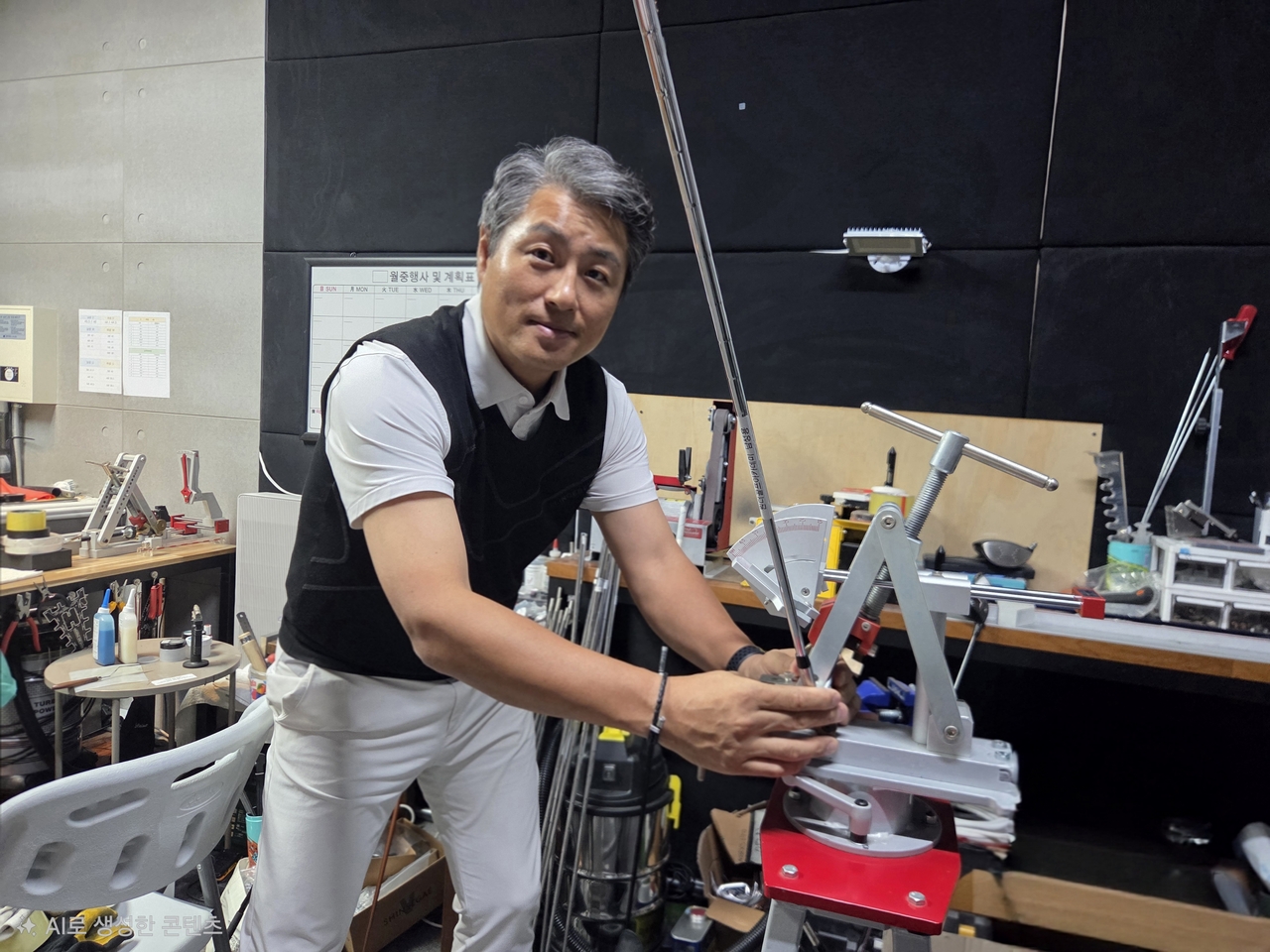
Woo Dong-won, 56, named an outstanding instructor at the United States Golf Teachers Federation (USGTF)-Korea awards ceremony held late last year, pursues what he calls "pain-free golf." His teaching philosophy holds that a comfortable swing that does not strain the body is the key to enjoying the game in good health for years to come.
Woo runs Wonder Golf Academy, a 1,650-square-meter facility in Yeomchang-dong, Gangseo-gu, Seoul. A former taekwondo athlete who competed through university, he retired after suffering a leg injury during his time with the national reserve team. He took up golf on the recommendation of a professor at Keimyung University and has been teaching the sport ever since.
Woo holds USGTF licenses obtained separately in the United States in 1999 and in South Korea in 2008. In 2003 he traveled to the United States and Australia to deepen his knowledge of golf instruction. Feeling he needed a stronger academic foundation for his junior coaching work, he enrolled in the sports management program at Kyunghee Cyber University in 2018 and studied there for four years. From 2019 he also spent five years playing on the KPGA Champions Tour.
Woo begins every lesson by analyzing each student's joint structure, upper-to-lower body proportions and arm rotation patterns before tailoring instruction to those physical characteristics.
Because the range of motion in arms and joints differs from person to person, he says grip style — whether strong or weak, and hand positioning — along with stance width and weight distribution must all be calibrated to the individual's body. He also stresses that backswing size and rotational axis are determined by a person's physique and mobility, and that forcing someone to copy another golfer's swing can place harmful stress on the body.
When a new student arrives, Woo assesses joint mobility and stability before any swing coaching begins, diagnosing physical limitations or imbalances upfront. The purpose is injury prevention.
Forcing a textbook swing on a body that lacks the physical prerequisites produces compensatory movements, which in turn lead to chronic injuries such as lower back pain and elbow or wrist problems. Building a swing within the limits of what the body can actually do is what prevents injury and allows a golfer to keep playing for the long term.
"The swing should fit the body — not the other way around," Woo said. He argues that one-size-fits-all instruction that ignores physical structure invites injury and undermines swing consistency. By contrast, diagnosing individual anatomical traits such as joint range of motion before setting grip, address and backswing size is, in his view, the most objective and rational approach to improving efficiency and staying injury-free.
Woo has coached visually and physically disabled golfers since 2014, and for the past two years has offered free two-hour lessons every Friday for students at Daehan School. In his youth he regularly visited facilities for people with physical disabilities and care homes for elderly patients with dementia. He traces his commitment to community service to his father's strict teaching that one must live alongside those who are marginalized. That genuine care for people makes for better golf instruction is a truth that speaks for itself.
sports@heraldcorp.com