Korea's National Academy of Engineering and Sciences holds seminar on three mega-projects
Yongin complex to demand 15 GW — more than Seoul's peak consumption
Government plans to draw surplus power from southern regions and East Coast
Calls emerge to extend life of Hanbit units 1 and 2 before 2030
More semiconductor fab land needed; government eyes sites near military airfields
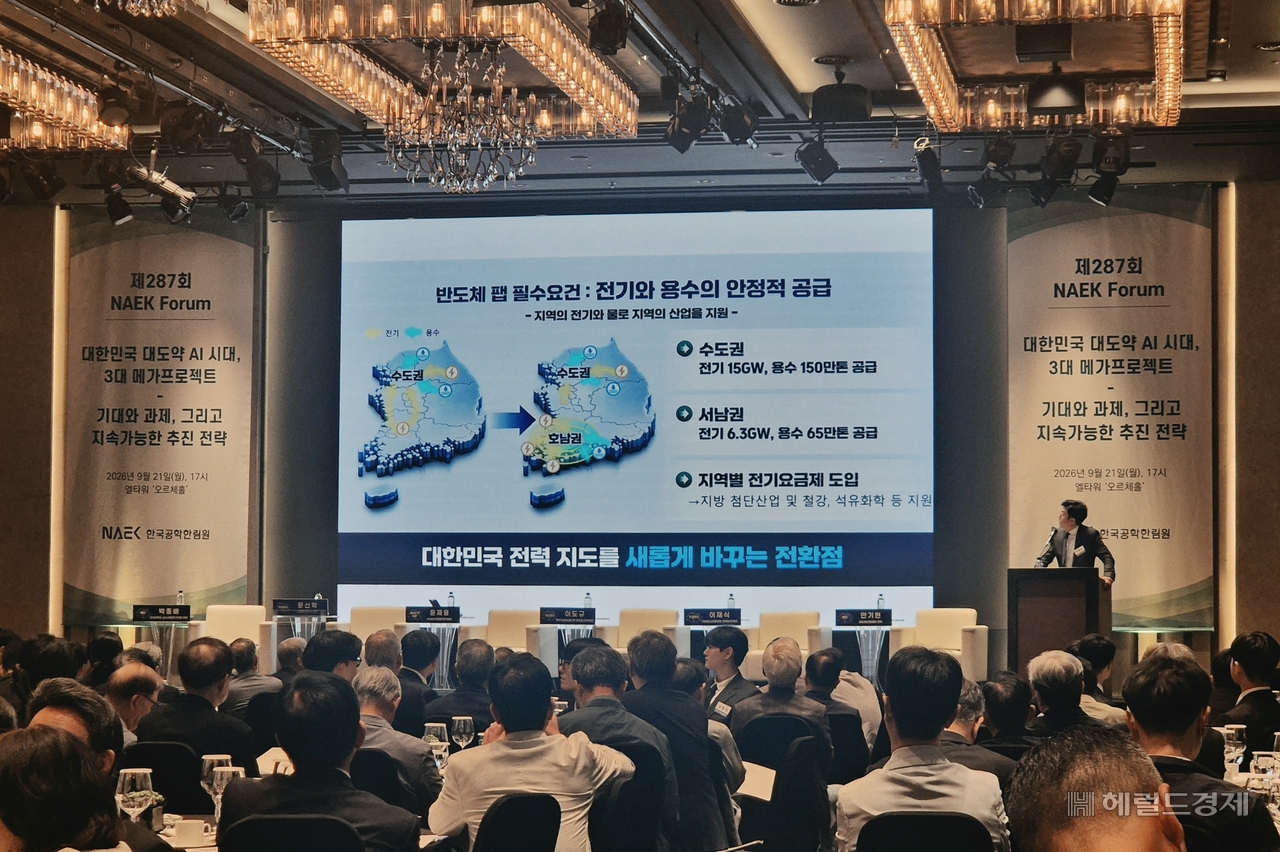
As power supply emerges as a critical challenge for the Yongin semiconductor complex — where Samsung Electronics is investing 360 trillion won ($260 billion) and SK hynix is investing 600 trillion won — the government has laid out a plan to build transmission lines along the East Coast and through the central region to draw electricity from outside the greater Seoul area.
The National Academy of Engineering and Sciences of Korea held the 287th NAEK Forum on Monday at L Tower in Seocho-gu, Seoul, under the theme "Three Mega-Projects: Expectations, Challenges and Sustainable Strategies."
Lee Jae-sik, director general for power grid policy at the Ministry of Climate, Environment and Energy, presented a power supply roadmap for semiconductor fabs to be built by Samsung Electronics and SK hynix in Yongin and the Honam region.
The Yongin complex will require a total of 15 GW — 9 GW for Samsung Electronics and 6 GW for SK hynix. Samsung Electronics is understood to have secured 6 GW of that total, while SK hynix has secured 3 GW.
"Seoul's peak power demand runs between 10 and 12 GW, and we must supply Yongin with even more than that by 2040," Lee said. "We will have to pull power in from all directions — the south, Yeongnam and the East Coast."
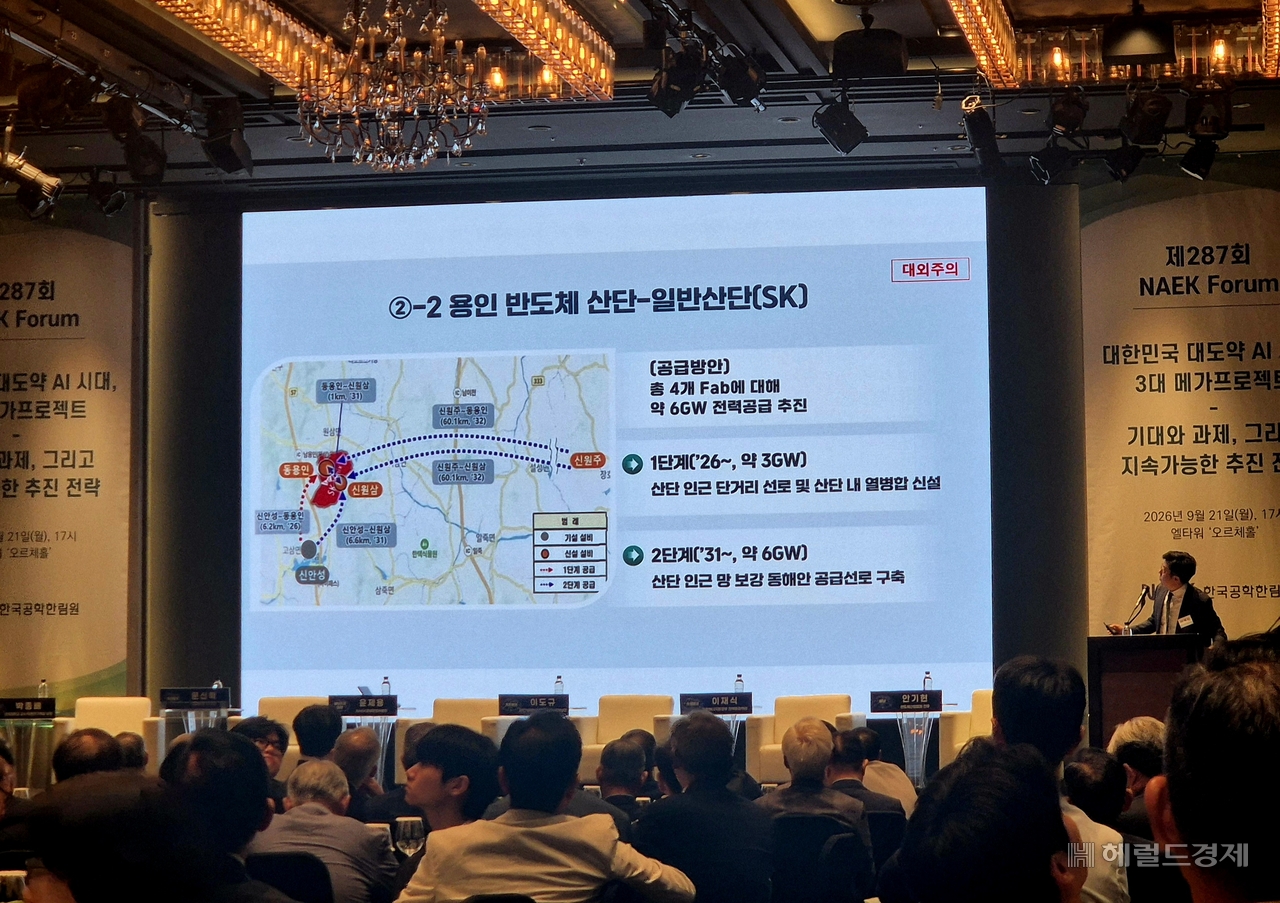
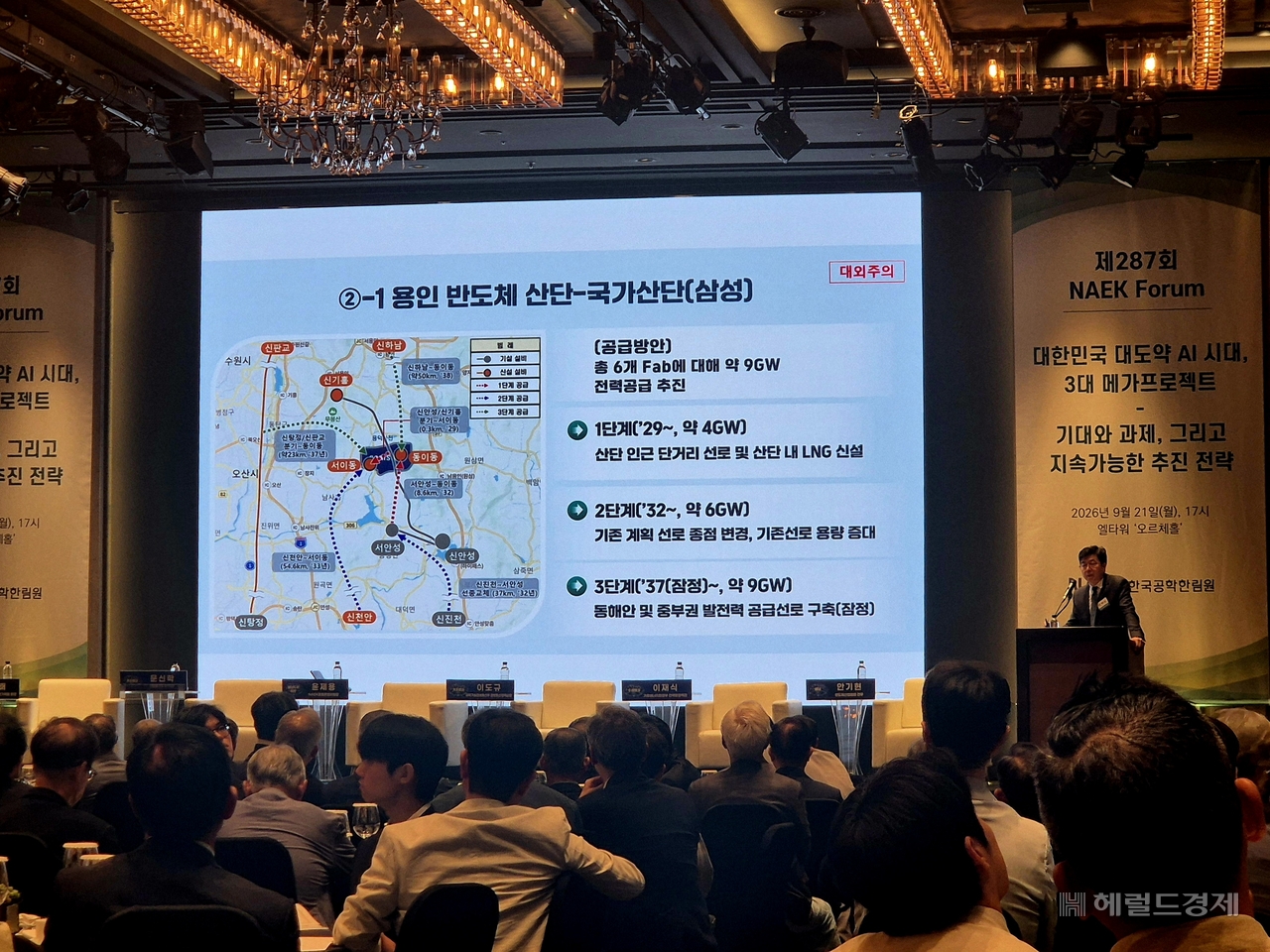
For the national industrial complex where six new Samsung Electronics fabs will be built, the government outlined a three-phase power supply plan.
In the first phase, a new LNG power generation facility will be built within the complex to supply 3 GW. By 2032, the capacity of existing transmission lines will be expanded to bring total supply up to 6 GW.
The final phase calls for building East Coast and central-region transmission lines by 2037 to meet the full 9 GW requirement.
"We will need all the transmission lines — Shin Jincheon, Shin Cheonan, Shin Tangjeong and more — and power will have to flow all the way up from the Honam region," Lee said.
For the general industrial complex where four SK hynix fabs will be located, the plan is divided into two phases. First, a new combined heat and power plant will be built within the complex to supply 1 GW, with short-distance lines near the complex adding enough capacity to reach a total of 3 GW. The second phase involves reinforcing the grid near the complex and building East Coast supply lines to deliver the final 6 GW by 2031. "We will supply power by drawing it in from the East Coast and the south," Lee said.
For the Honam region cluster, the government is pushing to complete the first phase of semiconductor fab construction by 2029. The plan calls for supplying 3 GW by that year, rising to 6.3 GW by 2031.
"The Honam region already generates more electricity annually than it consumes, so supplying power there is far less difficult than in Yongin," Lee said. "We plan to build transmission lines to draw power from nearby and construct substations within the complex."
Park Jong-bae, a professor at Konkuk University and president of the Korean Institute of Electrical Engineers, said at the subsequent panel discussion that extending the operational life of nuclear power plants was "the cheapest and fastest way to add power supply capacity by 2030." He called for an expedited life-extension review of Hanbit units 1 and 2 in the southwestern region, both currently shut down and undergoing life-extension assessments. "The life extensions need to happen quickly, within the bounds of safety, before 2030," he said.
Park also proposed that the introduction of small modular reactors be actively considered after 2035. "Until then, we need to think about all available resources together — transmission grid assets that can be used strategically, gas generators, energy storage systems, solar power and nuclear life extensions," he said.
Meanwhile, Ahn Ki-hyun, executive vice president of the Korea Semiconductor Industry Association, said at the panel discussion that the memory chip sector was expected to grow 20 percent annually through 2035. "We may need more land than the 11.88 million square meters at the Yongin complex and the 8.25 million square meters in the Honam region," he said.
In response, Choi Woo-hyuk, director general for advanced industry policy at the Ministry of Trade, Industry and Energy, said the 8.25 million square meters allocated in the Honam region fell slightly short of what Samsung Electronics and SK hynix had originally requested. He added that the government was reviewing options to secure additional land nearby, noting that if semiconductor fabs were built near the Gwangju military airfield, space would also be needed for partner companies.
joze@heraldcorp.com