Land ministry unveils housing stability plan targeting 190,000 units for middle-income households
Construction-type target of 175,000 units faces urban land shortage
Purchase pricing and site selection criteria still need to be worked out
![A housing construction site in Seoul. [Yonhap]](https://wimg.heraldcorp.com/news/cms/2026/09/22/news-p.v1.20241204.f46b12667c7640a7b4030cd1dc8e1bcd_P1.png)
As jeonse and monthly rent shortages spread across Seoul and the broader Greater Seoul area, the government has unveiled a blueprint to supply 190,000 units of universal public rental housing for middle-income households by 2030. The plan aims to build high-quality rental homes in urban centers and transit-oriented areas, and market attention is now focused on whether the newly introduced universal public rental model can actually be delivered. Given that the government has said it will directly build and supply more than 90 percent of the units, securing urban land is seen as the critical challenge.
According to the Ministry of Land, Infrastructure and Transport on Tuesday, the "Housing Stability Plan for Realizing Thick and Dense Residential Welfare" announced Monday contains four broad policy directions: supplying about 1.188 million public housing units by 2030, reforming public housing to guarantee residents' right to housing, resolving housing problems centered on consumer needs across different life stages, and laying the groundwork to deliver universal residential welfare.
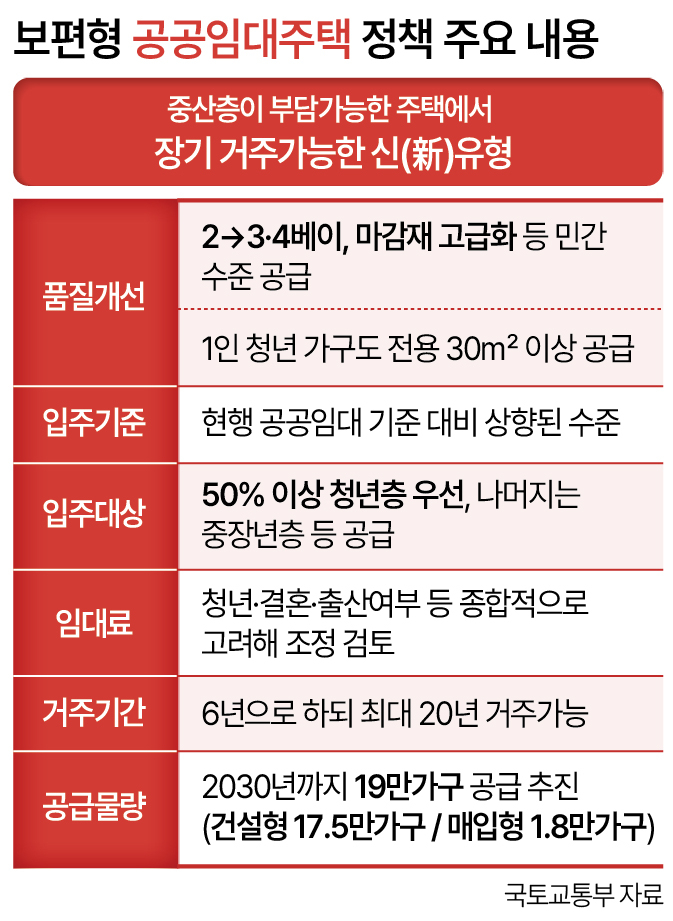
The standout element is the plan to supply 190,000 units of universal rental housing — a new category of public housing. The universal public rental model, whose creation the government announced through its Aug. 13 rapid housing supply measures, is designed to allow middle-income households and other groups to live long-term in well-located, high-quality and affordable homes. Half of the units will be reserved for young people, with larger unit sizes and premium finishes bringing the quality closer to private-sector housing.
Specifically, the plan calls for 175,000 construction-type units and 18,000 purchase-type units, led by three initial sites: the Goyang Changneung B-1 block (1,594 units), set to break ground this year, and the Namyangju Jinjeop 2 A-2 block (342 units) and Namyangju Wangsuk 2 A-5 block (351 units), both scheduled to break ground next year.
Construction-type target of 175,000 units set — but securing urban land is the key
The central question is whether the policy can be delivered and whether it will have the intended effect. The government introduced the universal public rental policy in response to an accelerating jeonse and monthly rent crisis originating in Seoul — driven by a combination of tightened owner-occupancy requirements, jeonse loan regulations and a supply shortfall — as well as persistent criticism that the benefits of existing public rental programs are too narrowly concentrated among low-income and vulnerable groups. The intent is to correct the income-class imbalance that arose from allocating existing integrated public rental housing toward the most vulnerable, and to restore a housing ladder for middle-income households and young people.
Market observers have welcomed the expansion of the public housing safety net to a broader population, but say the government must first work through the practical details — including the feasibility of securing preferred sites, the fiscal burden and coordination with local governments.
A more immediate concern is that supply could end up concentrated on peripheral sites rather than in the core transit-oriented and urban locations that middle-income renters actually want. About 92 percent of the total universal public rental units — 175,000 homes — are to be built through construction, but analysts say there is not enough available urban land in the Greater Seoul area beyond new planned districts, making an outer-area concentration all but inevitable.
Song Seung-hyun, chief executive of Urban and Economy, said the locations middle-income households want are concentrated in transit-oriented urban centers, but construction on planned residential sites has limited capacity to meet that demand. "Ultimately, the deliverable volume amounts to little more than refining the existing third-generation new town pipeline, which will make it difficult to identify genuinely new project sites," he said.
Ham Young-jin, head of the real estate research lab at Woori Bank, said delivering 190,000 universal public rental units would require four elements to align: funding, land, construction costs and project pace. "Supplying universal rental housing in transit-oriented areas and urban centers means high land acquisition costs and the need to reconcile competing interests with residents and local governments," he added.
The Moon Jae-in administration set a similar precedent. It introduced integrated public rental housing with relaxed income thresholds and pledged to expand the supply of mid-size, high-quality public rental homes in the Greater Seoul area, but ran into difficulty securing urban land and hit limits on project viability and public finances — leaving the construction-type rental supply record thin. In the first half of 2022, near the end of the Moon administration, only five new construction-type public rental projects (1,139 units) received approval, with just 620 units in Gyeonggi Province — all in Icheon.
Yang Ji-young, a senior adviser at Shinhan Premier Pathfinder, also noted that some projects with existing permits have yet to break ground, even before new sites are secured. "Rather than pushing new volume, it is also necessary to first look at the root causes of why existing approved projects are not moving to construction," she said.
'Purchase-type units need clarity on pricing and site selection — detailed rental criteria must be set'
The 18,000-unit purchase-type component of the universal public rental plan is also expected to face difficulties in negotiations over purchase prices and the selection of acquisition targets.
Yang said that if the government proceeds with purchases, it needs to spell out where and how it will secure the units — details that are currently absent. "Vacant commercial spaces or knowledge industry centers have limits as mid-size rental housing even if purchased," she said. Song agreed, noting that the government will try to buy at the lowest possible price, but that its pricing benchmark will inevitably differ from what sellers expect.
With the government targeting 36,000 units in the first year and allocating 6.2 trillion won ($4.48 billion) for universal public rental housing in next year's budget, experts say the finer details — including rent levels and move-in eligibility criteria — need to be pinned down quickly. The housing stability plan sets only broad directional targets, such as "eligibility thresholds above current public rental standards" and "rents below prevailing market prices," and analysts say clear income and asset requirements, along with a detailed rent-setting framework by complex and unit size, must be finalized without delay.
Lee Eun-hyung, a research fellow at the Korea Institute of Construction Policy, said the plan's selling points — larger unit sizes, premium interiors and preferred locations in transit-oriented areas and urban centers — are all factors that directly affect rent levels. "It needs to be made concrete whether rents will be set to reflect the quality of the housing, or whether the public sector will subsidize the gap to keep rents low," she said.
hwshin@heraldcorp.com