Class records factor into some 2028 regular admissions tracks
Analysts say dropout surge cannot be pinned solely on five-tier grading system
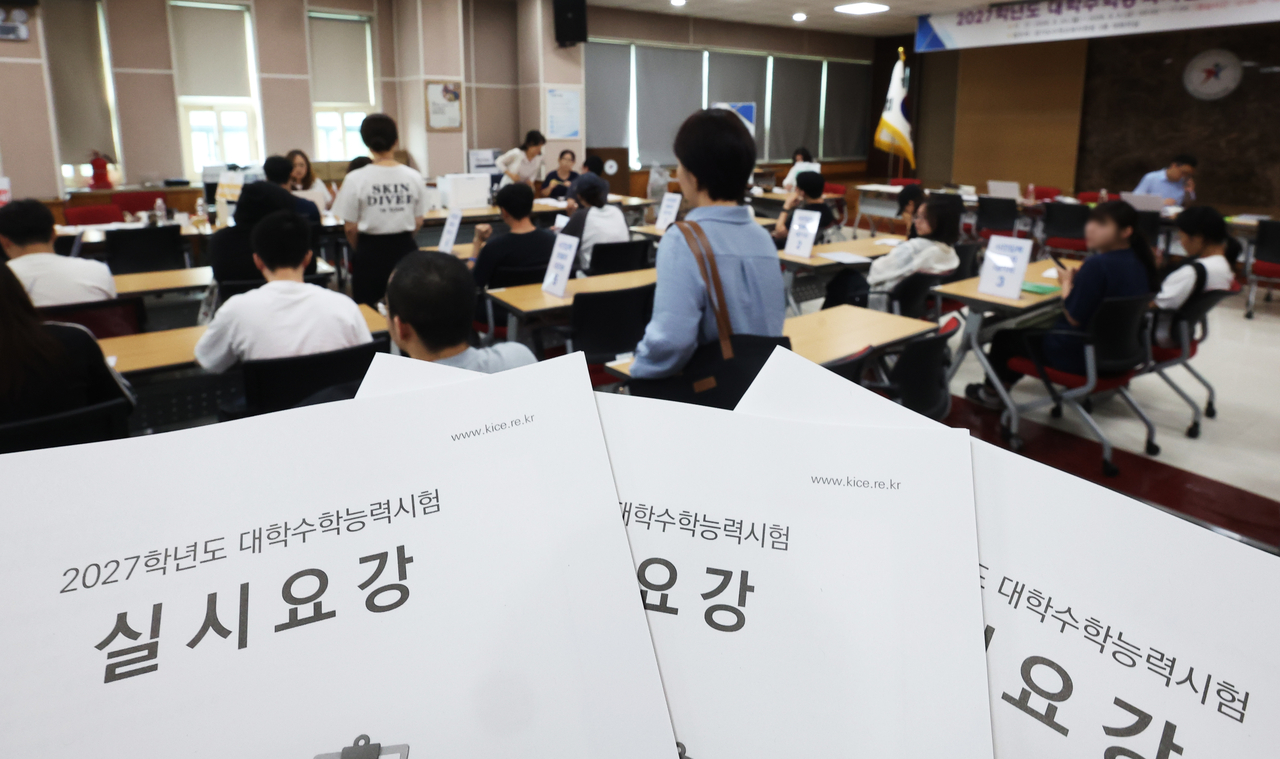
College entrance industry analysts are urging students to think carefully before dropping out of high school to focus solely on the College Scholastic Ability Test as a way to escape the pressure of internal school grades. Starting with the 2028 admissions cycle — the first under the reformed system — some universities and tracks in the regular admissions round will still evaluate school records, making it difficult to gauge admission prospects on CSAT scores alone.
The Education Evaluation Research Institute at Etoos Edu released its analysis Thursday, examining materials related to the five-tier internal grading system and the 2028 admissions plans of major universities.
School records do factor into regular admissions at Seoul's most selective universities. Seoul National University's 2028 regular admissions track — excluding the colleges of medicine and veterinary medicine — selects three times the number of available spots based solely on CSAT scores in the first round. The second round weighs CSAT scores at 60 percent and an academic competency evaluation at 40 percent, drawing on not only coursework but also attendance records, behavioral characteristics and overall assessments.
Korea University's academic excellence track, excluding the medical school, combines CSAT scores at 80 percent with school records at 20 percent. Sogang University's regional balance track adds school records at 10 percent and attendance at 10 percent on top of an 80 percent CSAT weighting. Yonsei University's general track — excluding the pre-medicine program — reflects CSAT scores at 90 percent and a document review at 10 percent, with coursework and attendance assessed qualitatively. Hanyang University's general track similarly applies a 90 percent CSAT weighting alongside a 10 percent comprehensive school record evaluation.
Not all regular admissions tracks incorporate school records, however. Korea University's general track — excluding medicine and cyber defense — selects students based entirely on CSAT scores. Sogang University's general track and Sungkyunkwan University's general and specialized tracks are also 100 percent CSAT-based. Because evaluation methods differ by track even within the same university, students must check the specific track they are targeting.
![Changes in the number of high school dropouts from 2021 to 2025. [Provided by Etoos]](https://wimg.heraldcorp.com/news/cms/2026/09/24/news-p.v1.20260923.cef65dc5829d4f80894fb032dd78d3c0_P1.png)
Etoos also said it is difficult to attribute the phenomenon of first-year general high school dropouts surpassing 10,000 solely to the introduction of the five-tier internal grading system. The rise in dropouts had been under way before the system was introduced, and the increase in the first year of implementation did not deviate significantly from the existing trend, the institute said.
The institute also pushed back against the interpretation that high-achieving students had left school en masse to reset their internal grades. According to Ministry of Education data cited by Etoos, the average grade of students who dropped out in the 2025 academic year was 6.7 on a nine-tier scale — lower than the 6.2 to 6.3 range recorded in the two preceding years.
The number of dropouts in the top grade bracket rose by 52 from the previous year, with their share increasing by 0.68 percentage points, but both figures were down from two years earlier — by 12 students and 0.35 percentage points respectively. Such fluctuations alone are not enough to conclude that departures among top students are on a clear upward trend, the institute said. The number of students who re-enroll the year after dropping out has also remained similar to previous years, undermining claims that dropping out and re-enrolling to reset internal grades has become more common.
Kim Byung-jin, director of the Etoos Education Evaluation Research Institute, advised students not to decide to drop out based solely on the introduction of the five-tier grading system. "Before making that decision, students should first check how their target university factors school records into its 2028 regular admissions process," he said. "Admissions strategies should be built around balancing school life with CSAT preparation."
brunch@heraldcorp.com