Ministry of Health and Welfare launches community primary care pilot program Tuesday; 120 clinics nationwide to participate in building a Korean-style family doctor model
![A medical clinic strip mall [Naver Blog]](https://wimg.heraldcorp.com/news/cms/2026/09/28/news-p.v1.20260928.fc74d5d2f4734e93a2dc9332d61bfb12_P1.jpg)
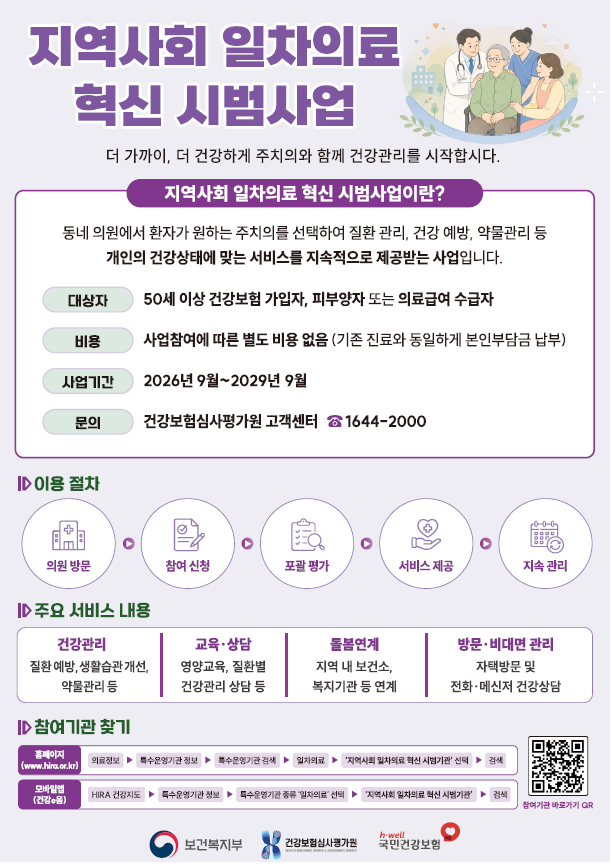
A pilot program allowing residents aged 50 and older to choose their own doctor at a neighborhood clinic — and receive tailored services ranging from disease treatment and medication management to health monitoring and care referrals — launches Tuesday.
The Ministry of Health and Welfare said Monday that 120 clinics across the country will take part in the program, with doctors, nurses, physical therapists and social workers forming teams to deliver services suited to each patient's health condition.
The program is open to national health insurance subscribers and dependents aged 50 and older, as well as medical aid recipients. Participants pay no additional fees beyond the standard out-of-pocket copayment for regular medical visits.
The ministry accepted applications from July 9 to Aug. 5, drawing 674 applicants, and selected 120 clinics after evaluation.
The participating clinics are divided into two models: 20 operate as standalone sites that form and run their own multidisciplinary teams, while the remaining 100 work in partnership with regional hub support organizations to deliver team-based services.
Enrolled patients will receive not only disease treatment but also personalized in-person and remote health management based on their individual health status.
The pilot will run for three years through September 2029, with the possibility of expanding the number of participating clinics depending on how the program performs.
Participating clinics will register and assess interested patients, develop individualized care plans, and provide comprehensive primary care services — including disease treatment, medication management, education and counseling, home visits by doctors and nurses, and referrals to community care resources.
The program will pilot an integrated fee structure based on annual care management, tied to each patient's health and demographic profile. The integrated payment system will apply to primary care services such as education and counseling, and clinics may also opt into the integrated payment model — rather than the standard fee-for-service system — for clinical services including examinations and procedures.
Participating clinics will also be eligible for operational support payments for forming and running multidisciplinary teams, as well as performance-based compensation tied to patient management outcomes and service delivery.
Ko Hyung-woo, the ministry's director general for regional essential medical policy, said the pilot aims to "successfully build a Korean-style family doctor model that both the public and medical institutions can trust, laying the groundwork for its institutionalization."
thlee@heraldcorp.com