Herald Business Forum 2026 opens, marking its 10th anniversary
Theme: 'Beyond Follower — Transition to a Leading Economy'
President Lee calls for bold AI integration to become a first mover
Experts in semiconductors, autos, robotics and space take the stage
More than 600 attend to share strategies for Korea's 'second great leap'
The "fast-follower" economic model that powered South Korea's rapid growth is hitting structural limits, prompting calls for a fundamental paradigm shift.
Voices are growing louder that the country must reinvent itself as a "first mover" that leads global markets from the front. With AI upending the global ecosystem, many see the current moment as a once-in-a-generation opportunity.
As a manufacturing and digital powerhouse, South Korea is positioning semiconductors — where it already holds a commanding technological lead — along with physical AI and AI data centers as its key advantages in the global AI race.
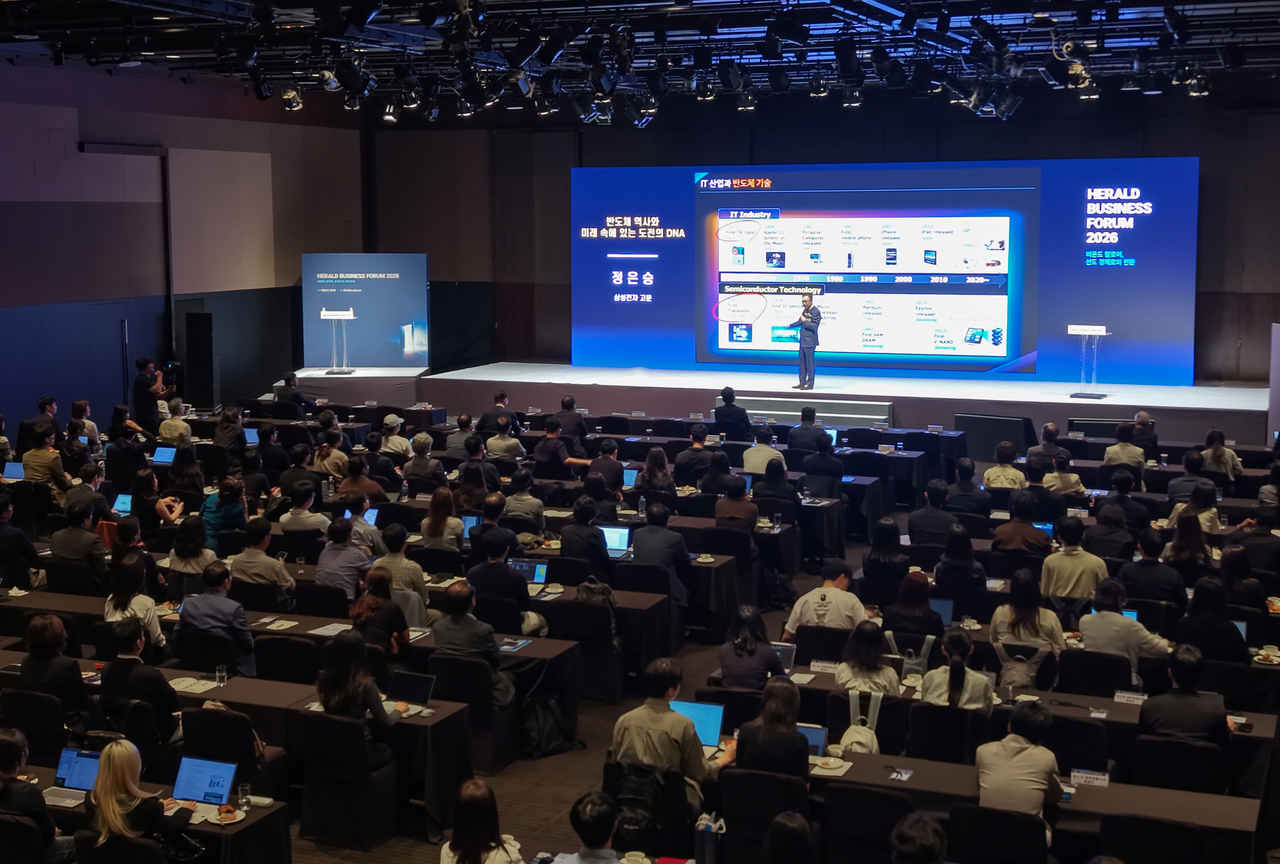
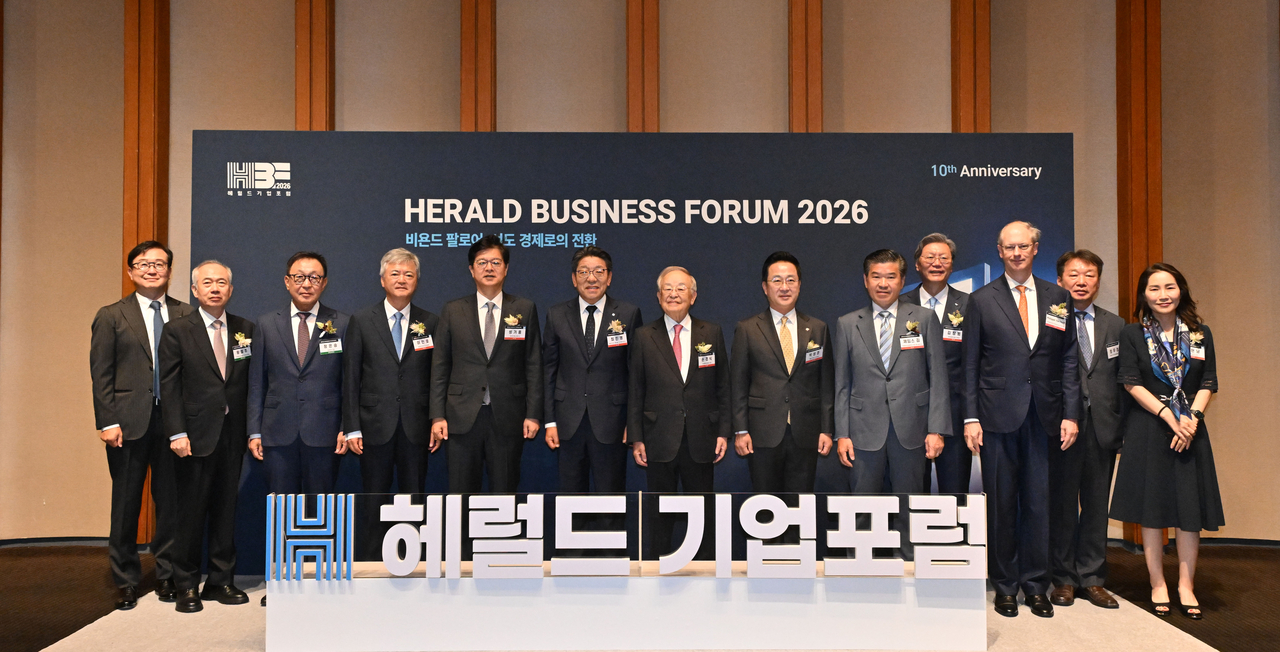
The Herald Business Forum 2026, held Tuesday at the Dynasty Hall of the Shilla Hotel in Jung-gu, Seoul, took up the theme "Beyond Follower — Transition to a Leading Economy," exploring in depth the growth strategies needed for South Korea's second great leap forward.
Now in its 10th year, the forum drew government officials alongside specialists representing AI, semiconductors, mobility, robotics, batteries, shipbuilding and space, lending added weight to the occasion.
An audience of more than 600 listened intently to presentations by industry leaders and academic experts, showing keen interest in the solutions proposed for South Korea's transition to a leading economy.
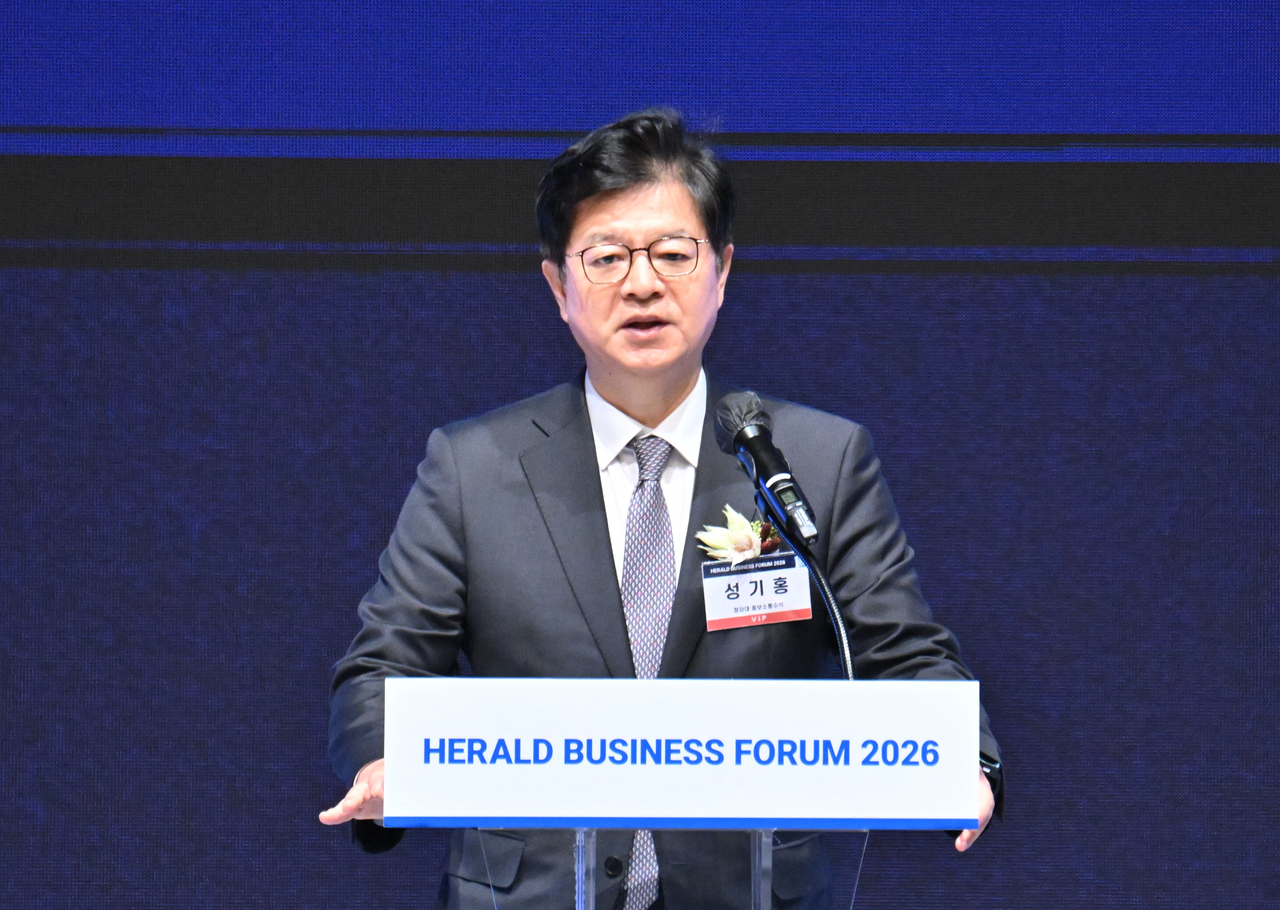
President Lee Jae Myung, in a congratulatory message read on his behalf by Cheong Wa Dae Senior Secretary for Public Communications Seong Ki-hong, said the past "fast-follower" growth strategy of rapidly absorbing and refining advanced technologies "is no longer valid."
"If we are to become leaders of the global economy and seize limitless opportunities, we must boldly integrate AI into industrial sites and build a robust ecosystem," Lee said.
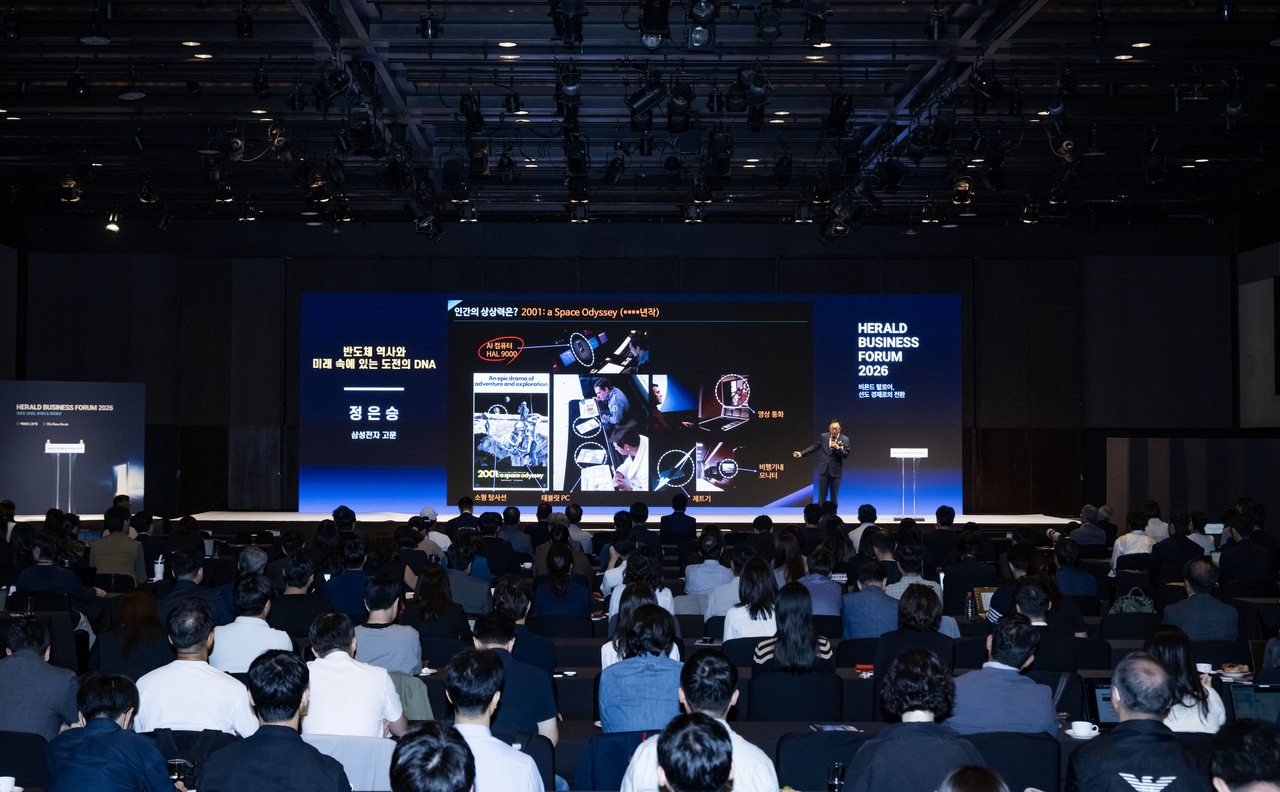
The keynote addresses were delivered by Jung Eun-seung, an adviser at Samsung Electronics who previously served as head of the company's semiconductor research institute, inaugural head of its foundry division and chief technology officer of its Device Solutions unit, and by Lee Jae-wook, a professor in the Department of Computer Science and Engineering at Seoul National University who also serves as director of the university's AI Institute.
Jung, who co-chairs the semiconductor strategy committee of the South Jeolla Province-Gwangju integrated special city, said "future competitiveness comes not from technology alone but from comprehensive innovation capabilities that connect memory, logic, foundry and packaging," adding that "such innovation is not achieved alone — it requires trust-based collaboration with customers, universities, research institutes, and materials and equipment companies."
Lee Jae-wook examined South Korea's crossroads between becoming a "components nation" and a "full-stack nation," stressing the importance of trust and talent. "Trust — between institutions, within organizations, and between humans and AI — is the most critical fuel," he said.
The first session, "Semiconductors: The Golden Engine of the AI Revolution," opened with a presentation by Hwang Cheol-joo, chairman and chief executive of Jusung Engineering. "No matter how great an innovation, more than 99 percent of it is something others have already thought of," Hwang said. "The core of new growth in the AI era is focusing on the 1 percent no one else has thought of and setting a new standard."
Lee Hwa-young, senior vice president for business development at LG Group's AI research institute, followed with real-world examples of AI applied on the factory floor, sharing insights on how AI technology can generate tangible business results.
Presentations by Samsung Electronics and SK hynix drew particularly strong interest, given both companies' central roles in the AI memory chip supercycle. Kim Gyeong-ryun, a vice president in Samsung Electronics' DRAM development division, introduced "zHBM" — a next-generation high-bandwidth memory architecture that pushes beyond the limits of conventional 2.5D structures into a new 3D memory design — sparking curiosity about how far next-generation HBM can evolve.
Im Eui-cheol, executive vice president for solution AT at SK hynix, said the rise of AI inference models and agentic AI is making memory chips ever more critical, and made the case for why memory is a core technology in the AI era.
Speakers also urged South Korea not to rest on its dominance in HBM but to press forward as an irreplaceable "intelligence-producing nation."
Kwon Seok-jun, associate dean of the College of Engineering at Sungkyunkwan University, said the memory supercycle "does not permit unconditional optimism," calling on the country to advance through stages: co-designing memory and systems, strengthening public fabs and the broader ecosystem, driving an AI transformation in manufacturing, and linking energy and semiconductor security.
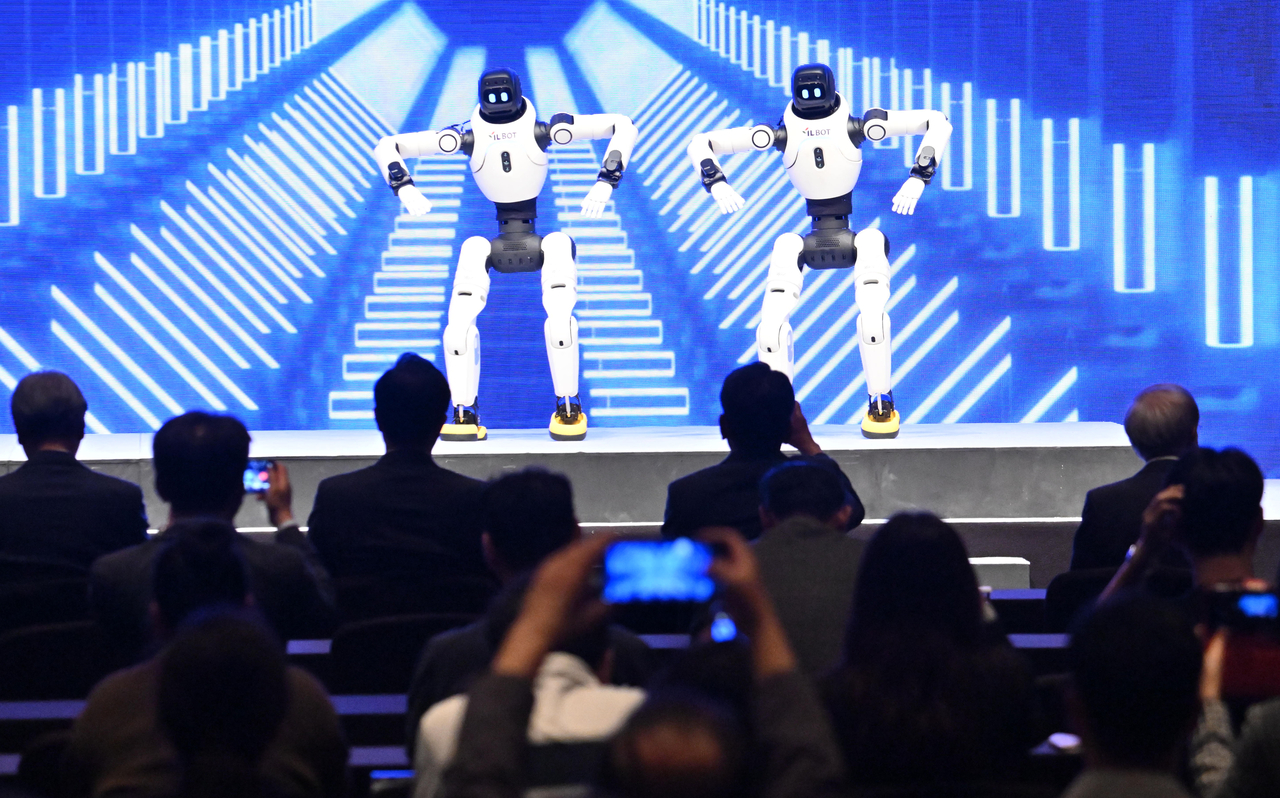
The second session, "Physical AI: Opening a New Industry," was kicked off by Jeong Jun-cheol, president of the manufacturing division at Hyundai Motor and Kia. Jeong laid out Hyundai Motor Group's vision for an "autonomously operating factory" — a smart manufacturing environment in which humans and robots work side by side.
Kim Young-jun, executive vice president and head of the AI research laboratory at LG Electronics, and Im Chi-hyun, head of the group DX strategy office at Posco Holdings, presented their respective visions for the development of robot foundation models and AI transformation strategies.
Hyeon Jang-seok, a vice president on the global TPM team in Samsung SDI's strategy and marketing division, highlighted cylindrical cells for humanoid robots and all-solid-state battery technology currently in development, stressing that batteries are the "heart" of the physical AI era. Kim Young-ok, chief AI officer at HD Hyundai, drew on the group's own AI transformation cases to chart the direction for South Korea's manufacturing AI sector.
This year's forum also featured a special session on branding strategy in the AI era. Noh Hee-young, chief executive of Hino Consulting Firm and widely known as "the woman who builds brands," said the key to brand competitiveness in the AI era lies in "how deeply a brand understands human taste and emotion, and how vividly it translates that into products and experiences," underscoring the importance of a branding strategy that interprets consumer preferences with precision.
The third session, looking ahead to South Korea's future space industry, featured Seo Hyeon-seok, head of the space business division at Korea Aerospace Industries, and Kim Jong-pil, executive vice president at LIG Defence & Aerospace. Both introduced their companies' space AI solutions and future visions for the new space era, in which the private sector is taking the lead in space development.
joze@heraldcorp.com