From energy to applications — Korea has every layer of AI
Memory bottleneck a structural opportunity, not just a cycle
Cross-industry integration the key to full-stack competitiveness
Trust and talent must come first in AI transformation
"In the age of AI, South Korea stands at a crossroads."
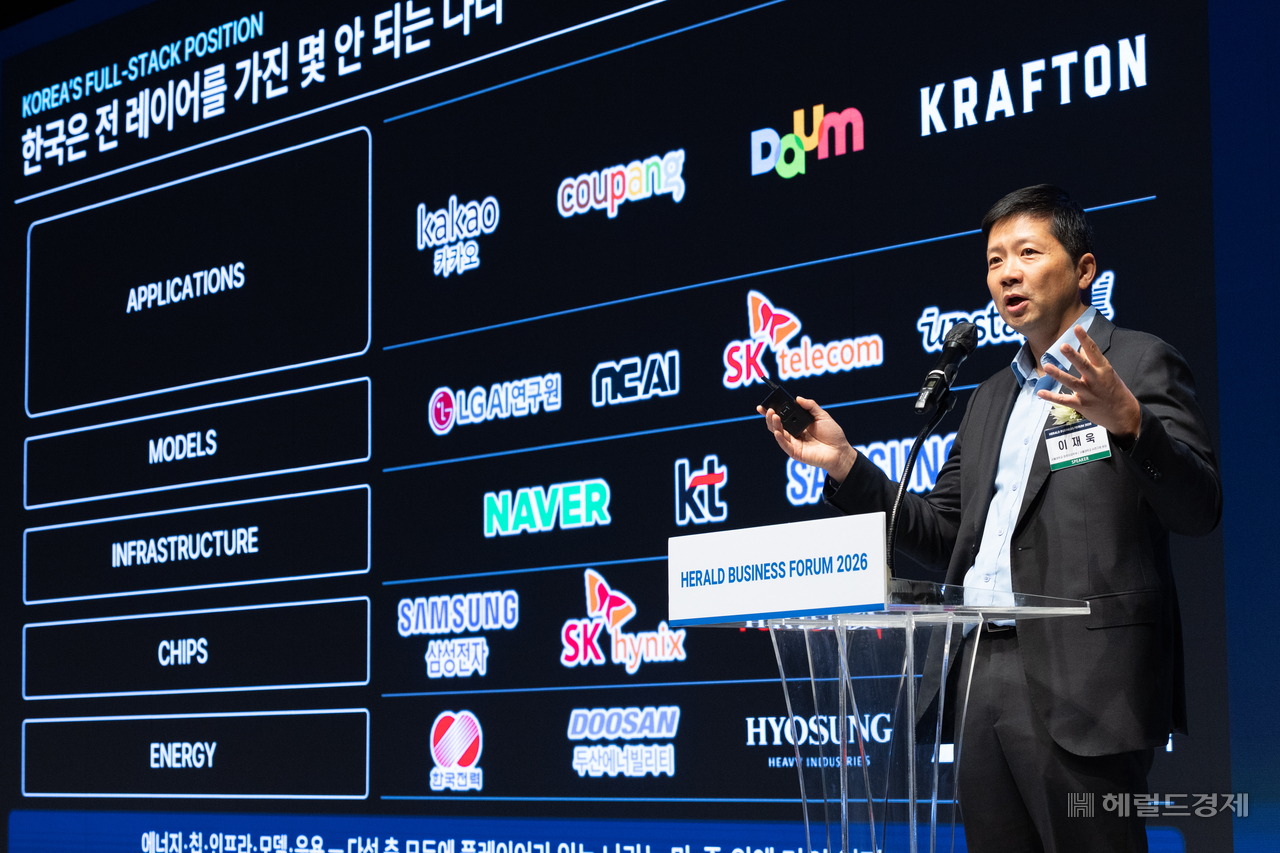
Lee Jae-wook, director of the Seoul National University AI Institute, said Tuesday that South Korea must move beyond simply supplying parts of the AI industry and instead evolve into an "AI full-stack nation" — one that commands every layer from energy and semiconductors to infrastructure, models and applications. He made the remarks in a keynote address at the Herald Business Forum 2026, held at the Shilla Hotel in Jung-gu, Seoul.
Speaking on the theme of "The Present, Future and Opportunities of AI in South Korea," Lee said the central question facing the country is whether it will remain a component supplier or evolve into a full-stack solutions nation. "I believe AI represents an enormous opportunity for our country," he said.
The "full-stack" concept he described spans five layers of the AI industry: energy, chips, infrastructure, models and applications. "South Korea is an exceptionally rare country that possesses every layer," Lee said. "We have players distributed across all five." He argued that as AI's value increasingly migrates toward the applications layer, South Korea's strong industrial base in manufacturing, defense, shipbuilding and healthcare positions it to capture a growing share of that opportunity.
Lee identified three foundations that could enable South Korea to rise as an AI full-stack nation: culture, geopolitics and industry. He pointed to the country's rapid technology adoption, its negotiating leverage between the United States and China, and the competitive strength of an industrial base that combines manufacturing and electronics with software, defense, shipbuilding, healthcare and content.
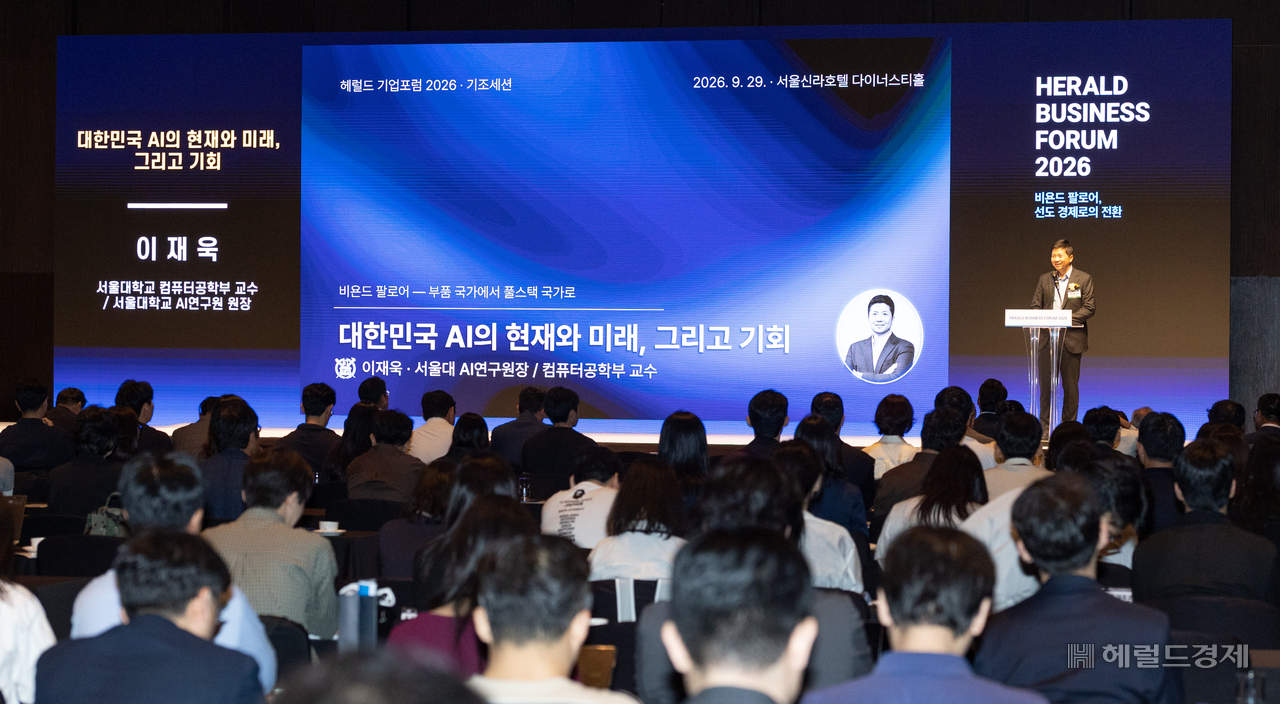
'Computing power up 60,000-fold, memory only 100-fold' — Korea's memory edge in focus
Lee singled out semiconductors — and memory chips in particular — as South Korea's most critical competitive asset. "Over the past 30 years, computing chip performance has improved 60,000-fold, while memory speed has grown only about 100-fold," he said. "Because computing has become so much faster, memory keeps creating a bottleneck."
He added that this memory demand is not a simple market cycle but is rooted in the fundamental architecture of computers. "That is exactly where South Korea stands," he said.
Chips' share of AI data center construction costs has risen from 40 percent in 2021 to around 60 percent this year, while the memory chip share expanded from 2 percent to roughly 18 percent over the same period. Combined, memory and logic chips now account for more than half of total AI data center build costs.
Lee cautioned, however, that strong individual industries do not automatically translate into full-stack competitiveness. "We have very strong players at each layer, but the connections between those layers — the links that would turn individual strengths into overall full-stack competitiveness — are somewhat weak," he said.
Rather than a single company dominating every domain, Lee proposed a "federated full-stack" model in which leaders from each sector are linked together. While companies like Google are expanding from energy and chips through cloud, models and services, and China is pursuing national-level full-stack self-sufficiency, he said it is realistically difficult for any single company to monopolize the vast AI value chain over the long term.
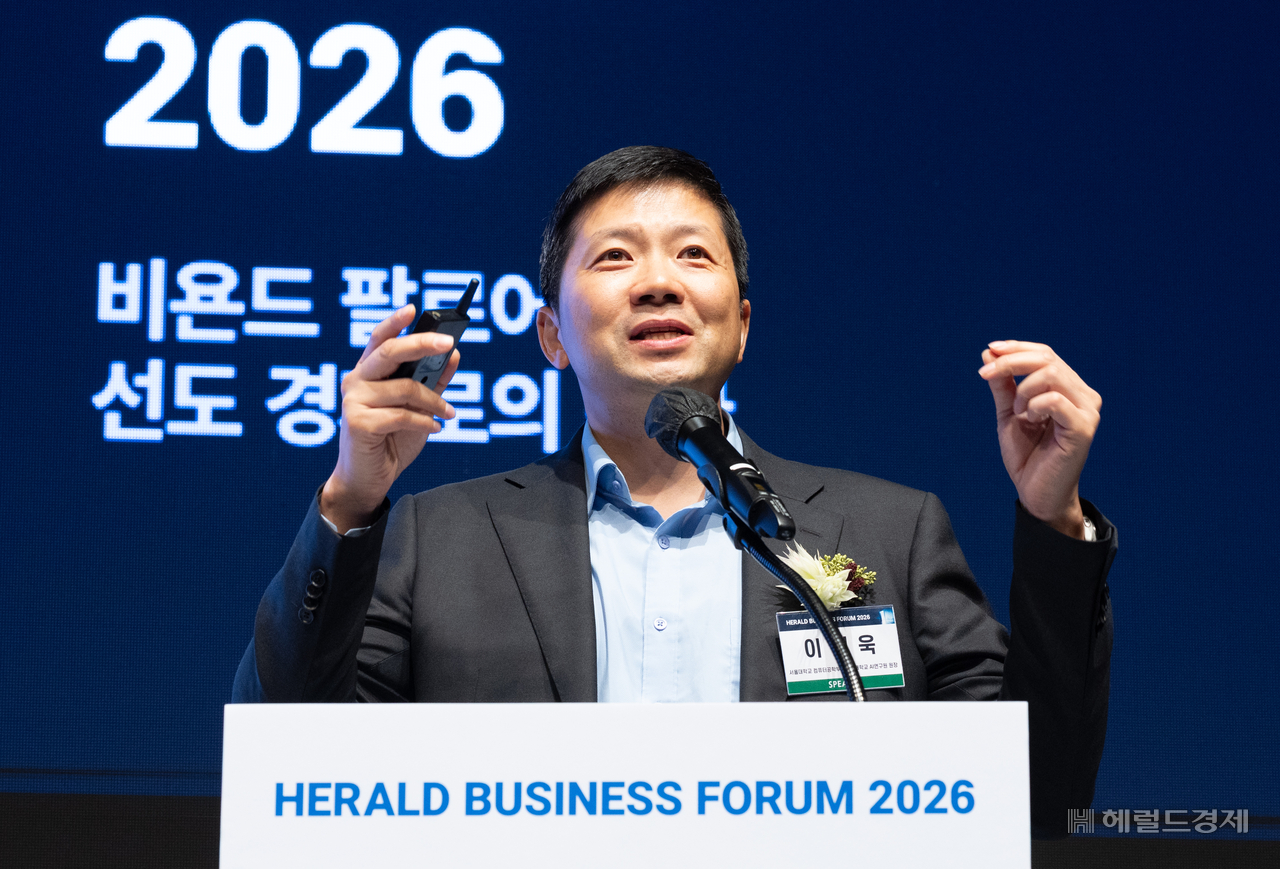
'Hard to predict even six months out — you have to fail fast'
Lee identified speed as the defining competitive principle of the AI era. Because predicting what the landscape will look like even six months or a year from now is nearly impossible, he said the ability to move quickly, experiment and course-correct matters more than waiting for the right answer.
"You have to learn from trial and error and set new directions," he said. "In the AI era, the most important competitive edge is how fast and precisely you can run that innovation loop." The cycle he described — humans define a problem, AI executes, humans verify the result, repeat — is what ultimately creates the gap between winners and losers.
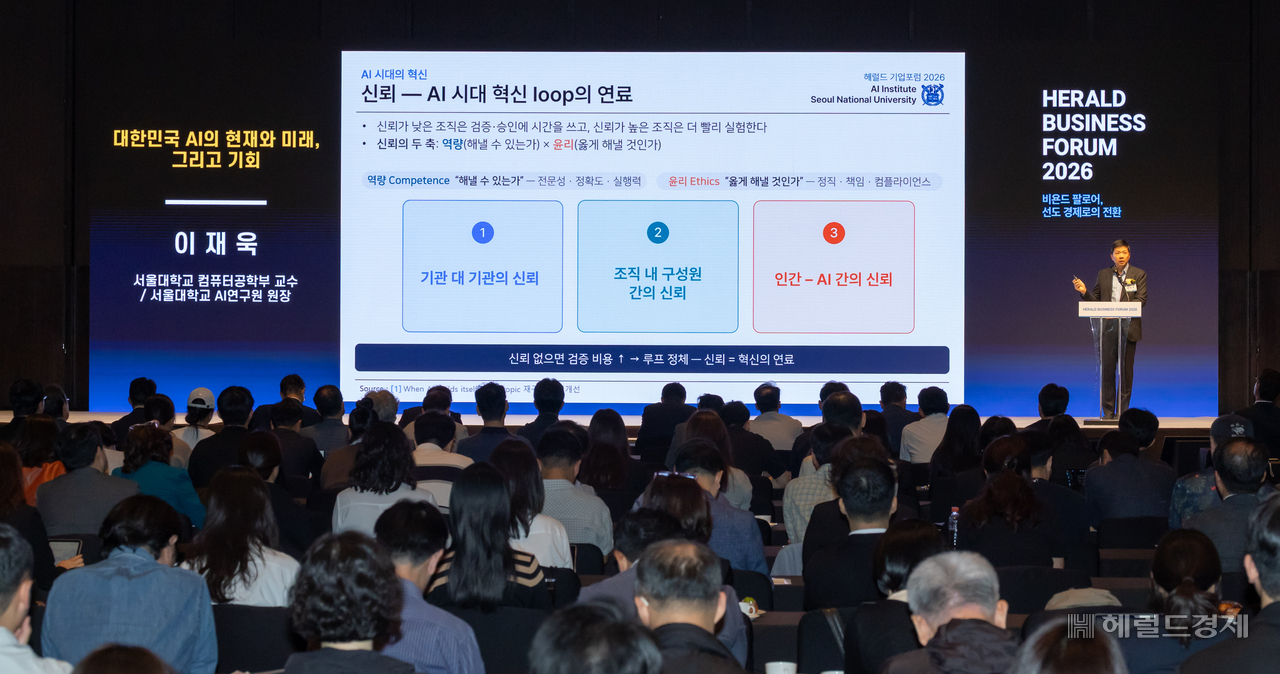
Lee said trust is the prerequisite for achieving that speed. "There are two things we need most in the AI era: trust and talent," he said. "Organizations with low trust are forced to spend time on extensive verification, approvals and monitoring, which inevitably slows the pace of innovation." He said trust is needed not only between institutions and among team members, but also between humans and AI.
He also predicted that people will ultimately become the final bottleneck of the AI era. No matter how rapidly AI performance advances, overall productivity will be constrained if the people and organizations using it cannot keep pace. "Once AI can make judgments quickly and accurately, the speed and accuracy of humans become the bottleneck in the entire process," Lee said.
He went on to say that in AI transformation, the first investment should go not into tools but into people's learning. "In a rapidly changing era, talent is the core competitive advantage," he said.
kwater@heraldcorp.com