Korea Consumer Agency releases 2025 Korean Consumer Lifestyle Index, ranking all 17 metropolitan and provincial governments — Daejeon comes in first
Daejeon residents recorded the highest consumer lifestyle satisfaction score among all 17 metropolitan and provincial governments nationwide, the Korea Consumer Agency said Wednesday, releasing the results of its 2025 Korean Consumer Lifestyle Index.
Daejeon led the country with a score of 67.4, driven particularly by high satisfaction in food and dining — a core category of everyday consumer life. The city also drew attention for its relatively high use of traditional markets over department stores, and for consumer cooperative membership rates that exceeded the national average.
Overall consumer lifestyle satisfaction rises from second place in 2023 to first in 2025
Daejeon's overall consumer lifestyle satisfaction score of 67.4 — the highest in the country — was 3.7 points above the national average of 63.7. While satisfaction scores generally trended downward nationwide in 2025, Daejeon bucked that trend, climbing from second place in 2023 to first this year.
Food and dining tops satisfaction categories for Daejeon consumers
Among the categories tracked in 2025, food and dining scored highest for Daejeon consumers at 73.0 points, followed by housing and household goods at 72.8 and clothing at 72.0. Relatively lower scores were recorded in ceremonial services such as weddings and funerals (65.7), automobiles and transportation (66.7), and financial services and insurance (67.4).
The food and dining category saw the sharpest improvement, rising from third place in 2023 to first in 2025. Housing and household goods also climbed significantly, moving from a tied fifth to second, while clothing advanced from a tied fifth to third. By contrast, information and communications technology fell from second to fourth, and healthcare and personal care slipped from fourth to fifth.
Consumer problem rate highest in mobile shopping at 44.3%
The consumer problem rate — defined as the share of consumers who encountered difficulties, obstacles or inconveniences at any stage of purchasing or using a product or service — stood at 47.9 percent in Daejeon, below the national average of 50.4 percent. By transaction type, mobile shopping recorded the highest problem rate at 44.3 percent, followed by online shopping at 41.0 percent. By product category, food items — including agricultural, fishery, livestock and processed products as well as health foods — accounted for the highest share at 31.5 percent, followed by dining services at 29.1 percent and delivery and takeout services at 28.2 percent.
Local small-business use: 68.0% of Daejeon consumers shop at neighborhood stores
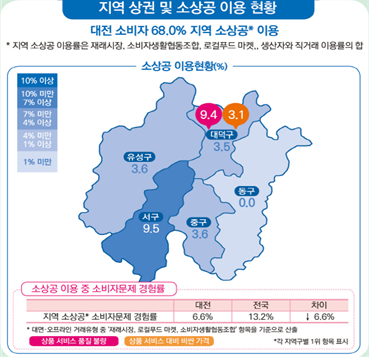
Some 68.0 percent of Daejeon consumers said they patronize local small businesses, and the traditional market usage rate reached 40.9 percent — higher than the 36.5 percent recorded for department stores. Consumer cooperative usage was particularly notable at 10.6 percent, roughly double the national average of 5.5 percent. Analysts attributed these figures to the popularity of local bakeries and food-and-beverage businesses in the food and dining sector, as well as the city's efforts to promote local commerce through initiatives such as local gift certificate programs.
The share of consumers who experienced problems while using local small businesses was 6.6 percent — about half the national average of 13.2 percent.
Daejeon said it plans to further strengthen a consumer-friendly environment through the continued operation of its consumer lifestyle center, consumer rights education and awareness campaigns, and its Ontong Daejeon 2.0 local economic platform.
kwonhl@heraldcorp.com